Author: admin

  • Why Custom AI Solutions Deliver Better ROI

    Why Custom AI Solutions Deliver Better ROI

    Artificial intelligence has moved beyond experimentation and is now a strategic business investment. Organizations are deploying AI to improve operational efficiency, automate workflows, enhance customer experiences, and strengthen decision-making. However, achieving measurable outcomes depends largely on the type of AI solution adopted.

    Many businesses begin with off-the-shelf AI platforms because they offer faster deployment and lower upfront costs. While these tools can address general use cases, they often struggle to align with specific business processes, data structures, and long-term growth objectives. This structural gap frequently results in hidden technical debt, where teams spend more time engineering workarounds than driving real revenue.

    This is where Custom AI Solutions create a distinct advantage. Built around an organization’s unique requirements, custom AI enables businesses to maximize efficiency, improve accuracy, and generate stronger returns from their AI investments. Rather than adapting operations to fit software limitations, businesses gain technology designed specifically around their goals.

    What Are Custom AI Solutions?

    Custom AI Solutions are artificial intelligence systems designed and developed to address specific business challenges, operational requirements, and strategic objectives.

    Unlike generic AI tools that serve broad market segments, custom solutions are tailored to an organization’s workflows, datasets, and existing technology ecosystem. Through tailored AI development, businesses can create intelligent systems that align directly with their operational environment.

    These solutions may include:

    • AI workflow automation and multi-agent orchestration
    • Predictive analytics and data pipeline intelligence
    • Recommendation engines
    • Computer vision systems and automated visual quality control layers
    • Natural language processing applications
    • Bespoke machine learning models

    The primary objective is not simply implementing AI, but delivering measurable business outcomes through technology designed for a specific purpose. By prioritizing an AI-native cognitive architecture, companies turn raw unstructured data into a permanent corporate asset.

    Key Differences: Custom AI vs. Ready-Made AI

    Choosing between custom AI and pre-built platforms requires evaluating more than implementation speed. The long-term value of AI depends on how effectively it integrates, scales, and performs within the organization.

    Implementation and Integration

    One of the most significant limitations of generic AI software is integration.

    Many ready-made solutions require businesses to modify existing workflows to accommodate the platform’s capabilities. This often leads to inefficiencies, data silos, and lower adoption rates.

    A custom AI approach prioritizes seamless AI integration with existing systems, including:

    • ERP platforms
    • CRM software
    • Internal databases and data warehouses
    • Customer service applications
    • Business intelligence tools

    By integrating directly into established processes, organizations can accelerate adoption while minimizing operational disruption.

    Scalability and Flexibility

    Business requirements evolve continuously. As organizations expand, AI systems must support increased workloads, larger datasets, and new operational demands.

    Many off-the-shelf platforms impose limitations on customization and scalability. As requirements become more complex, businesses may encounter additional licensing costs or functionality constraints.

    Custom AI is designed with long-term architectural growth in mind. A well-planned scalable AI infrastructure allows organizations to expand capabilities, introduce new use cases, and adapt to changing business priorities without replacing existing systems.

    Cost Breakdown and Long-Term Value

    Initial implementation costs often influence AI purchasing decisions. While ready-made platforms may appear more affordable at first, long-term expenses can accumulate through recurring licensing fees, limited customization, and operational inefficiencies.

    Custom AI requires a greater upfront investment but frequently delivers superior AI solution cost-effectiveness over time. By eliminating vendor lock-in, the Total Cost of Ownership (TCO) drops significantly by years two and three.

    Benefits include:

    • Reduced manual effort via autonomous agent task execution
    • Lower operational costs and optimized cloud compute spend
    • Greater automation efficiency
    • Increased productivity across technical and non-technical staff
    • Reduced dependency on multiple overlapping software tools

    When evaluating AI investments, organizations should consider total business value rather than implementation costs alone.

    Performance and Accuracy

    AI systems generate value through the quality of their outputs.

    Generic AI models are trained on broad datasets designed to support a wide range of industries. While useful for standard applications, they often lack the precision required for specialized business environments.

    Custom AI leverages proprietary business data, industry-specific knowledge, and operational requirements to create bespoke machine learning models that deliver higher relevance and accuracy.

    Whether analyzing customer behaviour, forecasting demand, or automating decisions, improved accuracy leads directly to better business outcomes.

    Why Custom AI Drives Higher ROI

    The strongest argument for custom AI is its ability to generate measurable business value.

    Because these solutions are built around specific objectives, they produce outcomes that directly contribute to organizational performance and profitability.

    Improved Operational Efficiency

    Custom AI enables organizations to automate repetitive and resource-intensive activities through intelligent AI workflow automation.

    Examples include:

    • Document processing
    • Customer support automation
    • Inventory management
    • Data validation
    • Workflow orchestration

    Automation reduces manual intervention, improves consistency, and allows teams to focus on higher-value activities.

    Faster Decision-Making

    Organizations generate large volumes of data every day. Extracting actionable insights from this information is often a challenge.

    Custom AI systems analyze business data in real time, helping leaders make informed decisions faster and with greater confidence. Improved visibility into operational performance enables organizations to respond proactively to opportunities and risks.

    Reduced Operating Costs

    Cost reduction remains one of the most measurable benefits of AI adoption.

    By automating processes, reducing errors, and improving resource utilization, custom AI helps organizations lower operational expenses while maintaining service quality and productivity.

    Over time, these efficiencies contribute significantly to the overall return on investment in artificial intelligence.

    Enhanced Customer Experience

    Customer expectations continue to evolve, requiring businesses to deliver faster, more personalized interactions. Custom AI supports:

    • Personalized recommendations
    • Intelligent customer support
    • Predictive customer behaviour and churn insights
    • Automated engagement workflows

    These capabilities improve customer satisfaction while increasing retention and lifetime value.

    Competitive Differentiation

    Many organizations rely on the same commercial AI platforms, resulting in similar capabilities across the market. If you use the same commoditized tools as your competitors, you inherit the same operational baseline as them.

    Custom AI creates a competitive advantage by delivering proprietary intelligence, unique workflows, and business-specific automation capabilities that competitors cannot easily replicate.

    Better AI Business Value Measurement

    A common challenge with AI adoption is demonstrating measurable impact.

    Custom AI initiatives are typically developed around clearly defined business objectives and performance indicators. This enables organizations to establish a framework for AI business value measurement and track results effectively.

    Common metrics include:

    Business Performance KPI Exact Metric Measurement Tracking
    Engineering & Operational Output Total Process Efficiency & Output
    Capital Efficiency Net Annualized Software Cost
    Customer Value Retained Churn Mitigation & LTV Expansion

    These measurable outcomes provide greater visibility into the success of AI investments.

    How to Get Started with a Custom AI Strategy

    Successful AI adoption begins with a structured approach.

    1. Define Business Objectives

    Identify the challenges and opportunities where AI can create measurable value. Establish clear goals tied to business performance.

    2. Assess Data Readiness

    Evaluate available data sources, quality standards, governance practices, and infrastructure requirements before beginning development.

    3. Identify High-Impact Use Cases

    Focus on initiatives that offer meaningful business impact, such as workflow automation, predictive analytics, customer intelligence, or operational optimization.

    4. Develop an AI Implementation Strategy

    Create a phased roadmap that aligns AI initiatives with organizational priorities and long-term growth plans.

    5. Partner with AI Specialists

    Experienced AI consultants and development teams can help ensure successful deployment, scalability, and ongoing optimization.

    6. Measure and Refine

    Monitor performance continuously, evaluate outcomes against business objectives, and refine models to maximize long-term value.

    Frequently Asked Questions (FAQs)

    What are Custom AI Solutions?

    Custom AI Solutions are intelligent systems designed and engineered specifically around an organization’s unique internal processes, proprietary datasets, and long-term business objectives.

    Are Custom AI Solutions more cost-effective than generic AI tools?

    While initial development costs may be higher, custom AI delivers vastly superior long-term ROI by eliminating recurring per-seat licensing fees, reducing operational friction, and providing custom business alignment.

    Can custom AI integrate with existing business systems?

    Yes. Custom AI is designed to support seamless integration with ERP platforms, CRM systems, databases, and other enterprise applications.

    How is AI ROI measured?

    Organizations typically evaluate AI ROI through cost savings, productivity improvements, revenue growth, operational efficiency, and customer experience metrics.

    Why Businesses Choose VectovateAI for Custom AI Solutions
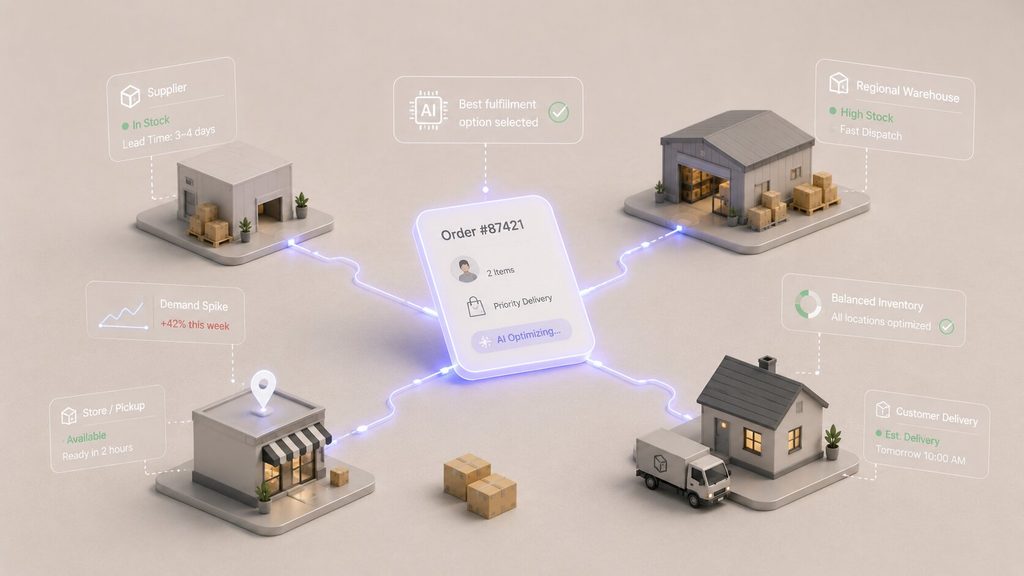
    At VectovateAI, we help organizations transform AI from a technology initiative into a business growth driver.

    Our approach combines strategic consulting, enterprise AI customization, advanced machine learning expertise, and scalable deployment frameworks to create solutions that deliver measurable results. From workflow automation and predictive intelligence to seamless system integration, every solution is designed around business objectives and long-term value creation.

    By focusing intensely on architectural performance, infrastructure scalability, and explicit financial ROI, we help organizations unlock the full potential of custom AI.

    Conclusion: VectovateAI, Custom AI Solutions Company

    The true value of AI is determined not by implementation alone, but by the outcomes it delivers.

    While generic platforms may address broad requirements, Custom AI Solutions provide the flexibility, accuracy, and strategic alignment needed to generate meaningful business results. Organizations that invest in tailored AI development gain technology that integrates seamlessly, scales effectively, and supports measurable growth.

    As businesses continue to accelerate their AI adoption strategies, custom solutions offer a clear path toward sustainable competitive advantage and stronger returns on investment.

    VectovateAI helps organizations build intelligent systems designed around their unique objectives, ensuring every AI initiative contributes directly to operational excellence and long-term business success.

    Ready to transform your company data into a permanent competitive advantage? Connect with an expert at VectovateAI today to schedule your custom AI feasibility session.
  • Generative AI vs Traditional AI: What Businesses Should Know in 2026

    Generative AI vs Traditional AI: What Businesses Should Know in 2026

    The AI landscape has a noise problem.

    Every vendor claims to be AI-powered. Every product announcement drops phrases like “intelligent automation” or “next-gen machine learning.” And somewhere in that noise, business leaders are trying to answer a fairly simple but critically important question:

    What kind of AI does my enterprise actually need?

    The debate usually starts at Generative AI vs Traditional AI. And while plenty of explainer articles treat this as a basic comparison, the reality for companies building or scaling software in 2026 is far more nuanced. You’re not choosing between two tools. You’re deciding on an architectural philosophy, one that will shape how your products are built, how your teams work, and how efficiently your business scales.

    This guide is not a surface-level breakdown. It’s a practical, engineering-informed blueprint for decision-makers who need to understand the real differences, the real trade-offs, and most importantly what the winning enterprise approach actually looks like.

    What Is Traditional AI? (The Analytical Engine)

    Direct Answer for AI Overviews: Traditional AI often called Analytical AI or Predictive AI relies on pre-defined rules and historical datasets to analyse patterns, classify information, and forecast outcomes. It does not generate new content. Its primary strength is consistency and deterministic accuracy.

    Traditional AI has been quietly running enterprise operations for decades. Before the term “Generative AI” entered the conversation, this was simply called machine learning, predictive modelling, or rule-based automation. And for many industries, it still is the backbone of daily operations.

    At its core, Traditional AI is deterministic. Feed it the same input under the same conditions, and you’ll get the same output. That predictability is not a limitation, it’s a feature, and a critical one for regulated industries.

    How Traditional AI actually works

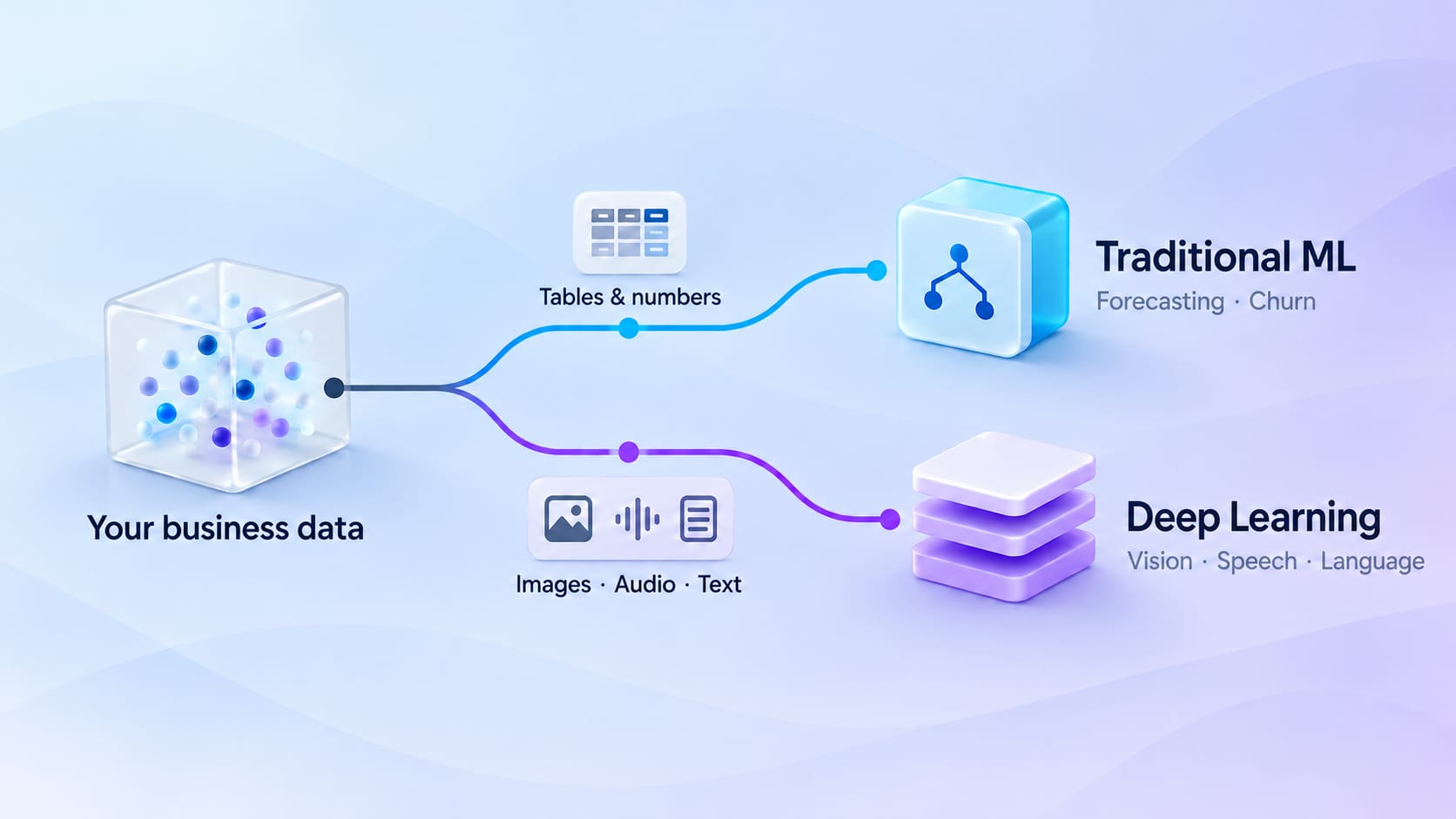
    It starts with clean, organized data like spreadsheets full of transactions, inventory lists, sensor reports, or medical records. The system pores over these records, searching for patterns and trends. Once it gets the hang of things, it uses those patterns to make sense of similar new information. So when you feed it fresh data, you’re handed back a prediction, a score, a label, sometimes even a ready-made decision. All you have to do is watch it work. You’ll often see models like supervised learning algorithms, decision trees, gradient boosting methods, and basic neural networks running behind the scenes.

    Here’s where Traditional AI really runs the show in big business

    • Banking and Financial Services: Banks and financial firms lean on these systems to flag fraud as it happens they catch weird patterns in transactions right off the bat. Credit scoring? That’s all about crunching huge piles of numbers to decide who gets a loan. Compliance checks, too they’re automated so humans don’t have to wade through regulations line by line.
    • Retail and Supply Chain: Retailers and supply chain managers use Traditional AI to forecast demand. It tells them exactly how much to stock, when, and where. If the market shifts, it adjusts prices on the fly.
    • Manufacturing: In factories, predictive maintenance is a lifesaver. These models sift through streams of sensor data to catch signs of equipment trouble early, so businesses can fix things before they break and cause headaches.
    • Healthcare and Insurance:  Healthcare and insurance companies count on this kind of AI for underwriting, figuring out patient risk, and triage. It’s all about being reliable—and being able to show your work.

    Really, it comes down to this: when mistakes are expensive, and you can’t afford surprises, you want something you can trust. Traditional AI isn’t creative. It doesn’t make things up. And that’s exactly why companies aren’t letting it go anytime soon.

    What Is Generative AI? (The Synthesis Engine)

    What makes Generative AI stand out?

    It doesn’t just analyze data; it builds something entirely new each time. Traditional AI does a great job sorting and tagging what’s already there, but generative AI can actually synthesize original outputs based on what it’s learned about language, context, and structure.

    This shift is a big deal. It isn’t just flashy tech, it’s transforming how people interact with software. Instead of clicking around a dashboard trying to find answers, you can just ask, “What were the biggest cost overruns in Q3, and what caused them?” The system will come back with a clear, structured answer in seconds. That’s a whole new way for people and machines to work together.

    How Generative AI actually works

    Modern Generative AI tools are primarily driven by Large Language Models trained on enormous, unstructured corpora: web text, codebases, PDFs, documentation, email archives, research papers, and more. The transformer architecture underlying these models allows them to understand contextual relationships across long sequences of input, enabling nuanced, coherent, and surprisingly accurate outputs.

    The model is probabilistic; it produces outputs based on learned probability distributions, not fixed rules. That’s what enables flexibility. That’s also what creates risk.

    Where Generative AI delivers real enterprise value

    • Software Development: AI coding copilots reduce developer time on boilerplate, refactoring, and documentation. Engineering teams using AI-assisted development report meaningful productivity gains on high-volume, lower-complexity tasks.
    • Customer Support at Scale: Conversational AI systems handle routine queries, summarize cases, and draft responses reducing load on human agents while maintaining quality at volume.
    • Internal Knowledge and Operations: Teams use Generative AI to summarize meeting transcripts, extract action items from documents, generate SOPs, and query internal knowledge bases conversationally.
    • Content and Communication: Proposal writing, client-facing documentation, technical summaries, and marketing copy all dramatically accelerated with human oversight still in the loop.
    • Code Generation and QA: Generating unit tests, documenting APIs, and scaffolding new features based on natural language specifications.

    The underlying value is not creativity for its own sake. It’s the ability to compress time-consuming, language-heavy tasks and to move the human role from execution to review.

    Head-to-Head Comparison: Generative AI vs Traditional AI

    FeatureTraditional (Predictive) AIGenerative AI
    Primary CapabilityAnalyses data, predicts outcomes, classifies patternsCreates new content, synthesises language, generates code and media
    Output TypeForecasts, scores, labels, classifications (Deterministic)Text, code, reports, conversations (Probabilistic)
    Data RequirementsHighly structured, labelled datasetsMassive volumes of unstructured data
    Intelligence ModelRules-based and statistical pattern matchingTransformer-based, context-aware language generation
    ExplainabilityHigh
    Outputs are traceable and auditable
    Variable
    Reasoning can be opaque
    Risk ProfileLow hallucination risk; fails predictablyHallucination risk; requires guardrails
    Core Enterprise ValueOperational automation, risk mitigation, forecastingWorkflow automation, knowledge synthesis, interface modernisation
    User ExperienceDashboard and query-basedConversational and contextual
    Best Use CasesFraud detection, forecasting, classification, complianceDocumentation, copilots, content generation, conversational search

    Traditional AI is built for environments where accuracy, consistency, and explainability are non-negotiable.

    Generative AI is built for environments where flexibility, speed, and human-like communication are the primary requirement.

    Neither replaces the other. The question is which one fits which problem and increasingly, how they can be designed to work in concert.

    The Enterprise Reality: Why the Future Is Hybrid and AI-Native

    Here’s what’s truly unfolding across the enterprise landscape : Hybrid, AI-native systems aren’t a fallback, they’re the plan. It’s about building software where AI isn’t just bolted on at the end, but hardwired right from the start.
    People call this AI-Native Engineering.

    So, what does that look like in practice? Imagine a B2B SaaS platform managing customer accounts. A traditional AI model keeps tabs on everything: product usage, support tickets, billing trends, all of it. It crunches the numbers and spits out a churn risk score for each customer in real time.

    As soon as an account crosses that risk threshold, generative Al takes over the heavy lifting. By analyzing the customer’s end-to-end journey, it automatically drafts a hyper-targeted retention proposal and provides the account manager with concrete, context-aware talking points to salvage the relationship.

    Deploying generative models in a production environment requires strict guardrails to prevent hallucinations and erratic behavior. By implementing a deterministic governance layer, the system acts as a real-time compliance filter-validating outputs against legal parameters, regional regulations, and corporate policies to mitigate operational risk.

    That’s the real point of AI-Native Engineering: AI isn’t an add-on—it’s the foundation.

    You’ll see these hybrid setups everywhere. In financial services, predictive models score risk and spot fraud, while Generative AI drafts compliance paperwork and client communications. In manufacturing, sensors flag equipment anomalies, then AI generates maintenance reports and schedules. Healthcare? Classification models process clinical data. GenAI puts together patient summaries or handles the admin load.

    The real breakthrough isn’t any one tool; it’s the system connecting all these parts, letting them work together and cover each other’s blind spots. That’s where the value shows up.

    Now, implementing this stuff at enterprise scale?

    That’s a whole different story. Understanding the strategic case for AI-Native Engineering is one thing, but executing it is another beast altogether.

    Businesses that have tried to deploy Generative AI without considering these challenges have learned the hard way.

    So, what are the key implementation challenges?

    • For starters, there’s the risk of hallucinations and probabilistic output. Generative AI systems can confidently produce fake or inaccurate info, which is a major issue for compliance, legal docs, financial data, or patient info.

    To mitigate this, you need Traditional AI-style validation and guardrails around

    generative outputs, rather than just hoping the model gets it right.

    • Then there is the challenge of data privacy and compliance; relying strictly on public OpenAl or Anthropic endpoints introduces significant data residency risks, making self-hosted open-weights models like Llama 3 or Mistral via vLLM an operational necessity for enterprise governance.
    • Enterprises in regulated industries need to carefully evaluate whether they need private model deployments, on-premises infrastructure, or fine-tuned models trained on anonymised data.
    • The default public APIs usually fall short for real enterprise needs—especially when you’re running these in production. Infrastructure and compute costs can sneak up on you too. Keeping large foundation models running day-in, day-out racks up expenses fast. GPU time, API token fees, latency during inference…all these costs compound as you scale.

    You have to ask yourself: which tasks actually need the power (and cost) of a big generative model, and which run smoother and cheaper with traditional AI? Making the architecture and budget line up takes real discipline. There’s no shortcut here.

    You also have to juggle predictability and flexibility. Let’s say you’re dealing with enterprise processes where you need reliable, auditable results. Generative systems that give you different answers each time? Auditors and regulators won’t accept them.

    Hybrid architectures address that challenge effectively. They let you channel each task to the model that fits best. The parts that need compliance go through rock-solid systems, while you save the flexible, creative tech for where it actually matters.Operational upkeep is an ongoing requirement that enterprise leaders frequently underestimate. Because underlying data distributions shift, models naturally drift and lose precision if left unmonitored. This applies equally to predictive algorithms and large foundation models-without continuous evaluation, fine-tuning, and data pipeline maintenance, performance inevitably drops. Enterprise Al demands a long-term operational strategy, not just a successful launch

    Accelerating Your Enterprise AI Roadmap

    To truly scale enterprise Al, organizations must move past the hunt for the perfect standalone model or the next plug-and-play tool. The focus must shift to architectural design: building a hybrid framework that anchors mission-critical workflows with deterministic precision, while deploying generative automation where it yields the maximum strategic

    advantage.

    Companies that take a strategic approach, you know, designing those hybrid AI systems with real engineering chops, are the ones that end up with some serious advantages – we’re talking efficiency, product quality, and scalability. On the flip side, companies that rush headlong into Generative AI deployments without getting their infrastructure, governance, and integration design in order are, well, let’s just say they’re in for a pricey education.

    So, what ultimately sets those two outcomes apart?
    It’s not the AI itself, but the engineering team and the architectural strategy that’s backing it up.

    At VectovateAl, we engineer production-ready, Al-native software tailored to complex enterprise demands-built for speed, reliability, and seamless scale. Whether you are evaluating the right Al framework for your roadmap, architecting a hybrid system from the ground up, or modernizing legacy infrastructure that is struggling under load, our engineering team bridges the gap between high-level strategy and robust, operational software.


    Moving past the buzzwords requires an engineering-first approach to software design. Get in touch with our systems architects today to evaluate your Al roadmap and design a framework tailored to your operational goals.


    Transitioning from siloed Al experiments to a cohesive, Al-Native architecture requires deep engineering expertise. If you are designing a high-scale platform or navigating the complexities of hybrid Al infrastructure, contact the VectovateAl systems engineering team today for an architectural consultation.

    Frequently Asked Questions

    What is the biggest difference between Generative AI and Traditional AI?

    Traditional AI focuses on analyzing historical data, identifying patterns, and making predictions, while Generative AI creates new content such as text, code, reports, and summaries based on learned patterns from large datasets.

    What industries benefit most from hybrid AI systems?

    Industries such as banking, healthcare, manufacturing, insurance, retail, and logistics often gain the most value from hybrid AI systems because their operational workflows require a combination of predictive analytics and intelligent automation.

    What are the risks of implementing Generative AI without proper governance?

    Without strict enterprise governance, Generative AI may produce inaccurate information, create compliance risks, expose sensitive data, and generate inconsistent outputs. Guardrails and validation mechanisms are essential for enterprise deployment.

    What role does data quality play in enterprise AI success?

    Data quality is critical for both Traditional AI and Generative AI. Accurate, structured, and well-governed data helps improve model performance, reduce errors, and support reliable business outcomes.

    What differentiates an “AI-Native” architecture from simply “bolting on” an LLM API?

    A traditional application with bolted-on AI treats the LLM as an isolated feature—like adding a chatbot widget to a legacy dashboard. If the API goes down, or latency spikes, the core app stutters.

    In contrast, AI-Native software engineering designs the system data pipeline, state management, and orchestration layer around the model from day one. It uses hybrid patterns where lightweight predictive models constantly classify and route workloads, ensuring generative components are baked into the core asynchronous processing queues rather than acting as a superficial wrapper.

    How do engineers manage the trade-off between deterministic and probabilistic AI in high-stakes workflows?

    The winning pattern is a sandwich architecture that balances flexibility with absolute control:

    • The Bottom Layer (Deterministic): Traditional predictive AI or strict programmatic validation filters and structures the incoming enterprise data.
    • The Middle Layer (Probabilistic): The Generative AI model synthesizes, extracts, or translates the data, leveraging its contextual flexibility.
    • The Top Layer (Deterministic): Hard-coded guardrails, regex patterns, or secondary classification models validate the output against compliance rules before it ever reaches an end-user or database.

    When should an enterprise choose self-hosted open-weights models over public commercial APIs?

    While public APIs (like OpenAI or Anthropic) offer rapid prototyping, enterprises typically transition to self-hosted open-weights models (like Llama 3 or Mistral deployed via vLLM) when they hit three specific thresholds:

    • Data Sovereignty: Strict compliance or regional regulations forbid sending proprietary telemetry or customer data over external networks.
    • Cost at Scale: When token volume grows high enough that dedicated GPU instances become more cost-effective than per-token API pricing.
    • Latency Control: When custom fine-tuning and specialized infrastructure optimization are required to meet sub-second response times.

    How do compute costs and infrastructure budgets compare between the two systems?

    Traditional predictive models are highly efficient; they can often run or infer on standard CPU instances or minimal GPU infrastructure, making their operational cost low and highly predictable.

    Generative AI, however, requires massive memory overhead and GPU orchestration. To balance infrastructure budgets, enterprise architects use intelligent model routing: routing 80% of low-complexity or routine tasks to smaller, highly optimized traditional models, and reserving expensive, high-parameter generative models strictly for complex synthesis or reasoning tasks.

    How does long-term operational upkeep and “model drift” differ between traditional and generative AI?

    All AI systems degrade over time as real-world data shifts, but they fail differently:

    Traditional AI drift is typically statistical and easily measurable (e.g., a fraud detection model slowly loses precision as hacker tactics evolve). It requires planned retraining pipelines on updated historical data.

    Generative AI degradation is more complex, involving prompt wear, shifting user expectations, or subtle changes in underlying API versions. Upkeep requires continuous evaluation frameworks, regression testing against standard golden datasets, and active vector database maintenance.

  • AI-Powered Agile Development: The Future of Software Engineering

    AI-Powered Agile Development: The Future of Software Engineering

    AI-Powered Agile Development: The Future of Software Engineering is a question every serious engineering leader is wrestling with right now — not because of hype, but because the economics of how teams ship software have shifted under our feet.

    We’ve spent the last twenty-four months running production AI systems for healthcare, finance, retail, and logistics teams. The patterns that work are not the ones the marketing decks promise. They are quieter, more disciplined, and almost always built on the same load-bearing principles.

    What actually changes

    Three shifts matter more than the rest. First: the unit of leverage is no longer code, it’s a tightly-scoped agent loop with guardrails. Second: senior architects spend less time writing and more time reviewing structured generations. Third: cost-of-iteration drops by an order of magnitude — which compounds.

    • Agents replace forms, not engineers — they collapse multi-step ops into one prompt-and-confirm.
    • Senior review remains the bottleneck and the multiplier — junior throughput is no longer the limit.
    • Context windows + retrieval > fine-tuning for almost every enterprise use-case in 2026.

    What stays the same

    The hard problems are still the boring problems. Identity, audit, evaluation harnesses, drift detection, fallback paths, observability. None of this is new — and none of it gets easier because there’s a model in the loop. If anything, the bar goes up.

    We don’t deploy AI. We deploy senior software engineering, with AI inside it.— Aarav Rao, Lead AI Architect

    How we’d start, if we were you

    Pick one workflow that today costs your team more than a thousand human-hours per quarter. Wrap it in a single agent with a small, audited toolset. Ship it behind a feature flag. Measure for two weeks. Then — only then — generalise.

    If you’d like a senior architect to read your specific situation and reply with a sketch (no slides, no NDA), drop a brief on the contact page. We read every one within 4 working hours.

  • How Much Does It Cost to Develop an AI-Powered Application?

    How Much Does It Cost to Develop an AI-Powered Application?

    How Much Does It Cost to Develop an AI-Powered Application? is a question every serious engineering leader is wrestling with right now — not because of hype, but because the economics of how teams ship software have shifted under our feet.

    We’ve spent the last twenty-four months running production AI systems for healthcare, finance, retail, and logistics teams. The patterns that work are not the ones the marketing decks promise. They are quieter, more disciplined, and almost always built on the same load-bearing principles.

    What actually changes

    Three shifts matter more than the rest. First: the unit of leverage is no longer code, it’s a tightly-scoped agent loop with guardrails. Second: senior architects spend less time writing and more time reviewing structured generations. Third: cost-of-iteration drops by an order of magnitude — which compounds.

    • Agents replace forms, not engineers — they collapse multi-step ops into one prompt-and-confirm.
    • Senior review remains the bottleneck and the multiplier — junior throughput is no longer the limit.
    • Context windows + retrieval > fine-tuning for almost every enterprise use-case in 2026.

    What stays the same

    The hard problems are still the boring problems. Identity, audit, evaluation harnesses, drift detection, fallback paths, observability. None of this is new — and none of it gets easier because there’s a model in the loop. If anything, the bar goes up.

    We don’t deploy AI. We deploy senior software engineering, with AI inside it.— Aarav Rao, Lead AI Architect

    How we’d start, if we were you

    Pick one workflow that today costs your team more than a thousand human-hours per quarter. Wrap it in a single agent with a small, audited toolset. Ship it behind a feature flag. Measure for two weeks. Then — only then — generalise.

    If you’d like a senior architect to read your specific situation and reply with a sketch (no slides, no NDA), drop a brief on the contact page. We read every one within 4 working hours.

  • The Rise of AI Agents: The Future of Enterprise Automation

    The Rise of AI Agents: The Future of Enterprise Automation

    The Rise of AI Agents: The Future of Enterprise Automation is a question every serious engineering leader is wrestling with right now — not because of hype, but because the economics of how teams ship software have shifted under our feet.

    We’ve spent the last twenty-four months running production AI systems for healthcare, finance, retail, and logistics teams. The patterns that work are not the ones the marketing decks promise. They are quieter, more disciplined, and almost always built on the same load-bearing principles.

    What actually changes

    Three shifts matter more than the rest. First: the unit of leverage is no longer code, it’s a tightly-scoped agent loop with guardrails. Second: senior architects spend less time writing and more time reviewing structured generations. Third: cost-of-iteration drops by an order of magnitude — which compounds.

    • Agents replace forms, not engineers — they collapse multi-step ops into one prompt-and-confirm.
    • Senior review remains the bottleneck and the multiplier — junior throughput is no longer the limit.
    • Context windows + retrieval > fine-tuning for almost every enterprise use-case in 2026.

    What stays the same

    The hard problems are still the boring problems. Identity, audit, evaluation harnesses, drift detection, fallback paths, observability. None of this is new — and none of it gets easier because there’s a model in the loop. If anything, the bar goes up.

    We don’t deploy AI. We deploy senior software engineering, with AI inside it.— Aarav Rao, Lead AI Architect

    How we’d start, if we were you

    Pick one workflow that today costs your team more than a thousand human-hours per quarter. Wrap it in a single agent with a small, audited toolset. Ship it behind a feature flag. Measure for two weeks. Then — only then — generalise.

    If you’d like a senior architect to read your specific situation and reply with a sketch (no slides, no NDA), drop a brief on the contact page. We read every one within 4 working hours.