Category: AI/ML Development

  • AI-Powered Web Development: How Generative Engineering Ships Production Software 2x Faster

    AI-Powered Web Development: How Generative Engineering Ships Production Software 2x Faster

    AI-powered web development is the fastest route from an idea to a shipped product. Businesses that adopt it are cutting release cycles in half. Developers who use it well are shipping cleaner code, faster.

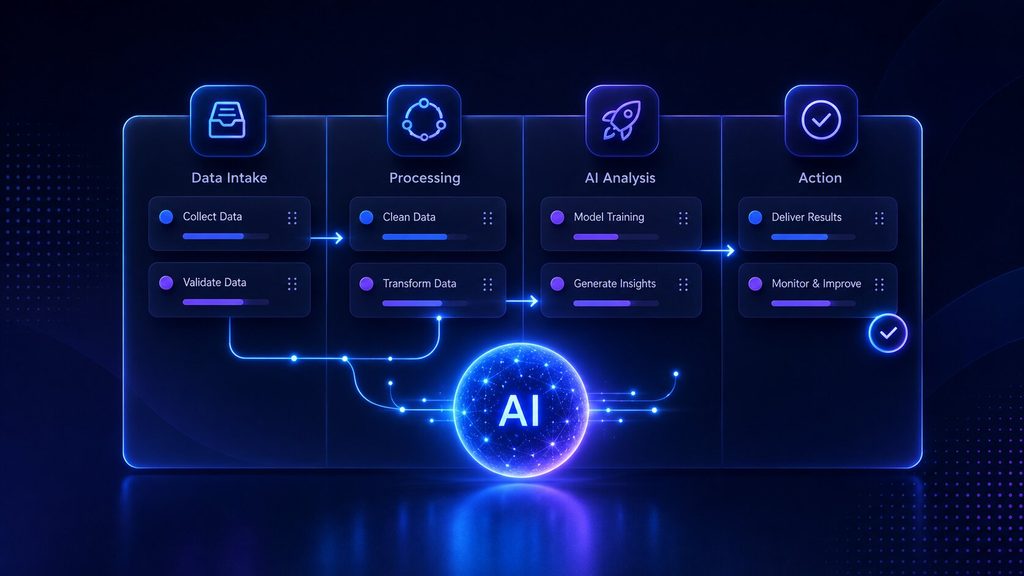
    This shift has a name: generative software engineering. It blends AI code generation, automated testing, and human oversight into one workflow. The result is production-grade software that ships in weeks, not months.

    If you are a founder or a CTO trying to understand this shift, this guide breaks it down. It also tells you exactly what to look for when picking an AI development partner for your next project.

    Key Takeaways

    • AI-powered web development can cut delivery timelines by 2x to 5x when paired with strong human review.
    • Generative AI now touches every stage of the software development lifecycle, from requirement gathering to deployment.
    • Speed without oversight is risky. AI-generated code still needs senior engineering judgment before it ships.
    • The right AI development partner depends on your use case: MVP building, enterprise agents, healthcare compliance, or computer vision.
    • Ahmedabad’s engineering talent pool is becoming a serious hub for agent-first, human-in-the-loop software delivery.
    • VectovateAI’s Engineering Team in Ahmedabad provides an agent-first, human-in-the-loop framework built for global scalability.

    What Generative Software Engineering Actually Means
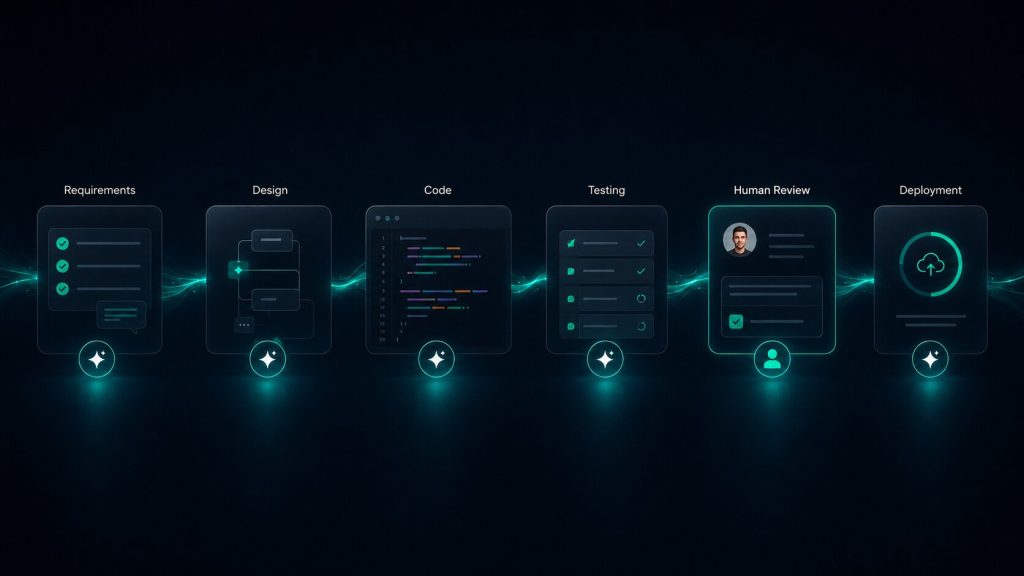
    Generative software engineering is not just “AI writes your code.” It is a full-cycle transformation of how software gets built.

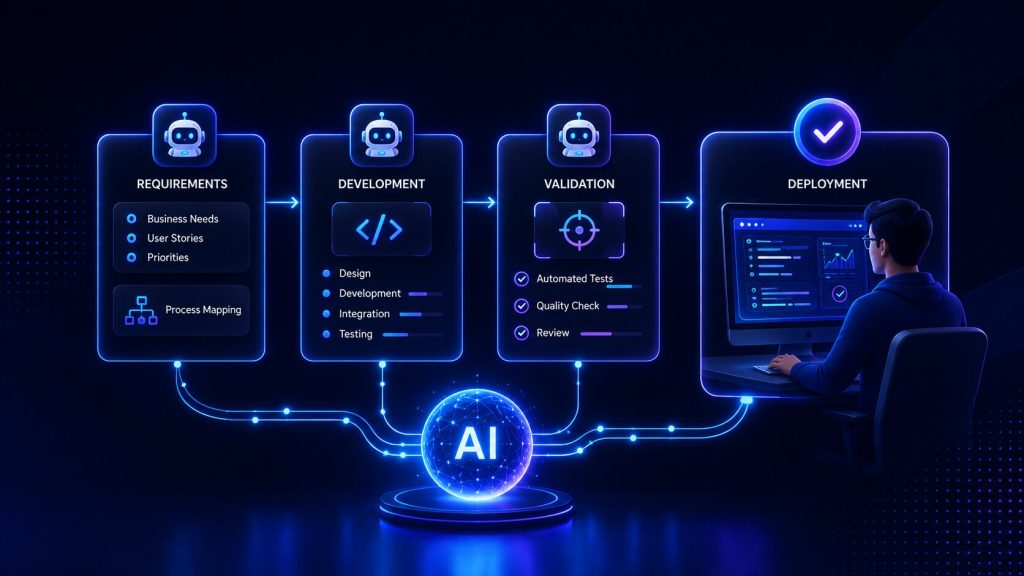
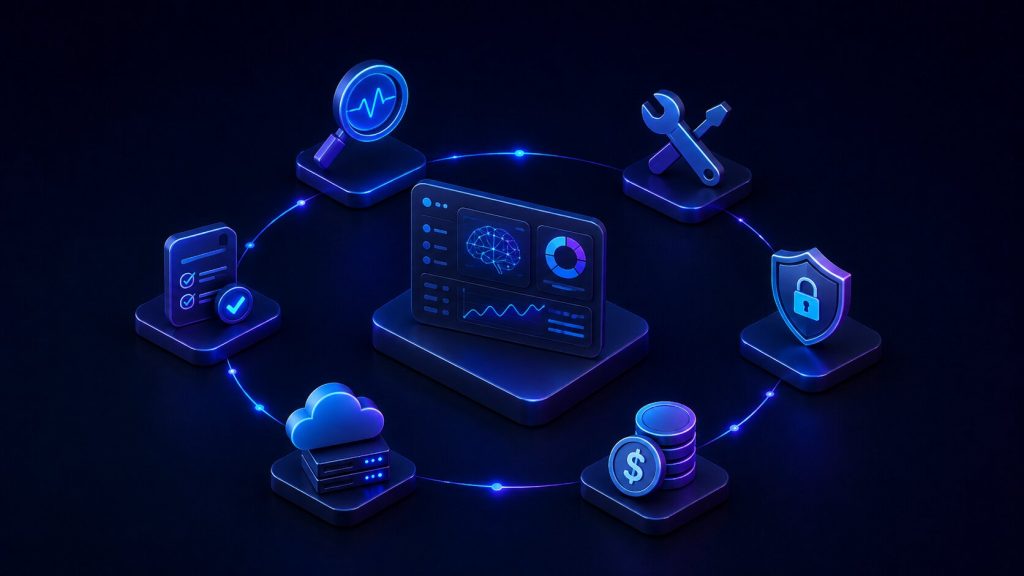
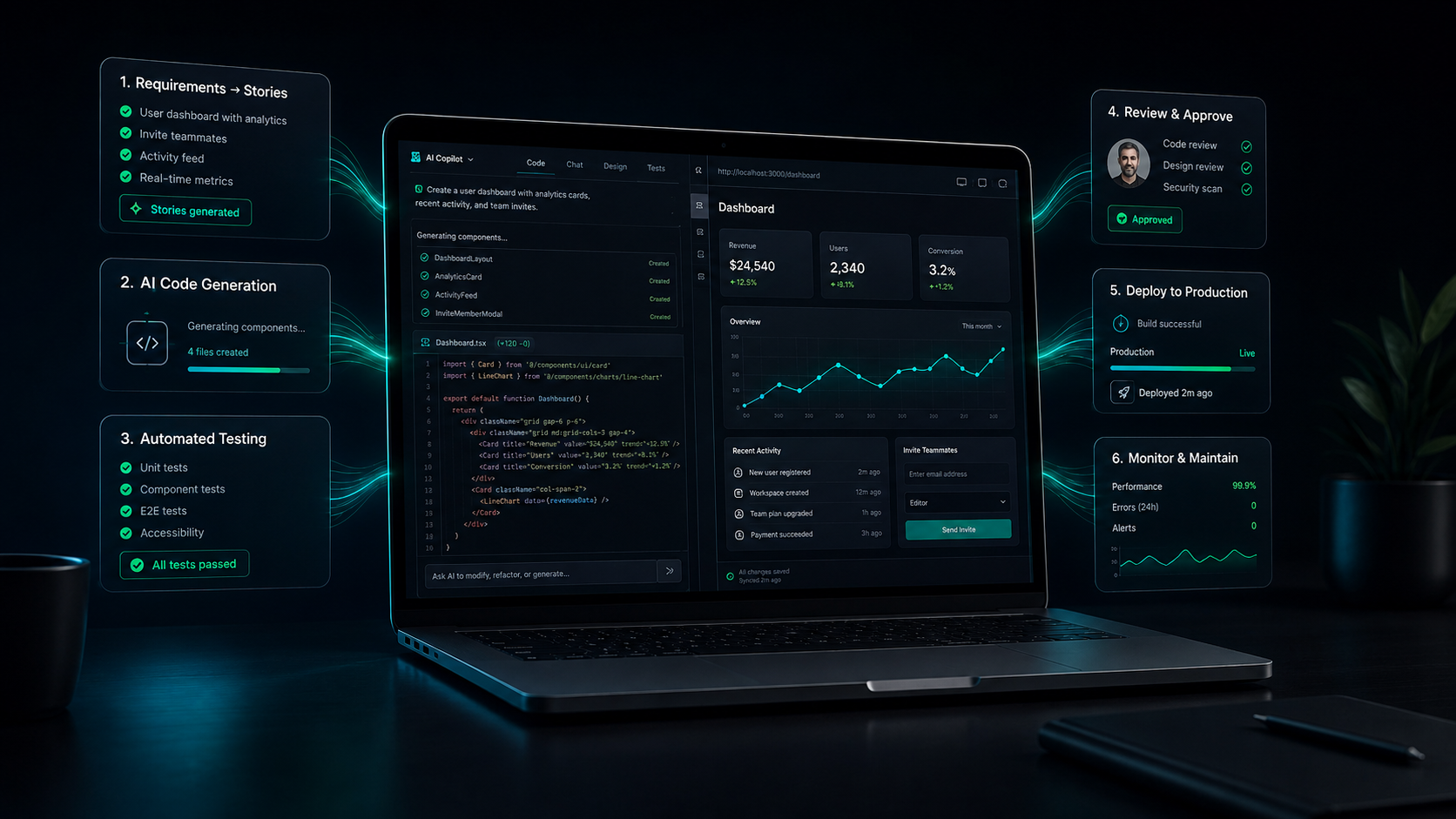
    Modern AI tools now assist across the entire lifecycle: requirement gathering, design, coding, testing, deployment, and maintenance. Generative AI transforms ideas into requirements, then converts those requirements into user stories, test cases, code, and documentation, all while working alongside human developers.

    According to forecasts by Gartner, over 80% of enterprise software engineering teams will integrate generative AI and agentic workflows into their core development lifecycle by 2026.

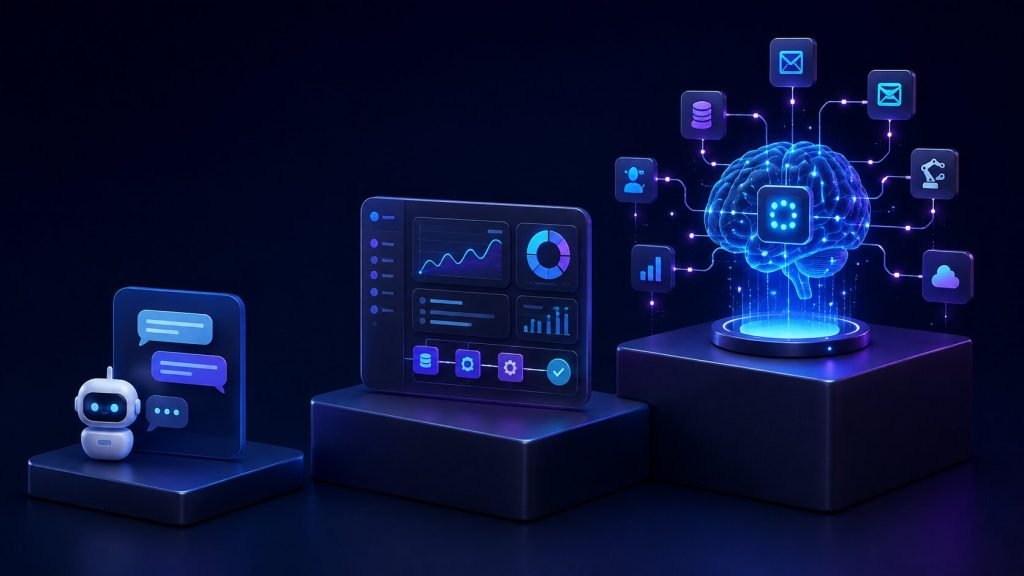
    This is the core idea behind AI product engineering. Instead of treating AI as an autocomplete tool, teams treat it as a collaborator across the whole build process, from architecture decisions to final QA.

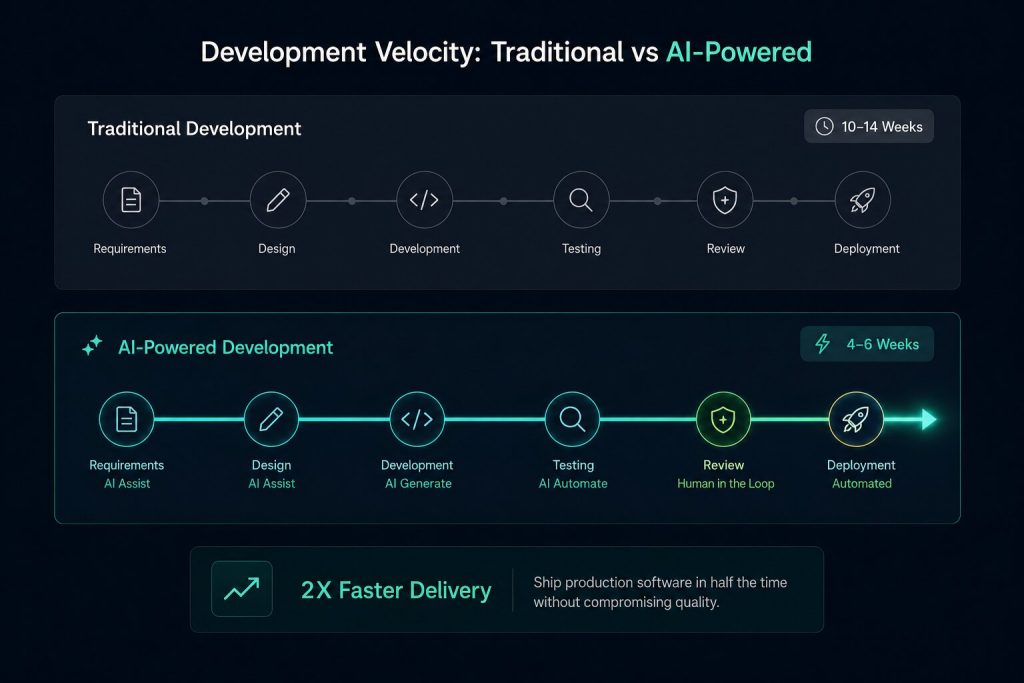
    Why AI-Powered Web Development Ships Software 2x Faster?

    The speed gain is not hype. It comes from removing friction at every stage.

    Empirical research by GitHub and MIT demonstrates that developers using generative AI workflows complete software engineering tasks 55.8% faster than those using traditional manual methods.

    Teams using AI-powered coding tools report productivity gains of 2 to 5 times when compared to traditional workflows. A task that once needed a full workday now takes hours.

    Here is where the time actually gets saved:

    Development StageTraditional TimelineAI-Powered Timeline
    Requirement to spec3-5 daysSame day
    Boilerplate coding2-3 daysFew hours
    Test case writing1-2 daysMinutes to hours
    Documentation1 dayAuto-generated, reviewed same day
    Bug detectionOngoing manual QAContinuous, real-time

    AI tools accelerate coding, reduce human error, and free developers to focus on complex and creative tasks, while AI-driven testing systems generate adaptive test cases and prioritize the most critical ones.

    This is why generative software engineering is becoming the default approach for teams that need to ship fast without sacrificing quality.
    The Trap Nobody Talks About: Speed Without Understanding

    Faster is not always better. This is the part most agencies skip when they pitch AI development.

    A developer who documented months of real AI-assisted coding put it plainly: the risk is not that AI writes bad code. The real risk is that AI generates code that looks correct, compiles, and passes basic tests, but quietly encourages the developer to stop thinking.

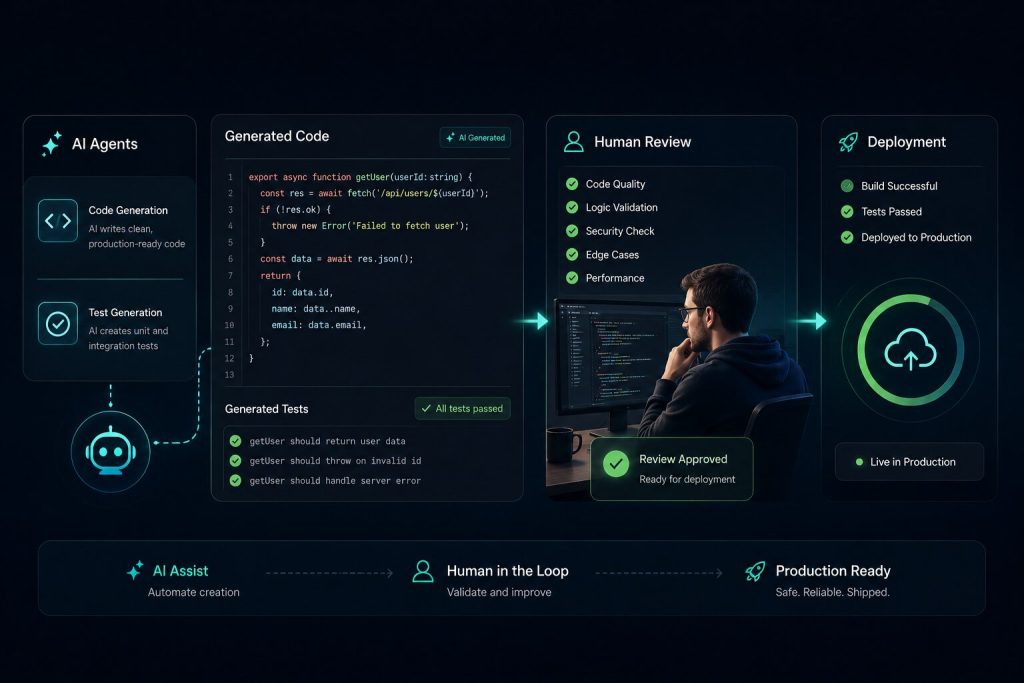
    This is exactly why human-in-the-loop review is not optional. It is the difference between an AI development partner who ships fragile code fast, and one who ships resilient production software fast.

    AI is also confidently wrong at times. However, peer-reviewed research from Purdue University shows that over 52% of unvetted AI code outputs contain incorrect logic or security vulnerabilities, making senior engineer oversight critical.

    It can suggest insecure implementations, outdated libraries, or architectures that fail under real traffic. Senior engineering judgment catches what AI misses. That judgment is what you are actually paying for when you hire an AI development partner.

    How to Choose an AI Development Partner?

    Not every AI vendor is built for every use case. Here is what to look for, based on what you are trying to build.

    Your SituationWhat to Prioritize
    Creative agency looking for AI development partnerFast prototyping, design-to-code speed, flexible sprints
    Criteria for selecting healthcare app development partner AI MLHIPAA-aware architecture, model explainability, audit trails
    AI agent development partner for enterprise operationsWorkflow orchestration, system integrations, governance controls
    AI MVP development partnerLean team, quick iteration, cost-conscious tech stack
    AI development partner for computer visionDataset engineering experience, model tuning, edge deployment know-how

    What to Look for in an AI Development Partner?

    Whether you are a founder or a technical decision-maker, use this checklist before signing any contract:

    • Proven delivery, not just demos. Ask for a working production case, not a proof of concept.
    • Human-in-the-loop process. Every AI-generated module should go through senior review before deployment.
    • Transparent AI usage. They should tell you clearly where AI wrote code and where humans did.
    • Security-first mindset. AI-generated code needs the same security audits as human-written code.
    • Domain fit. A team strong in fintech may not be right for healthcare or computer vision work.

    CTO AI Development Partner Evaluation Framework

    If you are a CTO evaluating an AI development partner, go beyond the sales pitch. Ask these direct questions:

    • What percentage of your delivered code is AI-generated versus human-reviewed?
    • How do you handle AI hallucinations in production-critical logic?
    • Can you show a rollback plan if an AI-generated module fails in production?
    • What is your testing coverage strategy for AI-assisted code?
    • How do you train your engineers to review AI output critically, not just accept it?

    How to Choose an AI Strategy Development Consulting Partner?

    If your need is broader than one project, meaning you want an ongoing AI strategy development consulting partner, look for a team that can do three things well: assess your current tech debt, map a realistic AI adoption roadmap, and staff the roadmap with engineers who actually build, not just advise

    How to choose an AI strategy development consulting partner comes down to one test: can they show you a live system where AI and human engineers work together on the same codebase, today, not just in a pitch deck.

    Building Software the Right Way: Agent-First, Human-in-the-Loop

    Most agencies market AI speed alone. That is an incomplete pitch.

    The stronger model is agent-first, human-in-the-loop. AI agents handle the repetitive, high-volume work: generating boilerplate, drafting test suites, flagging vulnerabilities, and writing first-pass documentation. Human engineers handle architecture, security review, and the judgment calls that decide whether software actually survives contact with real users.

    This is also where VectovateAI’s engineering talent pool in Ahmedabad comes in. The city has quietly built a strong base of engineers who combine deep technical fundamentals with hands-on AI tooling experience. That combination, technical rigor plus AI fluency, is exactly what generative software engineering demands.

    Real-world teams are already proving this model works: solo founders are combining AI tools to cut build timelines from six months down to a few weeks, while agencies are launching client-ready websites in about 48 hours. The gains are real when the process includes proper review, not blind acceptance of AI output.
    Final Word

    AI-powered web development is not about replacing engineers. It is about giving good engineers a faster path to production, and giving bad shortcuts nowhere to hide.

    If you are evaluating an AI development partner, whether for an MVP, an enterprise AI agent system, a healthcare application, or a computer vision product, judge them on their review discipline as much as their speed. The partners who last are the ones who ship fast without ever letting AI think alone.

    See what this looks like at scale in our AI-native architecture case study, where a global travel aggregator reached 80% efficiency, and read why bolted-on AI fails where AI-first builds hold up.

    Ready to ship production software faster without losing review discipline? Book a Free AI Engineering Review with VectovateAI
  • AI-Native Software Development: Why Bolted-On AI Fails and What Building AI-First Actually Looks Like

    AI-Native Software Development: Why Bolted-On AI Fails and What Building AI-First Actually Looks Like

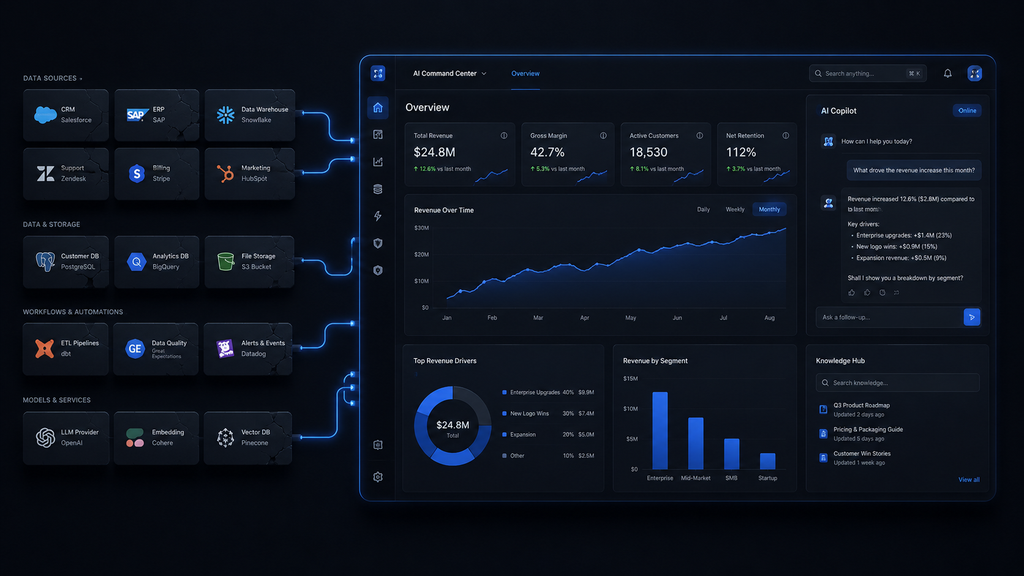
    Every software vendor claims “AI-powered” today. But most of that AI is duct-taped onto systems built for a different era.

    AI-native software development flips that model putting AI at the core of the architecture. This guide breaks down what that actually means, why bolted-on AI keeps failing, and what a real AI-first build looks like in 2026.

    Key Takeaways

    • AI-native software development puts AI in the core architecture, not on top of it. The removal test settles the question: take AI away, and if the product breaks, it was AI-native.
    • Bolted-on AI inherits every weakness of the legacy system underneath it, including data rigidity, per-seat pricing conflicts, and clunky UX.
    • Gartner projects 40% of agentic AI projects will fail by 2027, mostly from automating broken processes instead of rebuilding around AI-native principles.
    • Real AI-native platforms track rich, multi-attribute data foundations and adapt continuously, not reactively.
    • The right build order is: define the task, design the data model, choose the AI integration pattern, then build the interface last.
    • Human-in-the-loop review stays essential for high-stakes decisions, even in a fully agent-first system.

    What Is AI Native Development?

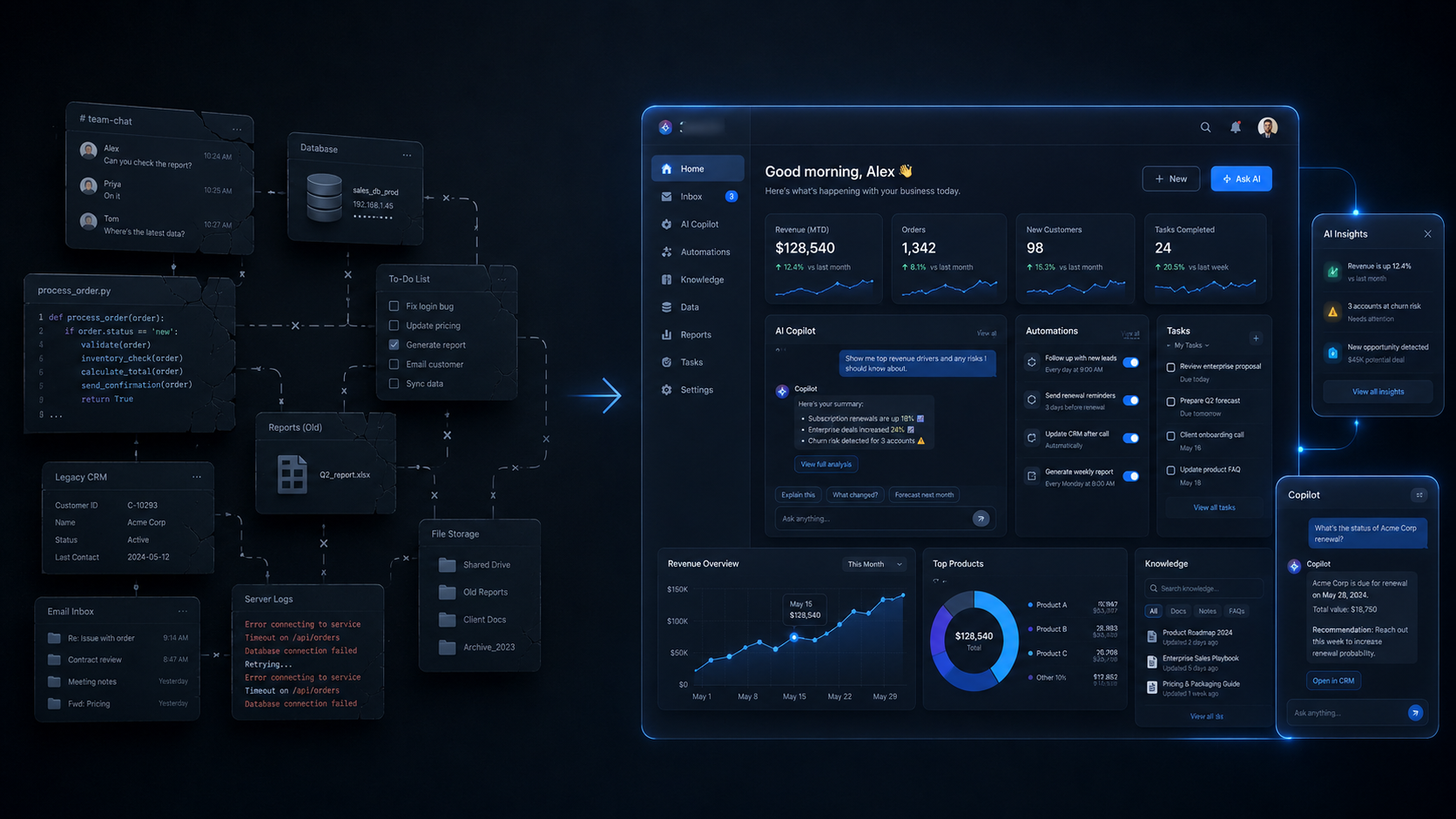
    In simple terms, it means designing a product’s data, workflows, and interface around AI from day one, instead of adding a chatbot to an existing system.

    Bolted-on AI sits on top of legacy architecture, it reads data, suggests actions, and stops there. AI-native development instead makes the model part of the core, structures data so the model can reason over it, and assumes intelligence is available at every step of the workflow.

    AI-Native vs Traditional Enterprise Development Tools

    This is where AI native app building platforms vs traditional enterprise development tools really diverge.

    A useful benchmark test involves removing all AI features from a product; if it still functions as a viable tool, the AI was added on, and if it collapses, the product is AI-native.

    ApproachData ModelAI’s RoleWhat Breaks Without AI
    Bolted-on AIBuilt for humans, AI reads it laterSuggests, summarizes, chatsNothing. Core product still runs
    AI-native developmentBuilt for AI agents to act onCore execution engineThe entire product

    In a bolt-on platform, the core execution engine still runs on scripts, not intent, so tests behave exactly as the scripts define them, and while the AI module may suggest fixes, the underlying rigid structure stays unchanged. That’s the trap. AI patched onto an old foundation inherits every weakness of that foundation.

    Why Bolted-On AI Fails: The Three Structural Traps

    AI native development platforms solve three problems that bolt-on tools structurally cannot fix:

    • Data model rigidity. Legacy databases expect humans to enter data slowly and carefully. AI agents generate and act on data at machine speed. Forcing that into an old schema breaks reports, integrations, and workflows built on top of it.
    • Pricing model conflict. Per-seat pricing assumes humans are the primary users. When AI agents handle work that used to need five people, that revenue model collapses on its own.
    • UX design conflict. Old interfaces are built around menus and forms. AI-native interfaces accept natural language and let agents act. Bolting one onto the other creates a clumsy hybrid that satisfies neither.

    The 2025 DORA Report, based on nearly 5,000 technology professionals globally, found that AI does not fix a team, it amplifies whatever is already there. That single line explains why so many “AI transformation” projects on old platforms quietly fail. You cannot automate your way out of a broken foundation.

    Gartner AI-Native Development Platforms 2026: What the Data Says

    The numbers back this up clearly. Here’s what the research firms are projecting for AI-native development platforms trends 2026:

    SourceFinding
    Gartner40% of enterprise apps will feature task-specific AI agents by end of 2026, up from under 5% in 2025
    Gartner80% of organizations will evolve large dev teams into smaller, AI-augmented teams by 2030
    Gartner40% of agentic AI projects will fail by 2027, largely because teams automate broken processes instead of redesigning around AI-native principles
    Deloitte78% of tech leaders anticipate broad AI agent integration into their architecture within the next five years

    That Gartner failure statistic matters more than the growth ones. It tells you the risk isn’t underusing AI. The risk is bolting AI onto broken processes and calling it transformation.

    Key Features of AI-Native Software Development Platforms

    If you’re evaluating AI native development firms, here’s what to actually look for. These are the key features of ai-native software development platforms 2025 2026 that separate real AI-native builds from marketing:

    • Intent-driven design: You describe the outcome. The system determines the steps, instead of forcing you to script every action manually.
    • Multi-attribute data foundations: Instead of tracking a single data point per element, resilient architectures track hundreds of attributes per element, so no single change breaks the system.
    • Continuous adaptation, not reactive patching: real self-healing monitors how the application changes and updates the model automatically before failures accumulate, rather than alerting a human after something breaks.
    • Human-in-the-loop governance: AI acts, but a person reviews high-stakes decisions before they go live.
    • Agent-first workflows: Routine, repeatable work runs through AI agents. People supervise outcomes instead of performing every step by hand.

    What an AI-Native Developer Actually Does Differently

    An AI native developer doesn’t start with wireframes. They start by defining the decision or task the AI will own, then design the data model around that task first. Only after that comes the interface. This order matters. Build the screen first, and you’ll end up retrofitting AI later, which is exactly the bolt-on trap this whole guide is about.

    Developer-first AI-native companies treat the model choice and AI integration pattern as a foundational decision, not an afterthought bolted on before launch. They keep a human review step for anything high-stakes, whether that’s a financial transaction, a healthcare workflow, or a customer-facing action. AI moves fast. Judgment still needs a person in the loop.

    Who’s Actually Behind These Builds?

    If you look closely at AI deployment manager profiles at developer-first AI-native companies, a pattern shows up fast. They’re people who sit between the agent and the business outcome, decide what the agent is allowed to touch, and own the rollback plan before anything goes live.

    That’s the real difference between a company that talks about being AI-native and one that actually is. Developer-first AI-native companies don’t treat deployment as an afterthought handled by whoever’s free that week. They build it into the role from day one, the same way they build AI into the architecture from day one.

    What Building AI-First Actually Looks Like: A Practical Example

    Picture two ways to build the same thing: an internal client portal with status tracking and a support assistant.

    The bolted-on route:

    Build database tables, design pages by hand, wire up a chatbot widget at the end. The chatbot can summarize what’s already there. It cannot restructure the workflow, act on data, or run anything autonomously.

    The AI-native route:

    Design the task first (client wants project status without asking a human). Build the data model so an agent can query it directly. Deploy the agent with real context and a clear boundary on what it can do without approval. The interface comes last, shaped around what the agent needs to work well.

    The difference isn’t speed alone. It’s capability. One produces a page with a chatbot stapled to it. The other produces a system where intelligence is load-bearing.

    Best AI Native Software Development Firms: What to Ask Before You Hire

    If you’re comparing best AI-native software development firms, skip the marketing deck and ask these directly:

    • Where does AI live in your architecture? Is it the execution engine, or a layer sitting on top of an older script-based system?
    • Can your platform work from a plain description of the outcome, without a developer writing every step first?
    • What happens when the underlying application changes? Does the system adapt on its own, or does someone get an alert to fix it manually?
    • Show a live build, not a recorded demo.

    Any firm that answers vaguely, or leans on phrases like “AI-enhanced,” is likely bolting AI onto an older system. That’s not automatically wrong for every project. But it’s not AI-native, and you should know which one you’re paying for.

    Our Take: Agent-First, Human-in-the-Loop, Built at VectovateAI

    Most AI-native conversations happen at the platform level: pricing tiers, SaaS dashboards, no-code app builders. We come at this from a different angle. As an Ahmedabad-based software engineering team, our focus is agent-first custom development, where AI agents handle the repeatable work and a human always reviews the outcomes that matter.

    That combination, agent-first execution paired with human-in-the-loop governance, is what separates AI-native systems that actually hold up in production from demos that look good in a pitch meeting. We build the data layer and the agent layer together, from the first sprint, not as a phase-two upgrade.

    That approach is documented in our AI-native architecture case study, where a global travel aggregator scaled to 80% efficiency. For the delivery side, see how AI-powered web development ships production software 2x faster.

    Planning an AI-first build or replacing a bolted-on layer? Book a Free AI Architecture Review with VectovateAI
  • Custom AI Development vs Off-the-Shelf Solutions: Which is Better?

    Custom AI Development vs Off-the-Shelf Solutions: Which is Better?

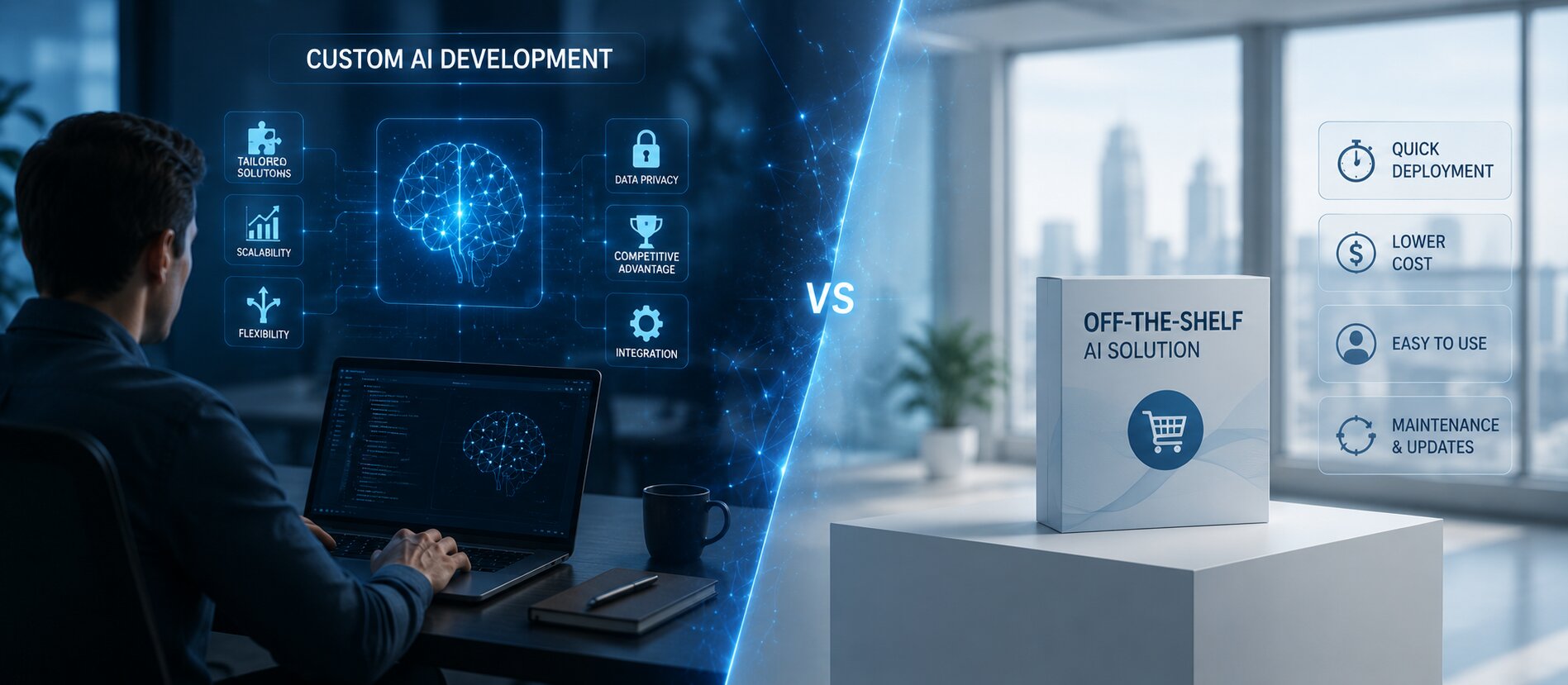
    Every business evaluating AI today lands on the same fork in the road: buy a ready-made tool, or build something that’s genuinely yours. The debate around Custom AI Development vs Off-the-Shelf AI isn’t just a budget conversation; it’s a decision about how much control, differentiation, and long-term value you want from your AI investment.

    As per McKinsey‘s 2025 State of AI report, only 5.5% of organizations are seeing real financial returns from their AI investments, underscoring how the difference between a generic tool and a system built for your workflow can directly decide whether AI pays off.

    Another research study by Gartner predicts that at least 30% of generative AI projects will be abandoned after the proof-of-concept phase due to escalating costs and unclear business value. This happens because a generic tool was asked to do a job it was never architected for.

    Key Takeaways:

    • Off-the-shelf AI platforms are faster to deploy and cheaper upfront, but come with licensing lock-in and limited flexibility.
    • Custom AI development services cost more initially but eliminate recurring “per-seat” fees and adapt to your exact workflows.
    • AI as a Service (AIaaS) models sit in between, useful for quick pilots, risky for core business processes.
    • The real cost isn’t the sticker price; it’s the Total Cost of Ownership (TCO) over 3-5 years.
    • Hybrid approaches (custom orchestration layer + pre-built models) are becoming the 2026 standard for enterprises.

    Custom AI Development vs Pre-Built Solutions: Key Differences Explained

    Before picking a side, it helps to see the two approaches laid out against each other:

    Parameter Off-the-Shelf AI Platforms Custom AI Development
    Time to deploy Days to weeks 2-6 months
    Upfront cost Low Moderate to high
    Ongoing cost Subscription/per-seat fees compound over time One-time build, lower recurring cost
    Data ownership Often shared with the vendor Fully proprietary
    Customization Limited to the vendor’s roadmap Built around your exact workflow
    Scalability Capped by the vendor’s architecture Scales with your business logic
    Vendor lock-in High None
    Competitive edge Same tool as competitors Proprietary AI systems unique to you

    This table is the crux of the decision. Pre-built AI solutions win on speed. Custom AI development services win on ownership and long-term economics.

    What Are Off-the-Shelf and White-Label AI Solutions?

    Off-the-shelf AI platforms are pre-built, configurable products, think chatbot builders, generic recommendation engines, or AI software packages you can subscribe to and switch on within a day. Many vendors also offer white-label AI solutions, letting you rebrand a generic engine as your own product.

    These work well when:

    • You need to validate an AI use case quickly, without engineering overhead.
    • Your requirement is generic (basic chat support, standard OCR, simple summarization).
    • The budget for a dedicated build isn’t approved yet.

    Where they fall short: the moment your workflow diverges from the vendor’s assumptions, you’re stuck submitting feature requests and waiting on someone else’s roadmap. And because many of these platforms operate as AI as a Service (AIaaS), your data and prompts often pass through third-party infrastructure, a governance concern for regulated industries like BFSI, healthcare, and legal.

    What Is Custom AI Development?

    Custom AI development means building proprietary AI systems designed specifically around your data, processes, and business rules, not a generic template with your logo on it. This includes custom LLM orchestration, fine-tuned models, agentic workflows, and integrations that sit natively inside your existing tech stack.

    This route makes sense when:

    • Your process is complex enough that no generic tool captures it (multi-step approvals, industry-specific compliance, proprietary data models).
    • You need the AI to act, not just answer, inside your existing systems (an agentic layer that triggers actions, not just chat).
    • Data sovereignty and IP ownership matter to your board or your regulators.
    • You’re building AI as a genuine differentiator, not a checkbox feature.

    The tradeoff is real: custom AI development services demand a longer runway and a more involved discovery phase.

    Real-World Application: FinTech & Insurance Scenarios

    Theory is easy to nod along to. It’s when you look at what these systems actually do inside regulated, high-stakes industries that the “custom vs off-the-shelf” question stops being academic.

    Fraud Detection in FinTech’s Infrastructure

    Off-the-shelf fraud tools are built to flag the fraud patterns everyone already knows about. They work from a shared, generic rulebook, which means every institution using the same platform is defending against yesterday’s threats in the same way.

    A custom-built fraud detection layer, by contrast, is trained on your own transaction history, your customer behavior baselines, and your specific risk appetite. It can flag a subtle deviation, an unusual login location paired with an atypical transaction size, for instance, that a generic model would wave through because it doesn’t fit a pre-defined template.

    For a bank or payments company, that difference isn’t cosmetic; it’s the gap between catching fraud in real time and explaining a loss after the fact.

    Making a Big Difference in Insurance Claim Automation

    Claims processing looks simple from the outside, submit a form, get a payout decision. In practice, it involves policy nuance, document verification, fraud checks, and regulatory sign-off, all stitched together differently by every insurer. An off-the-shelf claims tool forces your process to bend around its workflow.

    A custom AI system does the opposite, it’s built around your claims logic, your document formats, and your compliance checkpoints, automating the repetitive 80% of a claim (data extraction, policy matching, initial validation) while routing genuinely ambiguous cases to a human adjuster. The result is faster claims turnaround without sacrificing the judgment calls that regulators and customers expect a human to make.

    The Real Cost Comparison: Price vs. Value

    A cheaper monthly subscription can quietly become the more expensive option.

    Here’s a simplified 3-year cost lens:

    Cost Factor Off-the-Shelf Custom Build
    Year 1 Low license fee Higher development investment
    Year 2-3 Fees scale with users/usage Mostly maintenance, no per-seat tax
    Switching cost High (data migration, retraining teams) Low (you own the architecture)
    Feature requests Vendor-dependent, often delayed Built on your timeline

    This is where the “Maintenance Iceberg” conversation matters; the visible license fee is just the tip. Below the surface sit integration costs, data migration risk, and the compounding technical debt of stitching multiple SaaS tools together instead of one coherent system.

    Governance, Technical Debt, and the TCO Question

    Enterprises evaluating AI in 2026 are asking sharper questions than “what does it cost per month.” They’re asking about Total Cost of Ownership, model governance, and audit trails, what’s increasingly called “Governance-as-Code.” Off-the-shelf tools rarely expose this level of control. Custom builds bake governance into the architecture from day one, which matters enormously once regulators or enterprise clients start asking how your AI makes decisions.

    Model Drift and Architectural Drift: The Silent Risk Nobody Budgets For

    • AI models don’t stay still. When you depend on a third-party commercial model, you’re depending on something you don’t control the evolution of.
    • Vendors push updates, retrain underlying weights, adjust safety filters, or deprecate versions, and your integration inherits every one of those changes whether you asked for them or not. This is model drift.
    • Its quieter cousin is data lineage decay, where the path your data takes through a system becomes harder to trace as upstream components change beneath you.
    • The practical risk: a prompt that works flawlessly in January might yield degraded, incorrect, or subtly different outputs by July, not because your team changed anything, but because the third-party provider quietly adjusted the model framework underneath it.
    • There’s no changelog, no versioning control, and often no warning. For a regulated business, this becomes an audit trail problem, since you can no longer point to exactly which model version produced which decision.
    • With custom AI architectures, your engineering team retains absolute control over versioning, prompt registries, and data lineage pipelines.
    • Model updates happen on your schedule, against your test suite, with full visibility into what changed and why.
    • This ensures predictability and shields your operations from unexpected system performance drops, precisely the kind of stability regulators, auditors, and enterprise clients expect.

    Industry research from firms like Gartner and McKinsey consistently points to the same pattern: organizations that treat AI as strategic infrastructure see materially better ROI over a 3-year horizon, because they aren’t paying the compounding cost of vendor dependency.

    So, Which One Should You Choose?

    A simple way to decide:

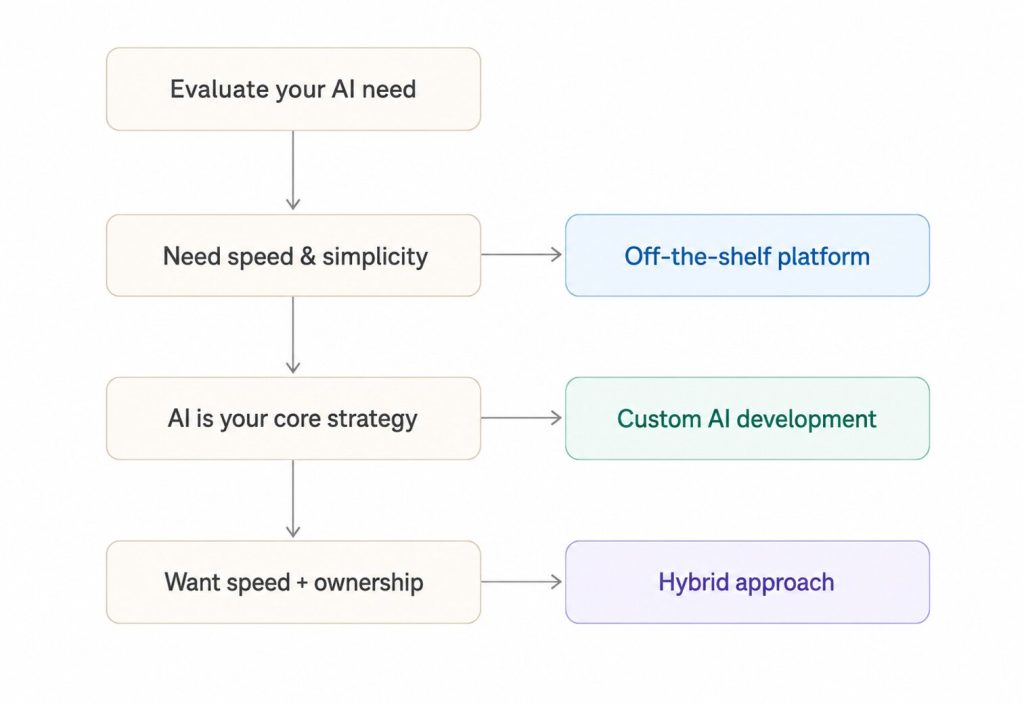
    • Choose off-the-shelf if you need speed, your use case is generic, and you’re testing a hypothesis before committing a budget.
    • Choose custom AI development if AI is core to your competitive strategy, your workflows are unique, or data ownership and compliance are non-negotiable.
    • Choose a hybrid, pre-built model wrapped in a custom orchestration and agent layer if you want the best of both: proven model quality with a system that’s genuinely yours.

    Why VectovateAI As Your Custom AI Development Company?

    This is exactly where VectovateAI, a custom AI Development Company, positions itself differently. Instead of a one-size-fits-all product or a purely off-the-shelf integration, VectovateAI builds agent-first, human-in-the-loop AI systems, proprietary architectures that combine the reliability of proven models with workflows engineered specifically around your business.

    Backed by Ahmedabad’s growing software engineering talent pool, VectovateAI brings enterprise-grade technical rigor without enterprise-consultancy overhead, helping businesses move past the “buy vs. build” debate entirely, toward AI that’s genuinely theirs.

    Final Word

    There’s no universal winner between custom AI development and off-the-shelf AI platforms, only a better fit for your specific stage, budget, and complexity. Early-stage or low-stakes use cases can lean on AIaaS and white-label AI solutions. But if your data is proprietary, your workflows are complex, or AI sits at the center of your competitive strategy, a custom AI development company will outperform any pre-built AI solution within the first year and keep compounding from there.

    Looking to build AI that’s actually yours?

    Talk to VectovateAI about a custom AI development roadmap built around your workflows.

  • AI-Powered Agile Development: The Future of Software Engineering

    AI-Powered Agile Development: The Future of Software Engineering

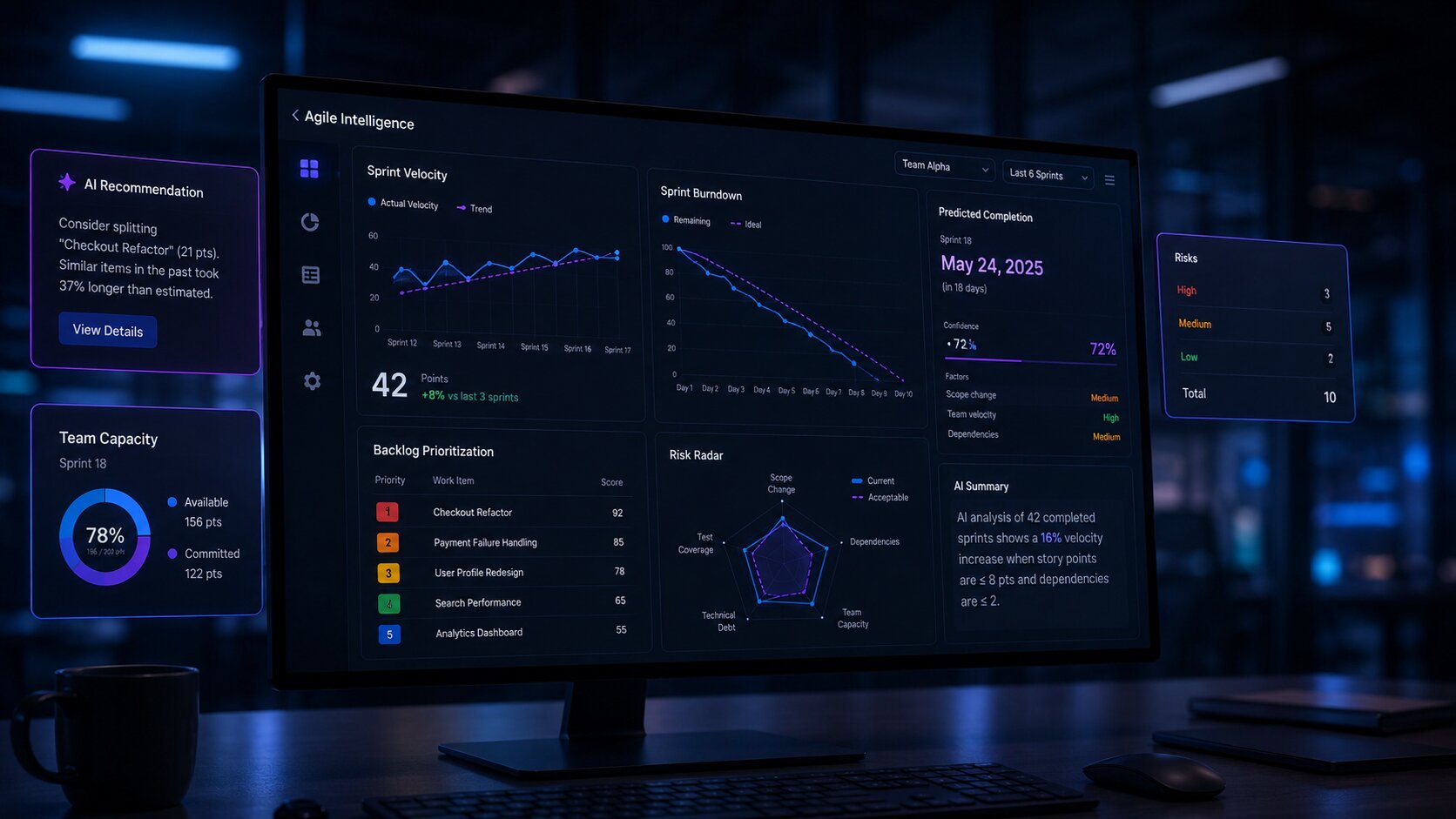
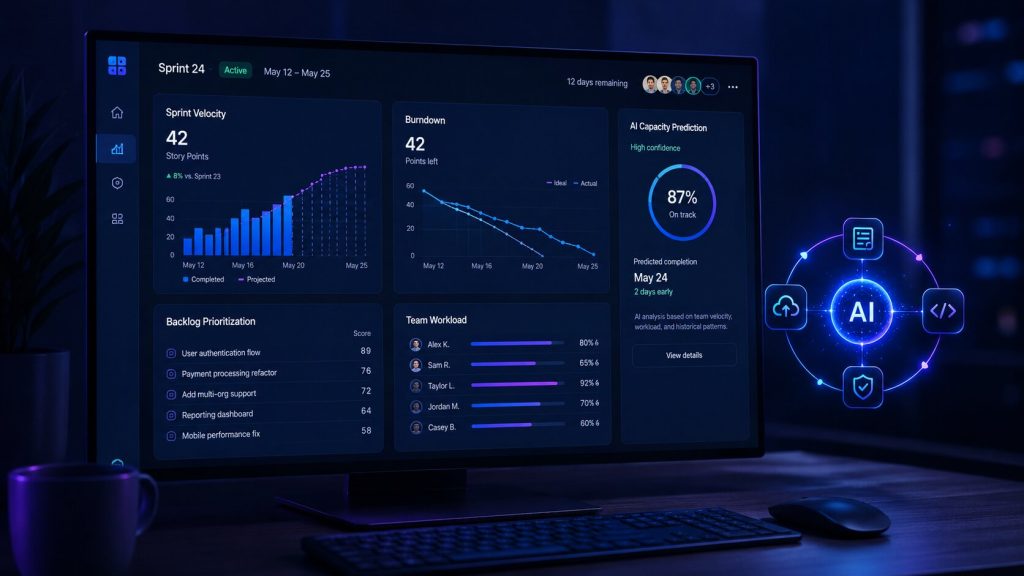
    Software teams are not writing code the old way anymore. AI in software development has moved past isolated autocomplete suggestions and turned into a full engineering partner that plans, codes, tests, and even manages sprints alongside human teams. If you run a dev team, lead a product roadmap, or you’re a student trying to understand where the industry is heading, this shift changes almost every part of the software development lifecycle.

    This blog breaks down how AI coding tools, agentic AI in software development, and AI in agile project management are reshaping delivery speed, code quality, and business outcomes in 2026.

    Key Takeaways

    • AI in software development now spans the full lifecycle, from requirements to deployment, not just code generation.
    • 92% of developers already use AI coding assistants monthly, but results depend heavily on existing process discipline.
    • Agentic AI in software development is shifting engineers from writing code to orchestrating and reviewing agent output.
    • AI in agile project management is automating backlog grooming, sprint planning, and requirement mapping, cutting planning friction.
    • Human-in-the-loop checkpoints, not full autonomy, separate reliable AI adoption from risky rollouts.
    • Security, IP ownership, and integration complexity remain real risks that need governance from day one.
    • Structured adoption, starting small with clear approval gates, consistently outperforms a rushed, all-at-once rollout.

    What Is AI-Powered Agile Development?

    It blends core Agile principles iteration, feedback, teamwork with AI that actively helps plan, build, and ship software: drafting requirements, proposing architecture, writing code, generating tests, and flagging risks early.

    Amazon calls this the AI-Driven Development Lifecycle: bolting AI onto old rituals just reinforces old inefficiencies. Real gains come when AI is a central collaborator across the whole lifecycle, not a one-off tool.

    Their model runs on three phases:

    Phase What AI Does What Humans Do
    Inception Turns business intent into requirements and user stories Validate AI’s proposals and questions
    Construction Proposes architecture, writes code, generates tests Approve technical and design decisions
    Operations Manages infrastructure-as-code and deployments Oversees outcomes and quality gates

    This “AI proposes, human decides” loop is quickly becoming the backbone of agile AI development across enterprises and startups alike.

    Why Agile Teams Can’t Ignore AI in 2026?

    The adoption numbers make the case on their own. At The Pragmatic Summit in early 2026, developer productivity researcher Laura Tacho shared fresh data showing that 92% of developers now use AI coding assistants at least once a month, saving teams an average of close to four hours a week on self-reported tasks. AI-driven onboarding has also sped up significantly for new hires over the past year

    But the same research flagged something important for business owners: results are uneven. Organizations with healthy engineering practices before AI adoption saw incidents drop by roughly 50%, while dysfunctional teams saw incidents double after adopting the same tools. AI amplifies whatever process discipline already exists. It doesn’t fix a broken one.

    That’s exactly why generative AI in software development works best when it’s introduced with structured governance, not dropped into chaos.

    At VectovateAI, this is the foundation of how we approach our development methodology: senior oversight on every AI-generated line, not junior devs experimenting on your budget.

    Best AI Coding Tools 2026: A Quick Comparison

    The market for AI code generation tools has matured fast, moving from basic autocomplete to full function and module generation with built-in test coverage. Picking the right tool matters as much as picking the right process. Here’s how leading platforms stack up for teams evaluating best AI coding tools for developers in 2026:

    Tool Core Strength DevOps Integration Best For
    GitHub Copilot Context-aware code suggestions Deep GitHub Actions integration Teams already on GitHub
    Amazon Q Developer / CodeWhisperer AI-DLC native workflows Native AWS integration AWS-heavy stacks
    Tabnine Autocompletion, code prediction CI/CD pipeline support Privacy-focused orgs
    Devin-style autonomous agents End-to-end task execution CI/CD integration Complex, multi-step builds
    Replit / Ghostwriter Browser-based debugging GitHub, CI workflows Fast prototyping

    No single tool wins across every use case. Teams pairing a code-generation tool with an agentic AI layer for orchestration tend to see the biggest lift in delivery speed.

    AI in Agile Project Management: Beyond the Codebase

    AI in agile project management is no longer limited to writing code faster. It’s changing how sprints get planned, how backlogs get groomed, and how standups happen.

    Some of the clearest use cases:

    • Automated backlog grooming: AI clusters and prioritizes tickets based on historical velocity and business risk.
    • NLP-based requirement mapping: Vague stakeholder input gets converted into structured user stories, cutting down the back-and-forth between product owners and engineers.
    • Predictive sprint planning: AI flags realistic sprint capacity based on team history, not gut-feel estimates.
    • Continuous quality monitoring: Real-time code quality and test coverage tracking replaces end-of-sprint surprises.

    CIO‘s coverage on best AI PM tools for agile software development notes that AI assistants are also closing onboarding gaps. New engineers ramp up faster because AI tools explain existing code and provide contextual help instead of forcing them to read through legacy documentation line by line.

    Generative AI Use Cases in Software Development

    Generative AI use cases in software development now go far beyond writing new functions. Teams are applying it across nearly every stage of the build process:

    • Code generation and completion: drafting boilerplate, functions, and full modules from natural-language prompts.
    • Automated documentation: generating and updating technical docs as code changes, instead of leaving them stale.
    • Test case generation: creating unit and integration tests aligned to actual code paths, not generic templates.
    • Code refactoring and modernization: rewriting legacy code into cleaner, maintainable structures with minimal manual rework.
    • Bug detection and root-cause analysis: scanning commits and logs to flag likely failure points before QA does.
    • Synthetic data generation: producing privacy-safe test data for QA environments without touching real user data.

    Agentic AI in Software Development: The Real 2026 Shift

    This is the part most blogs gloss over. Agentic AI in software development doesn’t just autocomplete a function. It runs multi-step workflows on its own, checking in with humans only at decision points.

    Atlassian‘s ex-CTO, Rajeev Rajan, described how some engineering teams now have members writing close to zero lines of code by hand. Their output is orchestrating AI agents instead, and teams report producing significantly more without expanding headcount.

    The direction of travel, based on CIOs’ reporting, includes:

    • Autonomous SDLC loops: agents generate stories, code, and tests, while humans approve reasoning, not raw code diffs.
    • Multi-agent ecosystems: specialized agents for requirements, architecture, and testing negotiate trade-offs between speed and cost.
    • Self-healing runtimes: agents detect early signs of failure and patch issues before they hit production.

    This is where human-in-the-loop design matters most. Full autonomy without checkpoints creates risk. Agent orchestration with clear human approval gates is what separates a reliable AI-native team from a risky one. It’s also the exact philosophy behind our AI agent development services, where every agent workflow ships with human oversight built in, not bolted on later.

    How to Use AI in Software Development: A Practical Starting Point?

    If you’re wondering how to use AI in software development without breaking existing workflows, start small and structured:

    1. Pick one lifecycle stage first. Testing and code review are lower-risk entry points than full autonomous builds.
    2. Set clear approval gates. Decide upfront what AI can ship without review and what always needs a human sign-off.
    3. Measure before and after. Track DORA metrics, defect escape rate, and cycle time, not just “developer happiness.”
    4. Train your team on prompting and review, not just tool usage. The skill gap isn’t using AI. It’s knowing when to trust it and when to override it.
    5. Bring in senior oversight for architecture decisions. AI can propose a design. It shouldn’t finalize one alone.

    Teams unsure where to start this process can get a structured roadmap through a software consulting engagement that maps AI adoption against real business risk, not hype.

    The Risks Nobody Talks About Enough

    AI-powered agile development isn’t risk-free. Reporting from CIO flags several recurring concerns for engineering leaders:

    • Data security: AI tools often need access to source code and internal docs, which raises exposure risk.
    • Reliability: AI suggestions still need human validation to catch bias or subtle errors.
    • Integration complexity: Plugging AI into legacy workflows takes real customization, not a plug-and-play setup.
    • IP and licensing questions: AI-generated code raises open questions about originality and licensing.

    Kent Beck, Laura Tacho, and Steve Yegge, speaking at a 2026 industry retreat on the future of software development, put it plainly: organizations are limited by human and systems-level problems first. No tool fixes a broken process by itself.

    That’s a useful reality check for any team chasing AI adoption purely for speed.

    Conclusion:

    AI-powered agile development is not a future trend anymore. It’s the operating model most competitive engineering teams are already running on. The teams winning with it are the ones pairing fast AI execution with disciplined human oversight, not the ones removing humans from the loop entirely.

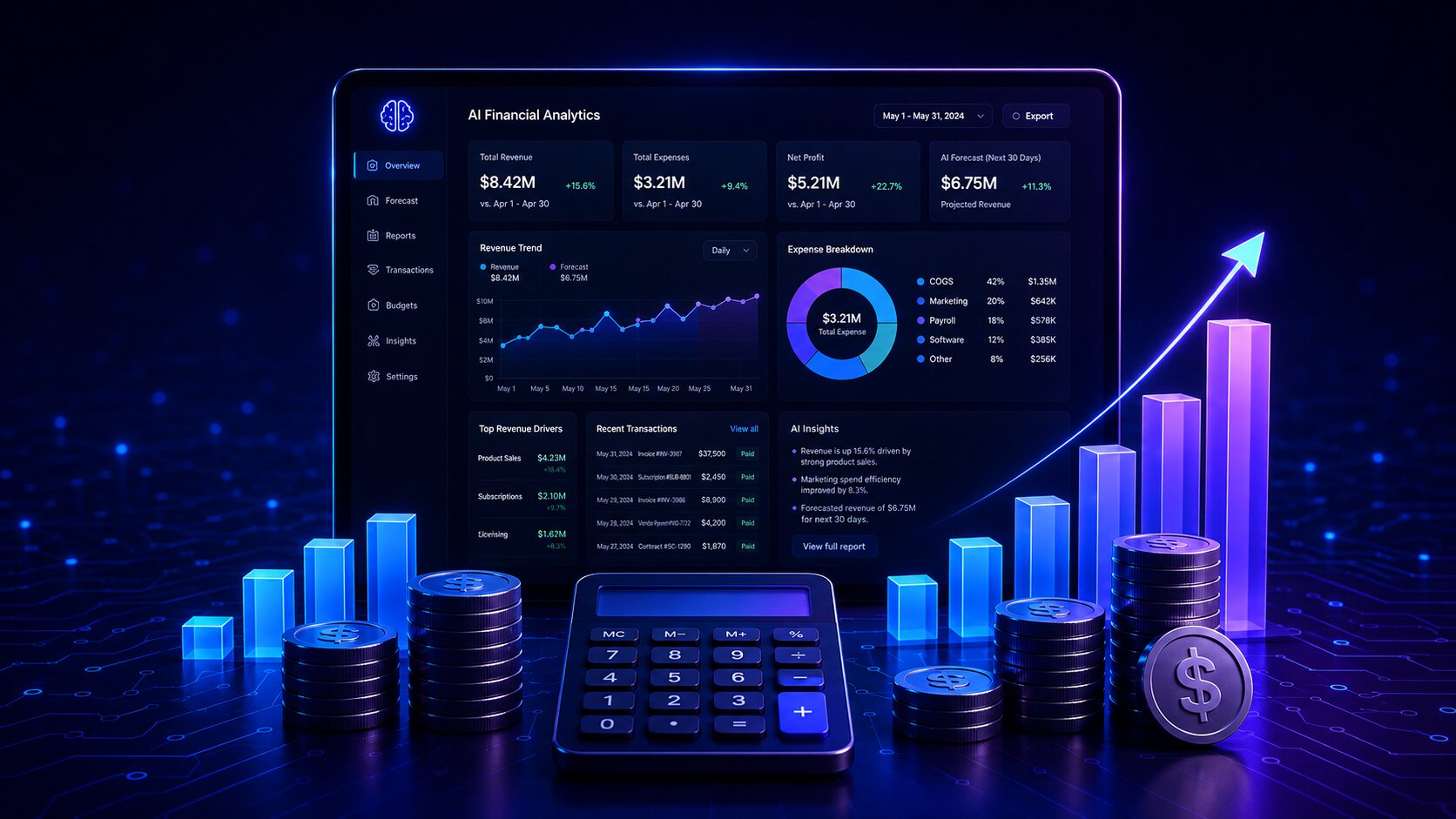
  • How Much Does It Cost to Develop an AI-Powered Application?

    How Much Does It Cost to Develop an AI-Powered Application?

    If you have searched “how much does it cost to develop an AI app”, you already know the answer feels like a moving target. One website quotes $20,000. Another jumps to half a million dollars. Neither is wrong. They are just answering different questions.

    The real answer depends on what you are building, how ready your data is, and how deep you want the AI to sit inside your business. This guide breaks down the actual AI app development cost in 2026, the AI development cost factors that move the number, and a simple framework you can use to estimate your own project before you talk to any vendor.

    Key Takeaways

    • AI app development cost typically falls between $40,000 and $400,000+, depending on complexity, data readiness, and scale.
    • AI agent development cost rises sharply once you add autonomous decision-making, multi-step workflows, and human-in-the-loop checkpoints.
    • Data preparation alone can eat up 15-40% of your budget.
    • AI chatbot development cost starts low with pre-built APIs but climbs fast once you add custom training, integrations, and compliance layers.
    • Hidden costs like model drift, monitoring, and legacy-system integration often double the “sticker price” businesses expect.
    • Choosing between in-house teams, offshore vendors, or an agent-first, human-in-the-loop approach changes your total cost of ownership more than any single technical decision.

    What Drives AI App Development Cost in 2026

    Most businesses want one number. But AI development cost is really a sum of several smaller decisions stacked together. Here is how the ranges typically break down.

    Project Tier Cost Range What It Usually Includes
    Entry-level AI $20,000 – $80,000 Chatbots, basic recommendation engines, pre-trained model integrations
    Mid-level AI $80,000 – $200,000 Custom AI assistants, predictive analytics dashboards, personalization engines
    Enterprise / Agentic AI $200,000 – $500,000+ Multi-agent systems, generative AI platforms, computer vision, full automation pipelines

    These figures line up closely across independent sources. Appinventiv places the overall AI development cost between $40,000 and $400,000+, while Coherent Solutions puts the broader market range at $20,000 to $500,000+ depending on project complexity.

    The overlap tells you something important: the cost of AI development is not random. It follows predictable patterns once you know what to measure.

    What Really Drives Up the Cost of AI Development

    Understanding the core AI app development cost factors helps you separate a fair quote from an inflated one. A content writer or a founder skimming three blogs will see the same five factors repeated everywhere. Here is what they actually mean for your budget.

    1. Data Readiness

    This is the single biggest lever. Businesses rarely start with clean, structured data. According to Coherent Solutions, data collection and preparation alone can account for 15-25% of total project cost, and roughly 96% of businesses begin without sufficient training data. Appinventiv puts this figure even higher, at 25-40% of the total artificial intelligence development cost, when manual labeling is required.

    If your data lives in scattered spreadsheets, expect this stage to stretch both your timeline and your custom AI development costs.

    2. Model Complexity and Approach

    You have three paths, and each has a different price tag:

    • Pre-trained models or APIs: fastest, cheapest, good for chatbots and simple automation.
    • Fine-tuning an existing model: moderate cost, more control, better fit for your business data.
    • Building from scratch: highest AI model development cost, reserved for genuinely novel problems.

    Most businesses in 2026 do not need to build from scratch. Fine-tuning gets you 80% of the value at a fraction of the cost.

    3. Infrastructure and Compute

    Once your app is live, every user interaction consumes compute. Generative AI systems, in particular, run on usage-based pricing rather than a one-time fee, which means the AI app development cost keeps growing after launch. A mid-sized NLP project on AWS, for instance, can run over $20,000 a month in infrastructure alone once you factor in GPU training instances, storage, and monitoring, based on Coherent Solutions’ cost modeling.

    4. Integration with Existing Systems

    An AI feature that does not talk to your CRM, ERP, or customer database is not very useful. Deeper integration means more engineering hours, which directly raises the AI agent development cost for anything beyond a standalone tool.

    5. Team Structure: In-House vs Outsourced

    This decision alone can swing your budget by 30-50%.

    Factor In-House Team Outsourced / Offshore Team
    Annual Cost $400,000+ for a small team, per Coherent Solutions 30-50% lower on average
    Hiring Speed Slow, competitive market Faster, ready-made teams
    Best For Long-term core AI products MVPs, pilots, scaling projects

    For most Indian and global businesses testing their first AI initiative, an experienced outsourced partner delivers a lower AI software development cost without sacrificing quality.

    AI Chatbot Development Cost: A Closer Look

    Since chatbots are the most common entry point into AI, they deserve their own breakdown. AI chatbot development cost depends heavily on how much customization you need.

    • Off-the-shelf chatbot platforms: $99 to $1,500 per month, according to Coherent Solutions, suitable for simple FAQ automation.
    • Custom-built chatbots: $20,000 to $80,000, when you need brand-specific tone, integrations, and proprietary training data.
    • Advanced conversational agents with memory and tool use: $80,000 to $250,000+, especially when the bot needs to take actions, not just answer questions.

    This is where the shift toward agentic AI development cost becomes visible. A chatbot that only answers questions is cheap. A chatbot that can check inventory, update a CRM record, or escalate to a human when confidence is low costs significantly more, but delivers far more business value.

    What Drives the Cost of AI App Development: The Hidden Layer

    The numbers above cover development. They rarely cover what happens after launch. This is where budgets quietly balloon.

    • Model drift: AI accuracy degrades as user behavior and data patterns shift, requiring periodic retraining.
    • Monitoring and observability: you need visibility into latency, error rates, and model performance, which means additional tooling.
    • Compliance and governance: data privacy regulations, audit logs, and bias checks are no longer optional for most industries.
    • Vendor lock-in: heavy reliance on third-party APIs can make switching providers expensive later.

    Appinventiv estimates that ongoing maintenance alone can account for 15-25% of the total cost of artificial intelligence annually. Plan for this from day one instead of discovering it six months post-launch.

    A Simple Framework to Estimate Your AI Development Cost

    Instead of guessing, walk through these questions in order:

    1. What problem are you solving? A single-task chatbot costs far less than a multi-workflow assistant.
    2. How ready is your data? Clean, centralized data significantly reduces both time and your AI software development costs.
    3. Which model strategy fits? APIs keep upfront cost low but add usage fees over time. Fine-tuning offers balance.
    4. How deep does integration need to go? Every connected system adds engineering hours.
    5. What is your expected scale? Higher usage volumes mean higher long-term infrastructure spend.

    Run your project through these five filters honestly, and you will arrive at a realistic AI app development cost before you ever request a formal quote.

    Why Agent-First, Human-in-the-Loop Changes the Math

    Most cost breakdowns online treat AI as either “fully automated” or “just a chatbot.” Neither framing fits how businesses actually operate in 2026. The smarter, and often more cost-efficient, approach is agent-first with human-in-the-loop design: AI agents handle repetitive decisions and workflows, while people stay in control of judgment calls, exceptions, and anything customer-facing that carries real risk.

    This model does not just reduce liability. It also controls cost, because you are not paying for full autonomous decision-making everywhere, only where it makes business sense. At Vectovate AI, this is the lens we apply to every AI engagement, whether it is a cost estimate conversation or a full build: start with the workflow, decide where agents add value, and keep humans anchored where accuracy and trust matter most.

    If you are still scoping your project, our AI development services page walks through how we structure engagements for Ahmedabad-based and global businesses alike, and our pricing and consultation process is built specifically to avoid the hidden-cost surprises covered above.

    Final Thoughts

    The honest answer to “how much does it cost to develop an AI app” is: it depends on scope, not on the technology itself. A simple chatbot can go live for under $50,000. An enterprise-grade agentic system with deep integrations can cross half a million dollars. What separates a smart AI investment from an expensive mistake is not the initial price tag. It is whether you planned for data readiness, infrastructure scaling, and human oversight from the start.

    Before you commit a budget, map your use case against the frameworks above. Then talk to a team that will tell you the real number, not just the number that closes the deal fastest.