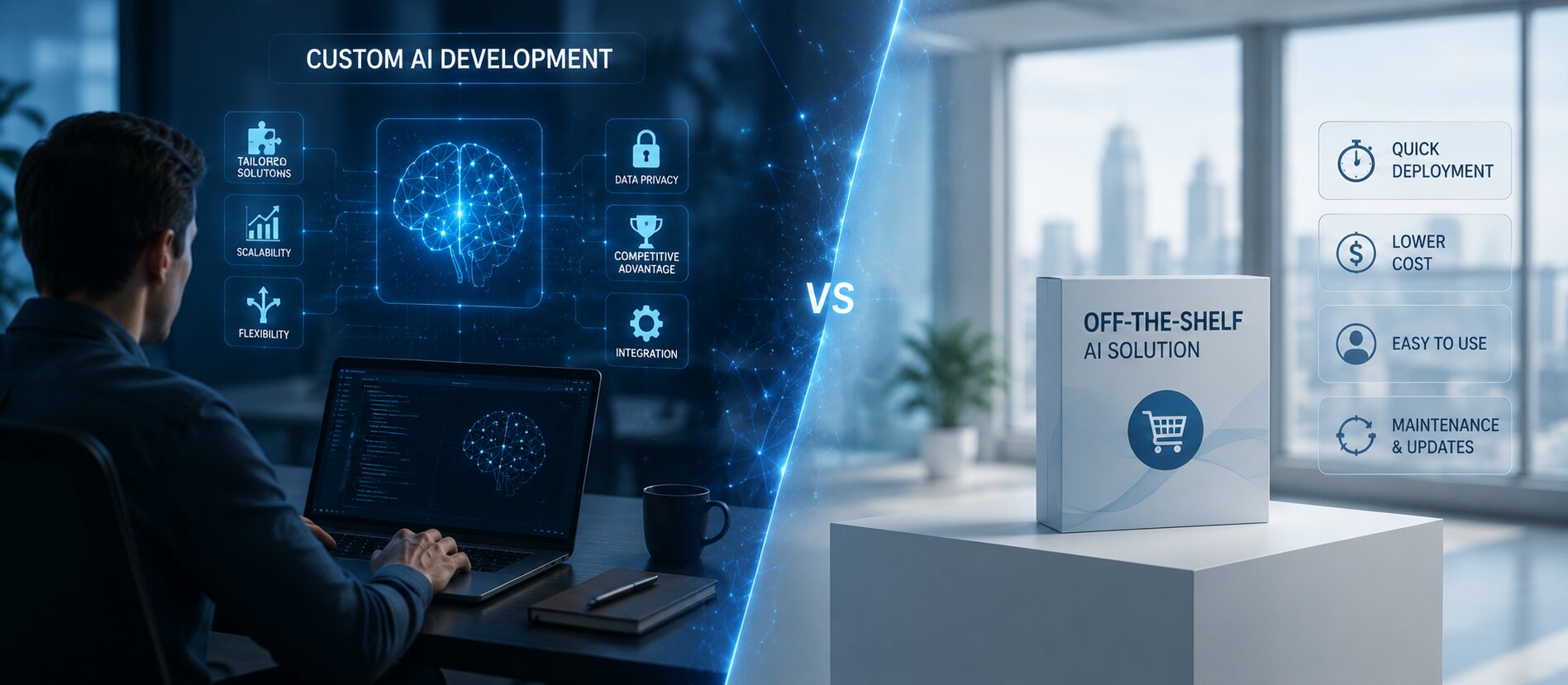
Every business evaluating AI today lands on the same fork in the road: buy a ready-made tool, or build something that’s genuinely yours. The debate around Custom AI Development vs Off-the-Shelf AI isn’t just a budget conversation; it’s a decision about how much control, differentiation, and long-term value you want from your AI investment.
As per McKinsey‘s 2025 State of AI report, only 5.5% of organizations are seeing real financial returns from their AI investments, underscoring how the difference between a generic tool and a system built for your workflow can directly decide whether AI pays off.
Another research study by Gartner predicts that at least 30% of generative AI projects will be abandoned after the proof-of-concept phase due to escalating costs and unclear business value. This happens because a generic tool was asked to do a job it was never architected for.
Key Takeaways:
- Off-the-shelf AI platforms are faster to deploy and cheaper upfront, but come with licensing lock-in and limited flexibility.
- Custom AI development services cost more initially but eliminate recurring “per-seat” fees and adapt to your exact workflows.
- AI as a Service (AIaaS) models sit in between, useful for quick pilots, risky for core business processes.
- The real cost isn’t the sticker price; it’s the Total Cost of Ownership (TCO) over 3-5 years.
- Hybrid approaches (custom orchestration layer + pre-built models) are becoming the 2026 standard for enterprises.
Custom AI Development vs Pre-Built Solutions: Key Differences Explained
Before picking a side, it helps to see the two approaches laid out against each other:
| Parameter | Off-the-Shelf AI Platforms | Custom AI Development |
|---|---|---|
| Time to deploy | Days to weeks | 2-6 months |
| Upfront cost | Low | Moderate to high |
| Ongoing cost | Subscription/per-seat fees compound over time | One-time build, lower recurring cost |
| Data ownership | Often shared with the vendor | Fully proprietary |
| Customization | Limited to the vendor’s roadmap | Built around your exact workflow |
| Scalability | Capped by the vendor’s architecture | Scales with your business logic |
| Vendor lock-in | High | None |
| Competitive edge | Same tool as competitors | Proprietary AI systems unique to you |
This table is the crux of the decision. Pre-built AI solutions win on speed. Custom AI development services win on ownership and long-term economics.

What Are Off-the-Shelf and White-Label AI Solutions?
Off-the-shelf AI platforms are pre-built, configurable products, think chatbot builders, generic recommendation engines, or AI software packages you can subscribe to and switch on within a day. Many vendors also offer white-label AI solutions, letting you rebrand a generic engine as your own product.
These work well when:
- You need to validate an AI use case quickly, without engineering overhead.
- Your requirement is generic (basic chat support, standard OCR, simple summarization).
- The budget for a dedicated build isn’t approved yet.
Where they fall short: the moment your workflow diverges from the vendor’s assumptions, you’re stuck submitting feature requests and waiting on someone else’s roadmap. And because many of these platforms operate as AI as a Service (AIaaS), your data and prompts often pass through third-party infrastructure, a governance concern for regulated industries like BFSI, healthcare, and legal.
What Is Custom AI Development?
Custom AI development means building proprietary AI systems designed specifically around your data, processes, and business rules, not a generic template with your logo on it. This includes custom LLM orchestration, fine-tuned models, agentic workflows, and integrations that sit natively inside your existing tech stack.
This route makes sense when:
- Your process is complex enough that no generic tool captures it (multi-step approvals, industry-specific compliance, proprietary data models).
- You need the AI to act, not just answer, inside your existing systems (an agentic layer that triggers actions, not just chat).
- Data sovereignty and IP ownership matter to your board or your regulators.
- You’re building AI as a genuine differentiator, not a checkbox feature.
The tradeoff is real: custom AI development services demand a longer runway and a more involved discovery phase.
Real-World Application: FinTech & Insurance Scenarios
Theory is easy to nod along to. It’s when you look at what these systems actually do inside regulated, high-stakes industries that the “custom vs off-the-shelf” question stops being academic.
Fraud Detection in FinTech’s Infrastructure
Off-the-shelf fraud tools are built to flag the fraud patterns everyone already knows about. They work from a shared, generic rulebook, which means every institution using the same platform is defending against yesterday’s threats in the same way.
A custom-built fraud detection layer, by contrast, is trained on your own transaction history, your customer behavior baselines, and your specific risk appetite. It can flag a subtle deviation, an unusual login location paired with an atypical transaction size, for instance, that a generic model would wave through because it doesn’t fit a pre-defined template.
For a bank or payments company, that difference isn’t cosmetic; it’s the gap between catching fraud in real time and explaining a loss after the fact.

Making a Big Difference in Insurance Claim Automation
Claims processing looks simple from the outside, submit a form, get a payout decision. In practice, it involves policy nuance, document verification, fraud checks, and regulatory sign-off, all stitched together differently by every insurer. An off-the-shelf claims tool forces your process to bend around its workflow.
A custom AI system does the opposite, it’s built around your claims logic, your document formats, and your compliance checkpoints, automating the repetitive 80% of a claim (data extraction, policy matching, initial validation) while routing genuinely ambiguous cases to a human adjuster. The result is faster claims turnaround without sacrificing the judgment calls that regulators and customers expect a human to make.
The Real Cost Comparison: Price vs. Value
A cheaper monthly subscription can quietly become the more expensive option.
Here’s a simplified 3-year cost lens:
| Cost Factor | Off-the-Shelf | Custom Build |
|---|---|---|
| Year 1 | Low license fee | Higher development investment |
| Year 2-3 | Fees scale with users/usage | Mostly maintenance, no per-seat tax |
| Switching cost | High (data migration, retraining teams) | Low (you own the architecture) |
| Feature requests | Vendor-dependent, often delayed | Built on your timeline |
This is where the “Maintenance Iceberg” conversation matters; the visible license fee is just the tip. Below the surface sit integration costs, data migration risk, and the compounding technical debt of stitching multiple SaaS tools together instead of one coherent system.
Governance, Technical Debt, and the TCO Question
Enterprises evaluating AI in 2026 are asking sharper questions than “what does it cost per month.” They’re asking about Total Cost of Ownership, model governance, and audit trails, what’s increasingly called “Governance-as-Code.” Off-the-shelf tools rarely expose this level of control. Custom builds bake governance into the architecture from day one, which matters enormously once regulators or enterprise clients start asking how your AI makes decisions.

Model Drift and Architectural Drift: The Silent Risk Nobody Budgets For
- AI models don’t stay still. When you depend on a third-party commercial model, you’re depending on something you don’t control the evolution of.
- Vendors push updates, retrain underlying weights, adjust safety filters, or deprecate versions, and your integration inherits every one of those changes whether you asked for them or not. This is model drift.
- Its quieter cousin is data lineage decay, where the path your data takes through a system becomes harder to trace as upstream components change beneath you.
- The practical risk: a prompt that works flawlessly in January might yield degraded, incorrect, or subtly different outputs by July, not because your team changed anything, but because the third-party provider quietly adjusted the model framework underneath it.
- There’s no changelog, no versioning control, and often no warning. For a regulated business, this becomes an audit trail problem, since you can no longer point to exactly which model version produced which decision.
- With custom AI architectures, your engineering team retains absolute control over versioning, prompt registries, and data lineage pipelines.
- Model updates happen on your schedule, against your test suite, with full visibility into what changed and why.
- This ensures predictability and shields your operations from unexpected system performance drops, precisely the kind of stability regulators, auditors, and enterprise clients expect.
Industry research from firms like Gartner and McKinsey consistently points to the same pattern: organizations that treat AI as strategic infrastructure see materially better ROI over a 3-year horizon, because they aren’t paying the compounding cost of vendor dependency.
So, Which One Should You Choose?
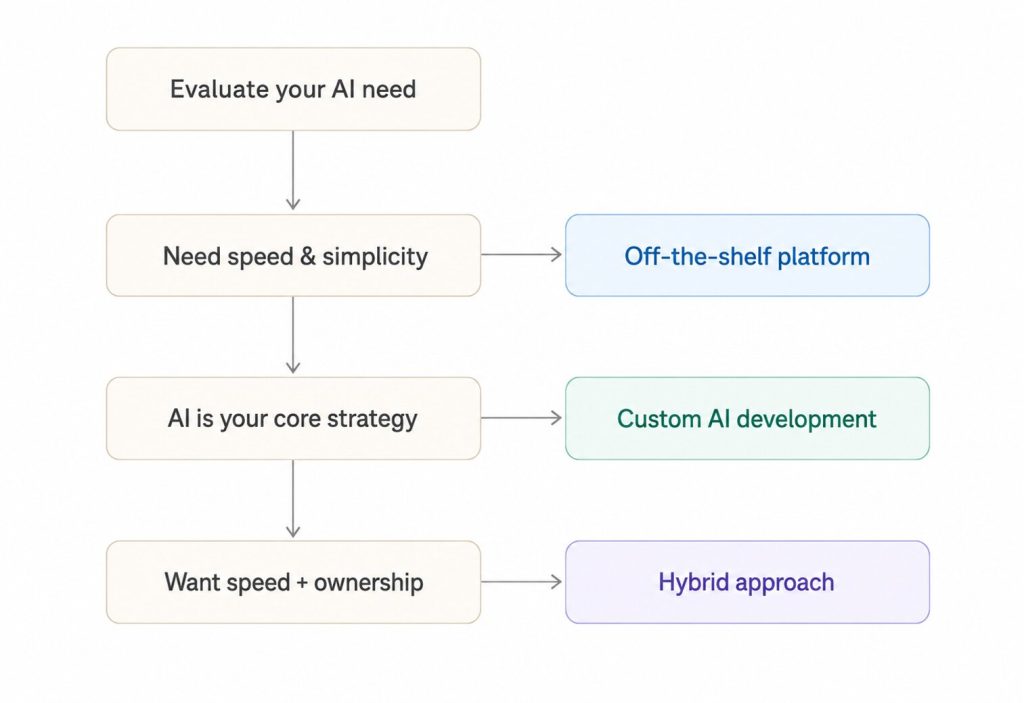
A simple way to decide:
- Choose off-the-shelf if you need speed, your use case is generic, and you’re testing a hypothesis before committing a budget.
- Choose custom AI development if AI is core to your competitive strategy, your workflows are unique, or data ownership and compliance are non-negotiable.
- Choose a hybrid, pre-built model wrapped in a custom orchestration and agent layer if you want the best of both: proven model quality with a system that’s genuinely yours.
Why VectovateAI As Your Custom AI Development Company?
This is exactly where VectovateAI, a custom AI Development Company, positions itself differently. Instead of a one-size-fits-all product or a purely off-the-shelf integration, VectovateAI builds agent-first, human-in-the-loop AI systems, proprietary architectures that combine the reliability of proven models with workflows engineered specifically around your business.
Backed by Ahmedabad’s growing software engineering talent pool, VectovateAI brings enterprise-grade technical rigor without enterprise-consultancy overhead, helping businesses move past the “buy vs. build” debate entirely, toward AI that’s genuinely theirs.
Final Word
There’s no universal winner between custom AI development and off-the-shelf AI platforms, only a better fit for your specific stage, budget, and complexity. Early-stage or low-stakes use cases can lean on AIaaS and white-label AI solutions. But if your data is proprietary, your workflows are complex, or AI sits at the center of your competitive strategy, a custom AI development company will outperform any pre-built AI solution within the first year and keep compounding from there.
Looking to build AI that’s actually yours?
Talk to VectovateAI about a custom AI development roadmap built around your workflows.