
Your team still spends hours every week on tasks a computer could finish in minutes:
- Reconciling invoices
- Routing tickets
- Chasing approvals
Traditional automation helped, but it only followed rules you wrote for it. AI agents do something different. They observe, decide, and act on their own, adjusting as conditions change rather than breaking when something unexpected happens.
For business owners and IT decision-makers, this isn’t a future concept anymore. It’s already running inside banks, hospitals, and manufacturing floors, cutting costs by double digits and freeing teams for higher-value work.
This blog covers what’s actually driving this shift and how to think about it before you invest.
Key Takeaways
- AI agents observe, plan, and act with minimal human oversight, unlike traditional software that only follows fixed rules.
- The market for AI agents is projected to grow at a 45% CAGR over the next five years, according to BCG.
- Agentic process automation can push autonomous operations from 20 to 30% of processes up to 50% or more, per Automation Anywhere.
- Real deployments are already showing results: one bank cut customer service costs by 10x using AI agents, and a global retailer saved more than $2 million annually.
- Success depends on data readiness and human oversight, not just picking the flashiest agent platform.
What Are AI Agents?
AI agents are software systems that use AI models and tools to accomplish goals with minimal human input. Unlike a chatbot that just answers a question, an agent can remember context across tasks, decide when to pull data from your systems, and take action on your behalf. Think of it less like a tool and more like a digital teammate that works through a process the way a person would, just faster and without needing sleep.
An autonomous AI agent doesn’t wait for instructions, it notices a problem, figures out what to do about it, and does it, checking in with a human only when the stakes are high enough to need one.
AI Agents vs Generative AI: What’s the Difference?
This is one of the most common points of confusion, so let’s clear it up directly.
| Confusion Points | Generative AI | Agentic AI |
|---|---|---|
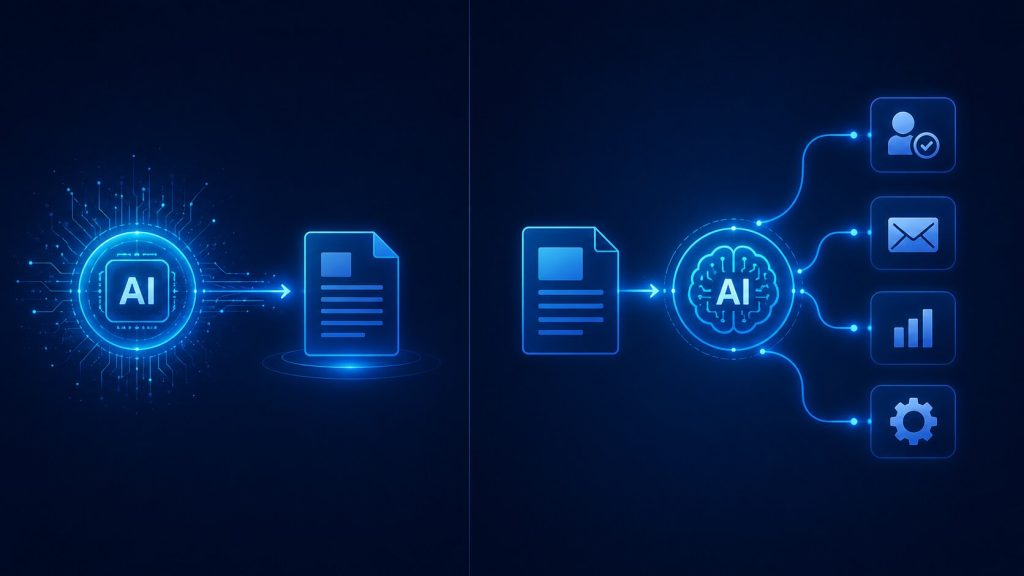
| What it does | Generates content, text, images, and code on request | Plans and executes multi-step tasks autonomously |
| How it works | Responds once per prompt | Observes, plans, acts, and adapts in a continuous loop |
| Memory | Typically stateless per conversation | Retains context across tasks and time |
| Decision-making | None, it produces output, you decide what to do with it | Makes decisions and takes action within defined guardrails |
| Best for | Drafting, summarizing, ideation | Running workflows: approvals, reconciliation, reporting, orchestration |
Put simply: generative AI writes the email. An AI agent decides the email needs to be written, drafts it, checks it against your policy, and sends it once approved. That distinction is the entire reason agentic AI vs generative AI searches have spiked this year.
Businesses have moved past experimenting with chatbots and are now asking what it takes to automate actual decisions, something our AI agent development team gets asked constantly.
How Do AI Agents Actually Work?
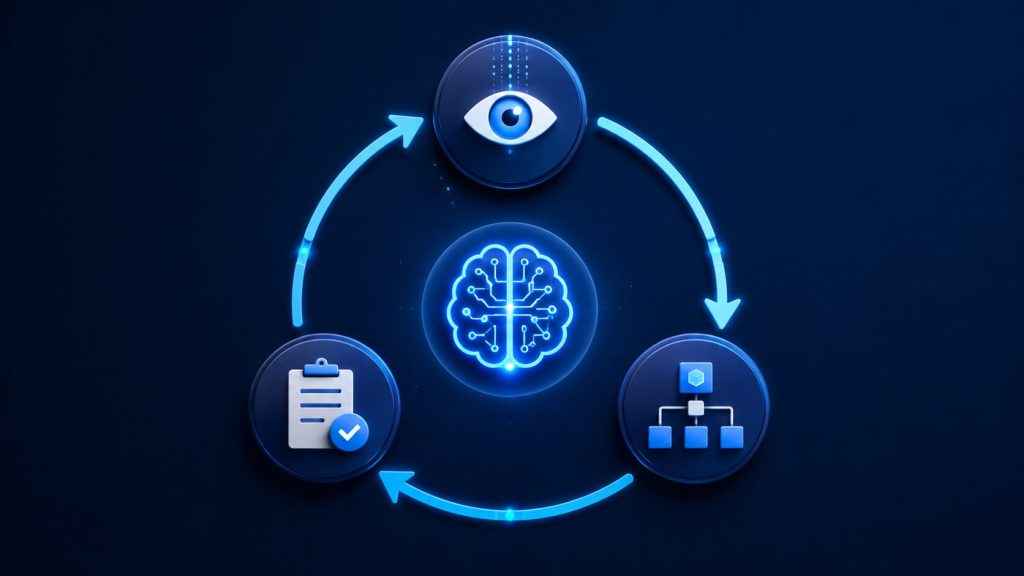
Every AI agent runs on a repeating cycle, sometimes called observe-plan-act:
- Observe: The agent collects information from its environment, user inputs, system data, past interactions, and holds that in memory.
- Plan: Using a language model, it evaluates options and decides the best next step based on its goal and the context it has gathered.
- Act: It executes the task by connecting to enterprise systems, CRMs, ERPs, databases, or by delegating to another agent.
This loop is self-reinforcing. Each cycle, the agent learns from what happened last time and gets more efficient. That’s fundamentally different from older rule-based automation, which just repeats the same steps regardless of what’s changed around it.
Types of AI Agents in the Enterprise
Not every agent does the same job. Enterprises typically deploy four broad categories:
- Conversational agents: Handle employee or customer inquiries with fast, accurate responses.
- Task automation agents: Execute structured, repetitive processes like payroll runs or invoice validation.
- Intelligent process agents: Analyze large datasets to recommend actions, useful for financial forecasting or marketing optimization.
- Autonomous AI agents: Manage end-to-end workflows with minimal human input, adapting as conditions shift. These are the most advanced categories, capable of owning a process from start to finish without a person triggering each step.
Most organizations start with the first two, then graduate to autonomous agents once trust and governance are in place, a progression that mirrors what we see across our AI/ML development engagements.
Why AI Automation Is Different From Traditional RPA
AI automation uses AI models, machine learning, NLP, and predictive analytics to complete business tasks without a human manually triggering each step. If you’ve used robotic process automation (RPA) before, you already know its limitation: it breaks the moment a screen layout changes or an input doesn’t match the expected format.
AI automation solves this by combining machine learning, natural language processing, and predictive analytics, so the system adapts instead of failing.
This is the core idea behind AI business process automation. Instead of scripting every possible scenario, you give the agent a goal and let it figure out the path, correcting itself along the way. That’s a meaningful shift for enterprise AI automation strategy, because it means fewer maintenance headaches and far less brittle automation than the RPA bots most IT teams are used to babysitting.
Do You Need AI Automation Services, or Can You Build In-House?
Most enterprises don’t have a team of agent engineers sitting idle, and that’s exactly why demand for AI automation services has grown so fast. Building an agent that reliably connects to your ERP, respects compliance rules, and knows when to escalate to a human isn’t a weekend project. It requires the same senior-architect oversight you’d expect from any production system.
That’s the gap external AI automation services fill: they bring the integration experience, the governance frameworks, and the pattern library from having done this before, so you’re not debugging agent failures in production. If you’re weighing build versus buy, our AI integration team can map out which processes are worth building in-house and which are faster to bring in expert help for.
Real Business Impact: The Numbers Behind the Hype
Skeptics are right to ask if agentic AI is just another buzzword. The data says otherwise.
- A leading global bank used AI agents to interface with customers, cutting service costs by 10x.
- A major U.S. retailer used AI agents for accounts payable and customer service, saving more than $2 million annually and dropping average call times to 85 seconds.
- One energy company used generative AI-embedded agents to uncover $120 million in tax savings in just three weeks.
- A healthcare provider automated billing and processed nearly $1 billion annually while saving 25,000 staff hours a year.
These aren’t hypothetical projections. Our own supply chain AI orchestration case study shows a similar pattern: a 60% reduction in operational costs once agentic workflows replaced manual coordination.
Agentic AI use cases are already delivering measurable results across industries, check out our other case studies to understand them better.
Each use case follows the same underlying pattern: replace a manual, repetitive decision with an agent that can make that decision reliably and explain why.
What Makes a Good AI Agent Builder or Platform?
If you’re evaluating an AI agent builder, ask these questions before committing:
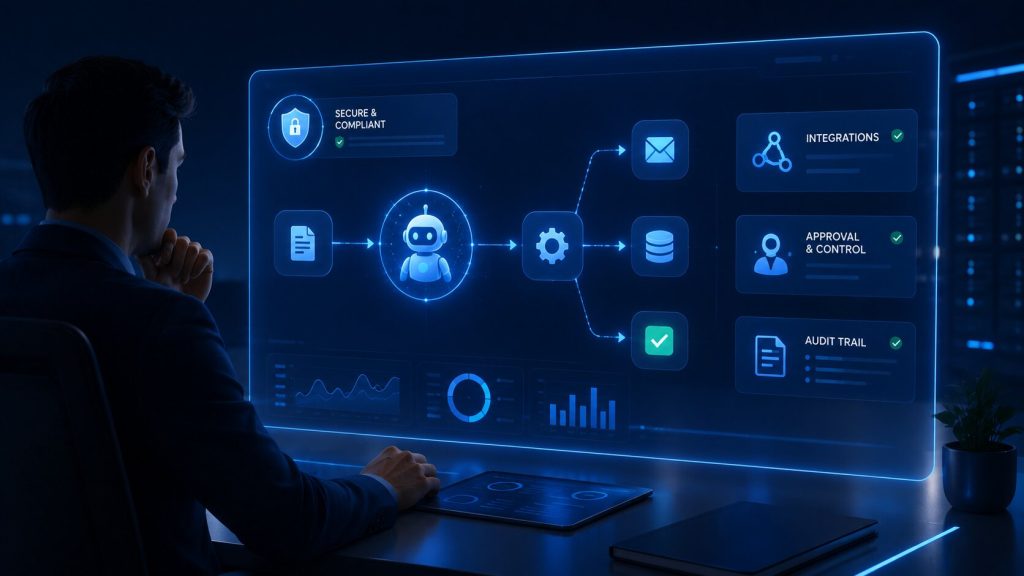
- Does it integrate with your existing systems? ERP, CRM, and HCM integration determines whether the agent actually works across your business or stays stuck in a silo.
- Can it operate across departments, not just inside one app? Siloed AI tools often improve a single team’s efficiency by a few percentage points while barely moving the needle company-wide.
- Does it support human-in-the-loop review for high-stakes decisions? Full autonomy isn’t the goal on day one, trustworthy autonomy is.
- Is it built with security and compliance in mind? Look for role-based access, encryption, and audit logging, especially in regulated industries.
- Can it scale from task automation to full workflow ownership? The best platforms let you start small and expand agent authority as trust builds.
If you’d rather have this mapped against your own systems than guess, our AI strategy & consulting team can walk through what a phased rollout would look like for your business.
Are Agentic AI Companies the Future of Enterprise Software?
The direction of travel is clear. BCG projects the AI agent market will grow at a 45% CAGR over the next five years, and nearly three-quarters of CEOs now consider themselves their company’s chief decision maker on AI investment. Agentic AI companies are no longer a niche category, they’re becoming the default layer enterprises build on top of, replacing large teams of people with smaller teams working alongside multiple types of agents.
That said, autonomy doesn’t mean unsupervised. Supervising AI agents is becoming a core management skill in its own right, and the enterprises getting this right are training employees in responsible AI oversight, not just deploying agents and walking away.
Final Words
AI agents represent the biggest shift in enterprise software since the move to the cloud. They don’t just execute rules, they observe, plan, and act, adapting as your business changes around them. But the companies seeing real ROI aren’t the ones chasing full autonomy on day one. They’re starting with high-impact, well-defined use cases, keeping humans in the loop on high-stakes decisions, and scaling agent authority as trust builds.
Leave a Reply