
Real estate has always run on data. Prices, locations, demand cycles, and buyer intent all feed into every deal. For decades, agents and appraisers processed this data manually. That approach is now changing fast. AI in real estate is replacing guesswork with precision at every stage of the property lifecycle.
This shift touches three core areas. Property search is getting smarter. Property valuation is becoming faster and more accurate. Investment decisions now rely on predictive models, not gut feel. Together, these changes are reshaping how buyers, investors, and developers operate.
Key Takeaways
- AI-powered platforms can cut real estate operational costs by up to 15%.
- Automated valuation models reduce pricing errors and speed up appraisals significantly.
- McKinsey estimates AI could unlock $430–550 billion in real estate value.
- 86% of investors call big data analytics essential for spotting opportunities.
- Agentic AI works best paired with human judgment, not in isolation.
Why AI is Transforming Real Estate: Smart Insights & Better Decisions
Real estate decisions used to depend on limited, backward-looking data. Buyers browsed listings manually. Appraisers judged value using recent comparable sales. Investors relied heavily on instinct and experience.
That model created real problems. Search results felt generic and disconnected from intent. Valuations varied between appraisers, causing pricing disputes. Investment choices carried more risk than necessary.
AI solves these problems by processing far more data, far faster. Machine learning models scan transaction histories, demographics, and market signals instantly. The result is sharper property market analysis and fewer costly mistakes.
McKinsey’s research puts real numbers behind this shift. Analysts estimate AI could unlock $430 billion to $550 billion in value across the real estate value chain. That potential is driving urgency, not just curiosity, across the industry.
AI in Property Search: From Filters to Intent
Traditional property search relied on static filters. Buyers set a budget, a location, and a bedroom count. The system returned everything that matched, regardless of true fit.
This created search fatigue. Buyers scrolled through dozens of irrelevant listings. Agents spent hours qualifying leads that never converted. Time was lost on both sides of the transaction.
AI-powered recommendation engines fix this bottleneck directly. They analyze browsing behavior, budget patterns, and past interactions continuously. Results adapt in real time as preferences shift.
A simplified view of how this works:
Buyer Activity → AI Behavior Engine → Intent Scoring → Ranked Listings → Faster Conversion
The impact is measurable. According to PwC, over half of real estate firms already use AI to improve customer search experiences. Listings using AI-enhanced visuals also see notably higher engagement than standard listings.
For buyers, this means less scrolling and more relevant options. For agencies, it means qualified leads and shorter sales cycles.

AI Property Valuation: Accurate, Automated, and Fast
Property valuation has long been a pain point. Manual appraisal depends on individual judgment. Two appraisers can value the same home differently, based on subjective interpretation.
This inconsistency creates friction. Buyers risk overpaying. Sellers risk undervaluing their assets. Lenders face uncertainty when underwriting loans against unclear pricing.
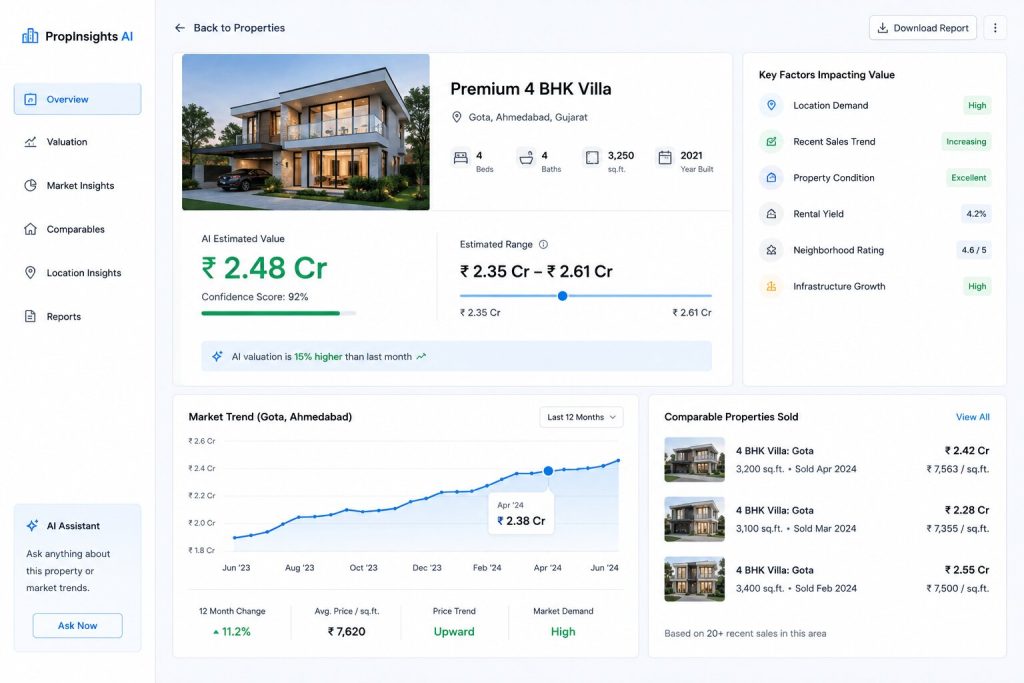
AI property valuation solves this through data, not opinion. Automated property appraisal tools analyze historical sales, location trends, and property specifications together. They also factor in rental yield, demand signals, and neighborhood momentum.
| Valuation Factor | Traditional Appraisal | AI Property Valuation |
|---|---|---|
| Speed: | Days to weeks | Minutes to hours |
| Data scope: | Limited comparables | Thousands of data points |
| Consistency: | Varies by appraiser | Standardized across properties |
| Bias risk: | Subjective judgment | Data-driven scoring |
| Update frequency: | Manual, periodic | Real-time or near real-time |
Comparative market analysis (CMA) AI tools take this further. They automatically pull recent comparable sales and price movements. This gives brokers a defensible, data-backed number in minutes, not days.
Home value estimation AI has also matured for everyday buyers. Public-facing tools now offer instant ballpark valuations before a formal appraisal begins. McKinsey research suggests AI-driven valuation approaches can meaningfully cut pricing errors across markets.
The outcome benefits everyone in the transaction. Buyers get transparent pricing. Sellers get realistic expectations. Lenders get more reliable collateral data.
Industry estimates suggest AI-led optimization can reduce operational costs by 15%. Those savings compound across marketing, sales, and property management functions combined. Faster, more consistent valuations directly support that broader cost reduction.
Automated property appraisal also reduces disputes during negotiations. When both parties trust the number, deals close faster. Fewer renegotiations mean lower transaction costs for everyone involved.
Real Estate Price Prediction and Property Market Analysis
Investment decisions carry real financial risk. Investors traditionally leaned on historical averages and personal intuition. Markets move faster than intuition can track.
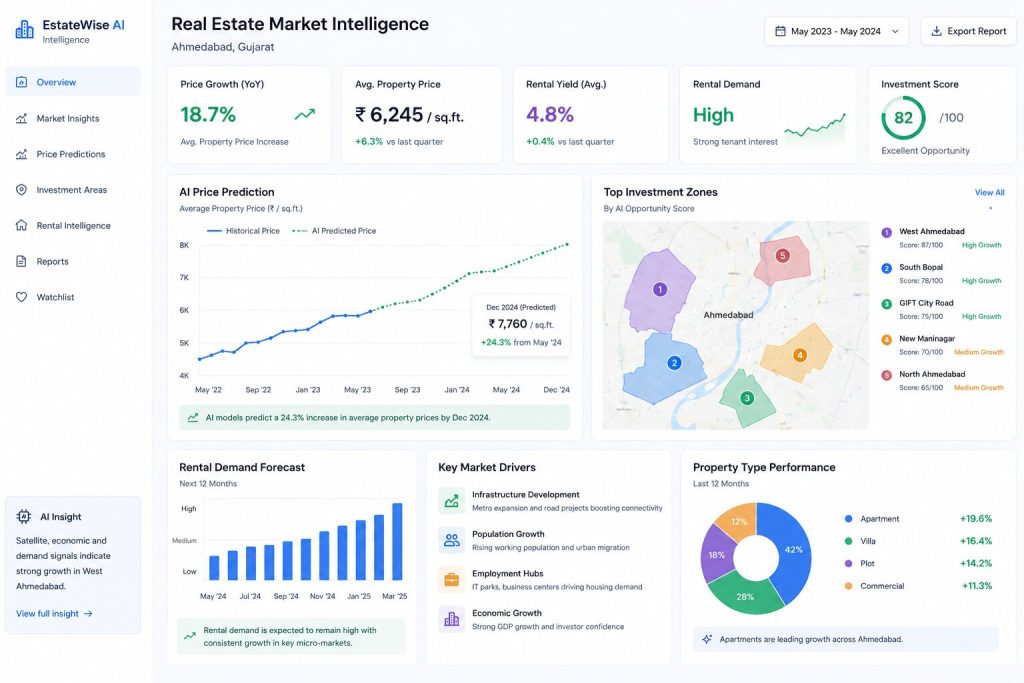
Big data analytics is changing that equation directly. Predictive models now study price cycles, rental demand, and vacancy risk together. They factor in infrastructure development and demographic shifts too.
Property value forecasting uses these signals to project future performance. Instead of looking backward, investors get a forward-looking view of returns. This shifts strategy from reactive to proactive.
| Forecasting Input | What It Reveals |
|---|---|
| Historical transaction data | Long-term price appreciation patterns |
| Rental demand trends | Yield stability and vacancy risk |
| Infrastructure pipelines | Future growth corridors |
| Economic indicators | Macro-level market timing signals |
| Demographic shifts | Emerging buyer and tenant demand |
Real estate price prediction models can identify high-potential locations early. One well-known example, the “Starbucks Effect,” showed homes near new cafes appreciating faster. AI systems now detect similar micro-patterns at scale.
According to MRI Software, 86% of investors consider big data analytics essential for spotting opportunities. Market trend models can also forecast pricing shifts with strong accuracy. This gives investors a measurable edge over instinct-based strategies.
Risk assessment improves alongside opportunity detection. AI models flag downturn signals well before traditional indicators react. Investors can rebalance portfolios early, protecting capital during volatile market cycles.
Property management also benefits from this same predictive layer. Portfolio owners track occupancy, rent rolls, and maintenance costs together. One connected dashboard replaces scattered spreadsheets and manual reconciliation work.
Retention improves too, once tenant preferences get factored into decisions. Data-driven property management can lift tenant retention by roughly 25%. That single metric meaningfully improves long-term rental income stability.
The Agent-First, Human-in-the-Loop Advantage
Many real estate platforms treat AI as a single tool. A chatbot here, a pricing widget there. This piecemeal approach limits real impact.
Genuine transformation comes from coordinated AI agents working across a full workflow. McKinsey’s research frames this as moving from isolated tools to true domain transformation. Leasing, valuation, and investment analysis work best when connected.
Full automation without oversight, though, creates its own risks. Erroneous or unclean data can lead AI agents to flawed conclusions quickly. Human review remains essential for judgment calls and edge cases.
This is why an agent-first, human-in-the-loop model works best. AI agents handle data aggregation, scoring, and pattern detection at scale. Human experts validate outcomes, manage exceptions, and maintain client trust.
Buyers still want empathy during high-stakes decisions. Investors still want a second opinion before committing capital. AI accelerates the process; people still own the outcome.
Ahmedabad’s Software Engineering Edge in PropTech
India’s technology hubs are increasingly shaping global PropTech innovation. Ahmedabad, in particular, has built a strong reputation for disciplined software engineering. Teams here combine AI expertise with real estate domain knowledge.
This matters because generic AI tools rarely fit real estate workflows precisely. Property transactions involve compliance, documentation, and long sales cycles. Software built specifically for this domain performs better.
Ahmedabad-based engineering teams bring senior-level talent to these builds. They understand global compliance standards like SOC2, GDPR, and PCI-DSS. That combination of technical depth and domain focus is a genuine competitive advantage.
Reach VectovateAI for Real Estate Development Management Software
If your business needs AI-native real estate software, VectovateAI can help. We build systems purpose-built for developers, brokers, and property management firms.
Our real estate development management software centralizes lead generation and sales pipelines. It automates follow-ups, booking, and secure payment processing end-to-end. Everything runs through one connected, transparent platform.
We also build adaptive CRMs, automated property management tools, and predictive analytics systems. Every solution combines deep AI integration with strict regulatory compliance. Your data stays isolated and is never used to train public models.
Our team operates from Ahmedabad with senior engineers working across global time zones. We follow an agile partnership model, a milestone-driven process from discovery through ongoing support. One client saw a 60% increase in deal closures after deployment.
Ready to modernize your property search, valuation, or investment platform? Schedule a technical deep-dive with VectovateAI and start building your AI advantage today.
Conclusion
AI in real estate is no longer optional or experimental. It is becoming the operating foundation for search, valuation, and investment. Businesses that adopt it early will capture a measurable edge.
The winners will not be those with the flashiest AI demos. They will be firms that combine strong data, capable agents, and human judgment. That balance defines the future of real estate.
Leave a Reply