Category: AI Engineering

  • How Agentic AI is Solving the 2026 Logistics Crisis in Food & Beverage

    How Agentic AI is Solving the 2026 Logistics Crisis in Food & Beverage

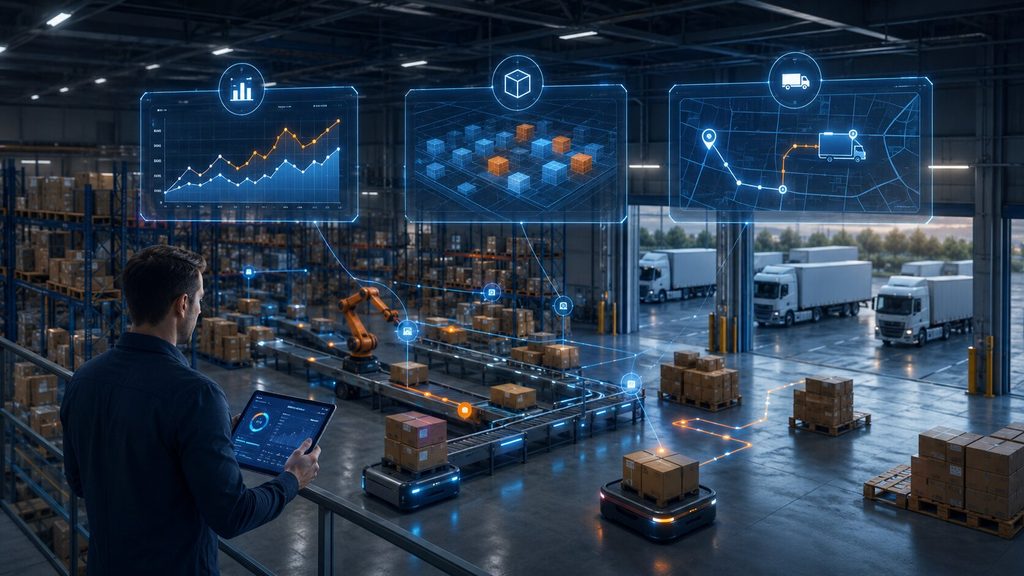
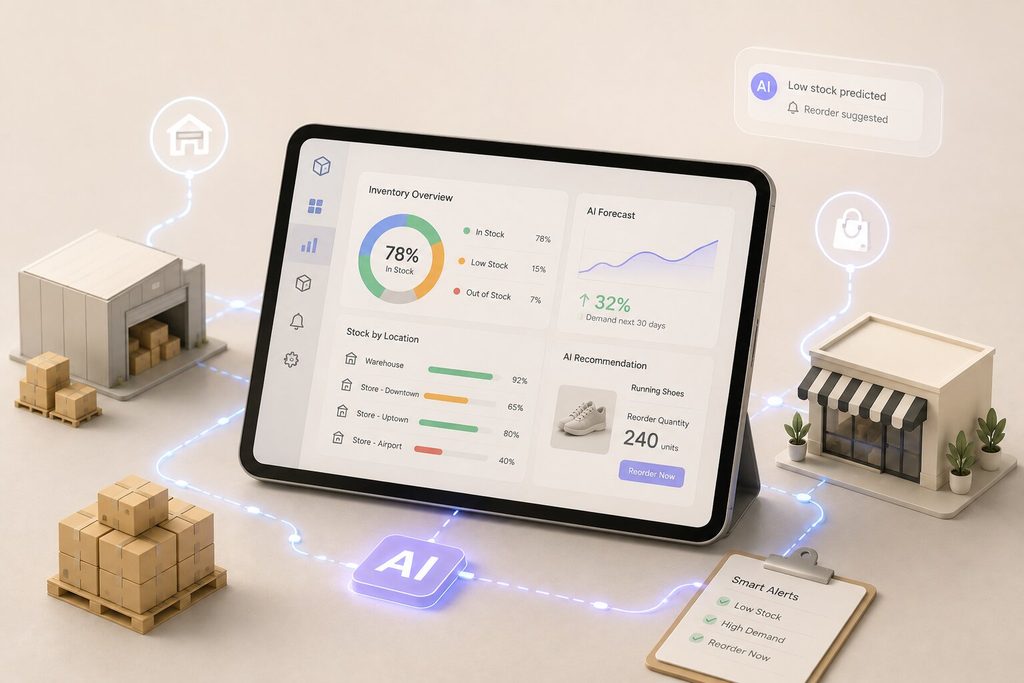
    Food and beverage supply chains are breaking under pressure. Spoilage, delayed shipments, and manual coordination are costing manufacturers millions every year. AI in food supply chains is now the fastest way to fix this crisis, and 2026 is the year it stops being optional. Enterprises are moving from experimental pilots to full deployment, and the numbers prove why.

    Key Takeaways

    • The agentic AI in the supply chain segment is valued at $8.67 billion in 2025 and is projected to hit $16.84 billion by 2030, growing at roughly 14.2% CAGR.
    • Early deployments show 30 to 50% reductions in manual workload and 80 to 90% reductions in scheduling effort, as per the AWS article.
    • Food & beverage manufacturing AI solutions already hold over 30% of the FMCG generative AI market, the largest of any sub-vertical.
    • AI-powered forecasting cuts supply chain errors by 20 to 50%, which translates into a 65% drop in lost sales from stockouts.
    • Gartner projects that half of all cross-functional supply chain solutions will run on intelligent agents by 2030, up from under 5% in 2025.

    Why Is Food & Beverage Logistics in Crisis Right Now?

    Perishability makes food logistics unforgiving. A two-hour delay in a cold chain can ruin an entire truckload. Rising fuel costs, labour shortages, and unpredictable demand spikes are stacking up on manufacturers already running on thin margins.

    Most F&B companies still depend on manual coordination. Someone calls the carrier. Someone else checks the warehouse system. A third person updates the retailer. This chain of manual steps is exactly where inefficiency hides, and it is why AI in food and beverage industry operations is shifting from a nice-to-have to a survival tool.

    Traditional automation cannot fix this. It only follows fixed rules. When a shipment gets delayed, rule-based systems simply escalate the problem to a human. They do not investigate, they do not decide, and they do not act. That is where Agentic AI in logistics changes the game entirely.

    What Is Agentic AI in Supply Chain?

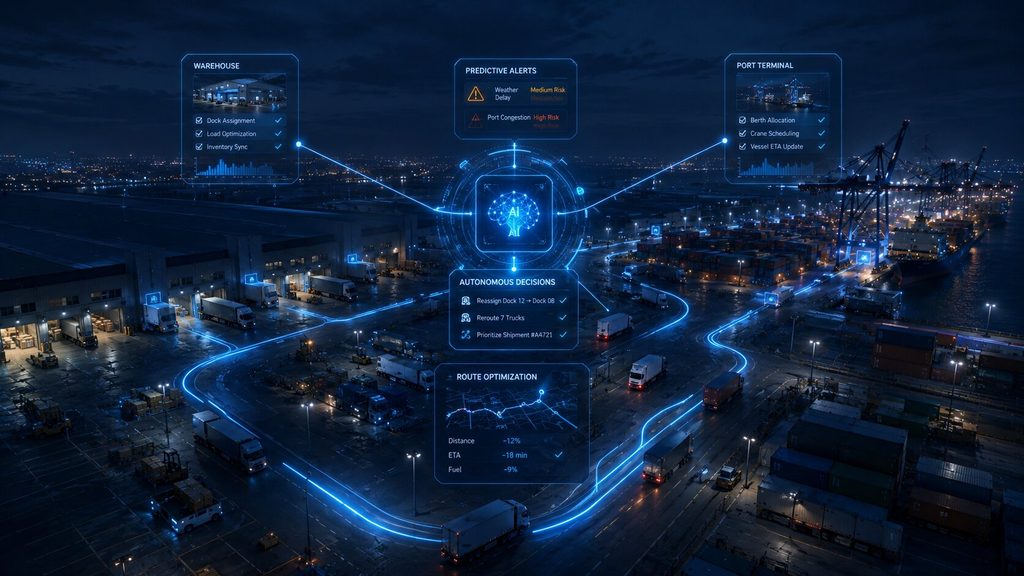
    Agentic AI in supply chain operations refers to systems that sense, plan, act, and learn continuously, without waiting for a human trigger. Instead of just flagging a problem, these AI agents evaluate options and take corrective action on their own.

    Think of it as the difference between a smoke alarm and a firefighter. A smoke alarm only alerts you. A firefighter assesses the situation and acts. Agentic AI in food supply chains behaves like the firefighter. It reroutes shipments, re-tenders loads to alternate carriers, and updates stakeholders automatically, all within pre-approved guardrails.

    Here is how agentic AI differs from the legacy automation most F&B plants still use today.

    Dimension Traditional Automation Agentic AI
    Decision logic Fixed if/then rules Continuous sense-plan-act-learn loop
    Data handling Structured data only Structured plus unstructured (emails, sensor feeds, voice)
    Exception response Escalates to a human, waits Investigates and acts autonomously
    Cold chain monitoring Manual temperature checks Real-time sensor-driven correction
    Scalability Needs more staff as volume grows Handles complexity without added headcount

    Advantages of AI in Cold Chain Logistics

    Cold chain is where food and beverage logistics gets the most unforgiving. One temperature breach can spoil an entire shipment of dairy, seafood, or ready-to-eat meals. This is where the advantages of AI in cold chain logistics become impossible to ignore.

    • Predictive spoilage alerts. AI agents analyze temperature, humidity, and route data to flag risk before spoilage happens, not after.
    • Autonomous rerouting. When a delay is detected, agents evaluate alternate routes and reassign shipments without waiting for manual approval.
    • Reduced expedite costs. AWS ProServe and A*STAR demonstrated 3-5% savings in expedite-related logistics spend through agent-driven inventory and order orchestration.
    • Continuous carrier coordination. Agents automatically follow up with carriers, cutting communication overhead by more than 70% in some deployments.
    • Sustainability gains. Optimized routing reduces fuel use and emissions per delivery, which matters for F&B brands under pressure to report sustainability metrics.

    For a mid-sized dairy or beverage manufacturer, these advantages compound quickly. Fewer spoiled shipments mean fewer retailer penalties. Fewer manual interventions mean planners can focus on strategy instead of firefighting.

    AI Sensors for Food and Beverage Manufacturing: The Plant-Floor Layer

    Logistics does not start at the loading dock; it starts on the factory floor. AI sensors for food and beverage manufacturing are now feeding real-time data directly into agentic systems, closing the loop between production and delivery.

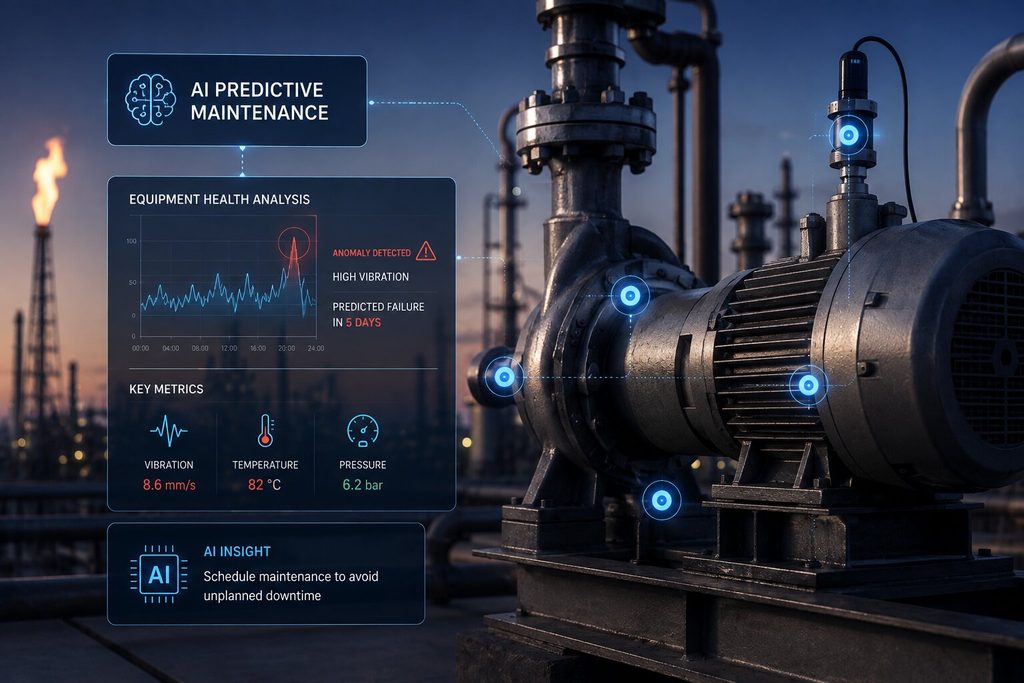
    Sensors track equipment vibration, temperature drift, and packaging line speed. When a sensor detects an anomaly, an AI agent does not just log it. It cross-references maintenance history, predicts the failure window, and automatically schedules a technician. This is what AI-driven maintenance analytics for F&B plants actually looks like in practice, and it prevents the kind of unplanned downtime that ripples straight into missed delivery windows.

    The connection matters because a five-minute delay at the packaging line can cascade into a missed truck slot, which in turn leads to a missed delivery window and a lost retailer relationship. Agentic systems catch this chain reaction at the source instead of reacting to it downstream.

    Tired of cold-chain spoilage and manual logistics firefighting?

    Move from reactive tracking to autonomous execution with an enterprise agentic pipeline tailored to your existing ERP/WMS.

    Book a Free AI Logistics Architecture Review with VectovateAI
    Agentic AI in Logistics: Where It Delivers Value Today

    Enterprises are not waiting for a perfect system. They are deploying agentic AI in specific, high-friction areas first.

    • Carrier follow-ups become continuous. Agents extract shipment updates from emails and documents in real time, rather than teams chasing down confirmations manually.
    • Scheduling moves to the background. AI agents manage appointments and reschedules dynamically, cutting scheduling workload by 80 to 90% in early deployments.
    • Delay detection becomes predictive. Instead of reporting a delay after it occurs, agents investigate the cause and take corrective actions before the disruption cascades.
    • Exception management scales. Routine exceptions get handled autonomously. Only ambiguous or high-risk cases reach a human.
    • Real-world results back this up. VectovateAI recently helped a logistics client cut operational costs by 60% by rebuilding their infrastructure around predictive analytics and agentic automation.

    For F&B manufacturers, this means fewer missed delivery windows and far less time spent on manual data entry, which industry research pegs at roughly 15 hours per week per logistics professional.

    AI in Food Service Industry and Fast Food: The Demand Side

    Logistics does not stop at the warehouse. It ends at the counter. AI in food service industry operations, including quick-service restaurants, is now shaping how much inventory moves and when. This shift is part of a much larger pattern. Across procurement, production, and delivery, AI in food industry operations is moving from isolated pilots to connected, end-to-end systems that talk to each other in real time.

    Menu velocity data (how fast an ingredient is adopted across menus) is feeding directly into demand forecasts. When an ingredient trend accelerates, agentic systems adjust procurement and delivery schedules before the demand spike hits.

    AI in fast food industry operations specifically benefits from this speed. Quick-service chains run on razor-thin windows between ordering and fulfillment. Predictive demand sensing means fewer stockouts during a viral menu trend and less wasted inventory when demand cools off. This directly supports AI in the food industry’s goals around waste reduction and margin protection.

    How to Stay Competitive in the Food Industry with AI?

    Knowing the technology exists is not enough. Here is a practical way to think about how to stay competitive in the food industry with AI without overhauling your entire tech stack overnight.

    • Start with one high-friction process. Exception handling or demand forecasting usually delivers the fastest, most measurable ROI.
    • Layer agentic AI on top of existing systems. You do not need to replace your core TMS, WMS, or ERP (e.g., SAP, NetSuite, Manhattan Associates). Agentic platforms integrate cleanly using REST/GraphQL APIs, real-time webhooks, and event-driven data buses (like Kafka) to act as an autonomous execution layer.
    • Build clean data foundations first. Agentic systems are only as good as the data feeding them. Siloed sales, sensor, and logistics data will limit results.
    • Set guardrails before autonomy. Define which decisions an agent can make on its own and which ones still need human sign-off.
    • Scale only after validating results. Nearly 40% of current agentic AI projects risk being scrapped by 2027 due to poor integration planning. Avoid becoming a statistic by proving value in one function before expanding.

    Adoption barriers are real. According to the ORTEC survey, roughly 42% of organizations have not yet explored agentic AI, and 32% cite high integration costs as their biggest frustration. That gap is precisely the opportunity for manufacturers willing to move first.

    The Bottom Line for 2026

    AI in food supply chains is no longer a research topic. It is an operational necessity for any F&B brand trying to survive rising costs, thin margins, and unpredictable demand. The manufacturers who win in 2026 will be those who pair autonomous execution with human judgment, not the ones who wait for the technology to mature further.

    That is exactly the approach we build around: agent-first systems with a human always in the loop, engineered with the kind of software discipline Ahmedabad’s engineering teams are known for. The goal is not to replace your logistics and plant teams. It is to remove the friction that keeps them from doing their best work.

    Ready to move from manual firefighting to autonomous execution? VectovateAI builds agent-first, human-in-the-loop AI systems for food and beverage supply chains, engineered by senior architects out of Ahmedabad.

  • From Customer Support Chaos to Intelligent Commerce: The 4-Pillar AI Framework Behind Modern RetailTech Growth

    From Customer Support Chaos to Intelligent Commerce: The 4-Pillar AI Framework Behind Modern RetailTech Growth

    A missed order update. A refund query stuck in a queue for three days. A customer who abandons a cart because no one answered quickly enough. This scattered support experience is exactly what’s costing retail brands loyal customers, and it’s why AI customer support retail strategies have moved from a nice-to-have to a growth requirement in 2026.

    Retail and eCommerce brands need a connected system that automates the busywork, engages shoppers in real time, predicts what’s about to go wrong, and gives leadership a live view of the whole operation.

    According to Mordor Intelligence, the agentic AI market in retail and eCommerce was worth USD 60.43 billion in 2026 and is growing at a 29.29% CAGR to reach USD 218.37 billion by 2031, a signal that this shift is no longer experimental.

    Here’s the 4-Pillar AI Framework that modern RetailTech companies are using to move from reactive support chaos to intelligent, revenue-driving commerce.

    Key Takeaways

    • Connected Systems Win: Automation, AI agents, analytics, and dashboards deliver maximum value when integrated into a single ecosystem rather than fragmented tools.
    • Fastest ROI: Order tracking, returns, and inventory sync are where ecommerce automation software delivers the fastest, most visible ROI.
    • Routine Ticket Deflection: Retail AI agents now autonomously resolve the vast majority of repetitive support queries.
    • Proactive Revenue Protection: Conversational AI catches cart abandonment, churn risks, and demand shifts before they impact margins.
    • Role-Based Visibility: Real-time dashboards present unified operational data tailored to founders, ops leads, and CX teams.

    The 4-Pillar AI Framework for Intelligent RetailTech Operations

    High-growth retail and eCommerce brands are building around four interconnected pillars instead of stitching together disconnected tools:

    • Pillar 1: Workflow Automation
    • Pillar 2: AI Agents & Intelligent Customer Engagement
    • Pillar 3: Predictive Analytics
    • Pillar 4: Operational Intelligence Dashboards

    Together, these four layers turn a retail operation from reactive and support-heavy into proactive and self-optimizing.

    Pillar 1: Workflow Automation

    Workflow automation is the foundation. It targets the repetitive, rules-based tasks that quietly eat up a support team’s entire day, without touching the judgment calls that still need a human.

    This is where ecommerce automation software earns its keep the fastest, because it turns scattered manual steps into a single trackable process. Instead of relying on simple rule-based scripts, modern workflow engines connect directly to your OMS and ERPs (like SAP, NetSuite, or Shopify Plus) using REST/GraphQL APIs and real-time webhooks.

    What gets automated:

    • Order Management Automation: Order confirmations, shipping updates, and delivery exceptions sync directly with your storefront and courier APIs, so customers stop messaging “where is my order” every single day.
    • Returns and Refunds Handling: AI systems triage return requests, check eligibility against policy, and auto-approve straightforward cases, cutting the manual back-and-forth that usually stretches into days.
    • Inventory and Catalog Sync: Stock levels update across every sales channel in real time, so a product doesn’t get sold out on the website while it’s actually out of stock in the warehouse.
    • Rules-Based Ticket Routing: Support tickets get tagged and routed automatically, and only the complex, judgment-heavy ones land in front of a human agent.

    Business impact:

    Manual Process With Workflow Automation
    Order status checked manually via email or call Real-time tracking pushed automatically to the customer
    Returns processed over 2-3 days Eligible returns auto-approved in minutes
    Inventory mismatches across channels Live sync across storefront, marketplace, and warehouse
    Support tickets sorted each morning manually Auto-tagged and routed the moment they arrive

    Pillar 2: AI Agents & Intelligent Customer Engagement

    The second layer is where AI agent for ecommerce take over the conversations that used to require a full support roster. Rather than relying on rigid decision trees, enterprise-grade AI agents utilize Retrieval-Augmented Generation (RAG) and vector databases grounded in your brand’s custom knowledge base.

    How retail AI agents help:

    • 24/7 order and product queries. A shopper browsing at midnight gets an instant, accurate answer instead of a “we’ll reply within 24 hours” auto-message.
    • Handling returns and refund queries conversationally. AI agents for handling ecommerce returns and refund queries walk customers through the process step by step, check order eligibility, and issue confirmations without a ticket ever being raised.
    • Conversational product discovery. Instead of scrolling through filters, shoppers describe what they want, and the agent surfaces the right products. McKinsey’s research found AI-generated recommendations convert 4.4x higher than traditional search results, a gap driven by how much more relevant agent-guided discovery feels compared to static browsing.
    • Multilingual, always-on support. For brands selling across regions, conversational AI agents for ecommerce remove language as a barrier to checkout.

    Why this matters for the bottom line:

    When e-commerce leaders evaluate the top AI agents for customer support, they are ultimately looking for one metric: which platform achieves the highest first-contact resolution rate without sacrificing customer satisfaction?

    The market data backs this up clearly. 80% of retail and online businesses either use AI chatbots or plan to use them soon, and 74% of shoppers feel AI makes their shopping experience better.

    On the support side specifically, ecommerce brands using autonomous AI agents are achieving 76-92% resolution rates depending on ticket type, which is a direct answer to what most brands are really asking when they search for the best AI customer service agents for ecommerce.

    The nuance that gets missed: the best-performing setups treat agentic AI for ecommerce as human-in-the-loop, and not human-replacing. Escalation to a real person needs to be instant whenever a query goes beyond what the agent should decide on its own, especially anything touching payments, disputes, or unhappy customers.

    Struggling with fragmented support bots and legacy OMS integrations?

    Transitioning from basic chatbots to action-oriented AI agents requires a clean, scalable architecture.

    Book a Free AI Agent Architecture Review with VectovateAI
    Pillar 3: Predictive Analytics

    Predictive analytics is where raw store data turns into decisions made before the problem happens, rather than after the monthly report shows it.

    Key use cases:

    • Cart Abandonment & Churn Prevention: Automated intent tracking flags high-risk sessions and triggers real-time nudges before checkout drop-off occurs.
    • AI agents for conversion rate optimization eCommerce: Dynamic pricing, tailored offers, and personalized recommendations trigger automatically based on live buyer signals.
    • Demand Forecasting: Predictive models align inventory and staffing with active market demand rather than historical guesswork.
    • Return-Risk Mitigation: Identifies high-return products and buyer segments early, enabling merchandising teams to adjust policies before margins suffer.

    Business impact:

    Retailers using AI-driven personalization report meaningful lifts in both conversion and revenue.

    AI personalization delivers conversion rate lifts of up to 23%, alongside revenue increases of around 40%, while operational efficiency gains include 30-50% reductions in forecast error and roughly 35% improvement in inventory optimization.

    Predictive analytics depends heavily on Pillars 1 and 2. Clean, structured order and conversation data is what makes accurate prediction possible in the first place, which is exactly why sequencing this framework matters.

    Pillar 4: Operational Intelligence Dashboards

    The final pillar turns everything the first three pillars generate into one real-time, role-specific view, because a founder, an ops manager, and a support lead all need to see different things from the same underlying data.

    Executive-Level Visibility

    Leadership teams can monitor resolution rates, customer retention, revenue recovered through cart and conversion assistance, cost per resolution, and channel performance.

    Operational Visibility

    Managers gain insight into ticket volume by type, response times, escalation rates, and AI-agent and human-handoff performance.

    Marketing and CX Visibility

    Growth teams can track recurring product questions that signal content gaps, intent-rich first-party conversation data, cart recovery and conversion patterns, and customer sentiment trends.

    How the Four Pillars Work Together

    Most retail brands invest in these capabilities in isolation: a chatbot here, an inventory tool there. The brands actually scaling fast connect all four so each pillar strengthens the next.

    The typical rollout sequence:

    • Automate the operational backbone (orders, returns, inventory) to eliminate manual friction and create clean data.
    • Deploy conversational AI agents to handle routine customer engagement around the clock.
    • Layer in predictive analytics using the data the first two pillars generate.
    • Monitor everything through real-time dashboards and refine continuously.

    This interconnected build is also why the market is moving fast. SellersCommerce reports that AI agents are expected to automate between 15% and 50% of business tasks by 2027. McKinsey estimates that by 2030, redesigning workflows around AI agents and robots could unlock $2.9 trillion in economic value in the US alone.

    Which AI Agents Are Best for Ecommerce Support?

    The best AI agents for ecommerce support are the ones that can understand customer intent, access the right business information, complete routine tasks, and hand off complex issues to human teams with the full conversation context intact.

    For eCommerce businesses, the most useful AI agents typically support:

    • Order Tracking & Management: Gives customers instant updates on status, shipping, and delays without agent intervention.
    • Returns & Refunds: Collects details, verifies policy rules, auto-approves eligible returns, and routes edge cases to human reps.
    • Product Discovery: Recommends relevant items based on conversational buyer input rather than static site search filters.
    • Cart & Conversion Assistance: Resolves on-the-spot sizing, shipping, or product doubts right at checkout to prevent abandoned carts.
    • Multilingual Support: Delivers 24/7 global coverage across multiple languages without building out regional support desks.
    • Context-Aware Human Handoff: Transfers sensitive or complex issues to live reps with the full chat history intact.

    Final Words

    The brands leading this shift are building one connected system: Workflow Automation to strip out friction, retail AI agents to extend support past business hours, predictive analytics to catch drop-off before it happens, and real-time dashboards to keep the entire operation visible.

    This is the foundation of intelligent commerce, and it’s the difference between a support function that reacts to chaos and one that quietly drives growth.

    At VectovateAI, we help retail organizations build AI-native solutions that transform fragmented support into intelligent, data-driven commerce.

    Retail brands can reduce costs, improve customer experience, and unlock measurable business outcomes through an AI-powered retail automation platform teams can actually rely on day-to-day.

    Ready to turn customer support from a cost center into a revenue engine? Book a Free AI Agent Architecture Review.

  • AI Recommendation Engines in eCommerce: How Personalization Lifts Conversions & AOV

    AI Recommendation Engines in eCommerce: How Personalization Lifts Conversions & AOV

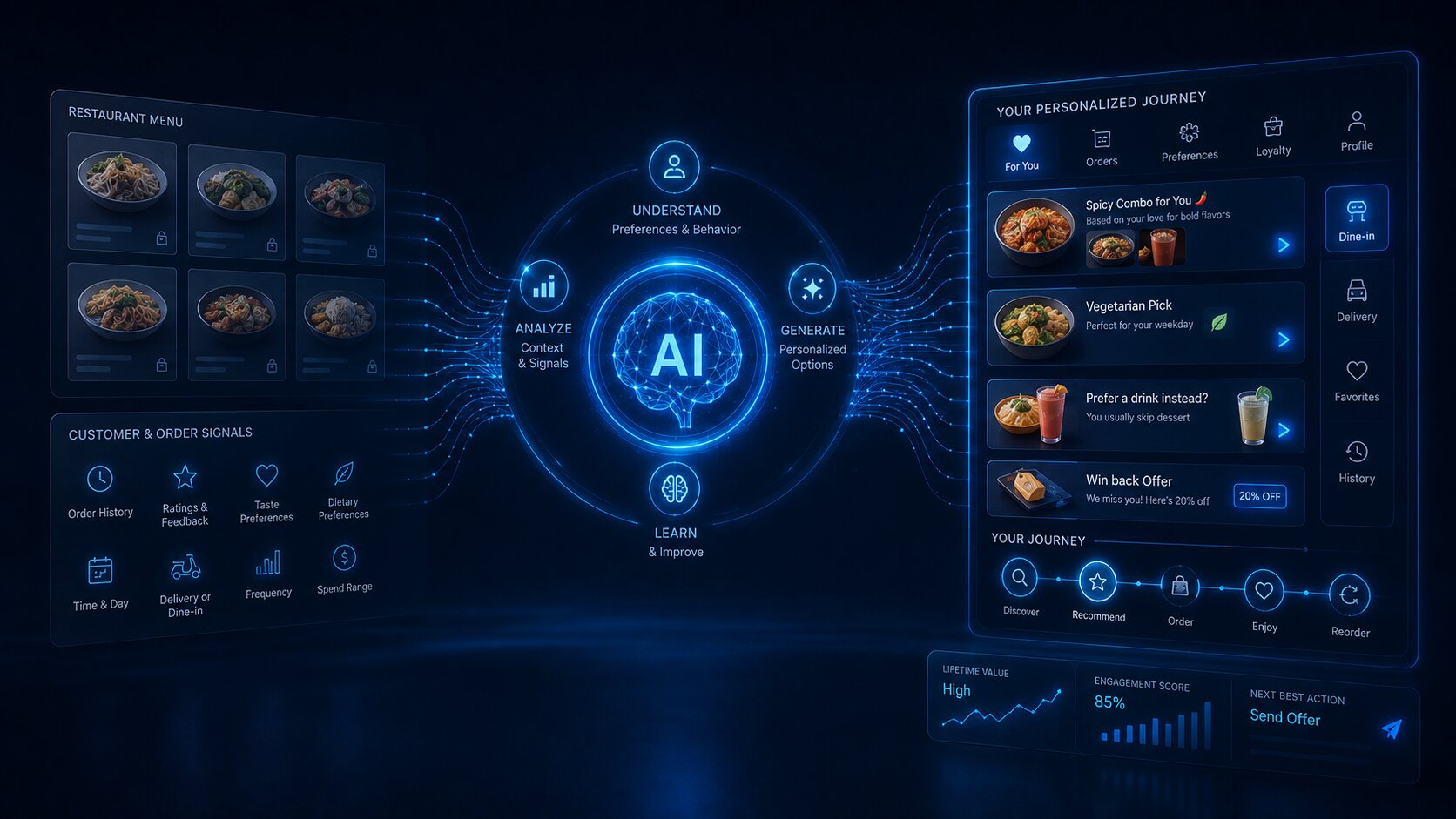
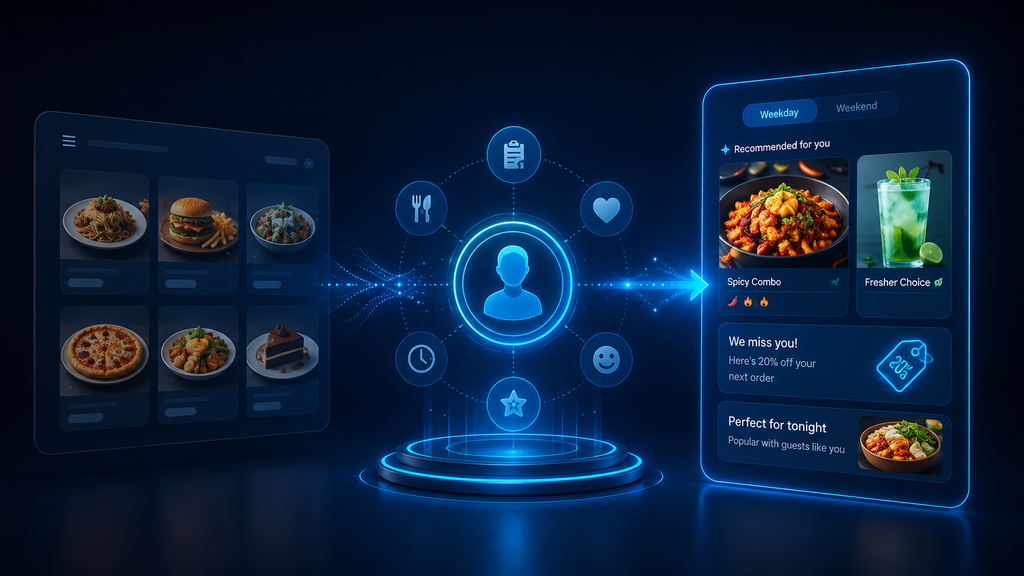
    Every online store owner asks the same question at some point. Why do some shoppers buy more, faster, while others bounce after one page view? The answer, most of the time, is personalization. A well-built AI recommendation engine ecommerce brands rely on studies of each visitor’s behavior in real time and shows them products they actually want. Not generic bestsellers. Not random upsells. Real, relevant picks.

    This is not a nice-to-have anymore. It is the difference between a store that scales and one that stalls.

    Key Takeaways:

    • An AI recommendation engine ecommerce stores use today can lift AOV by 15% to 25%, and in some cases much higher, when paired with strong behavioral data.
    • Amazon still generates roughly 35% of its sales through personalized recommendations, the industry’s most cited proof point.
    • Sessions where shoppers engage with a recommendation widget show AOV jumps as high as 369% compared to sessions without one.
    • Ecommerce personalization software is not just for enterprise brands anymore. Mid-market and even free ecommerce personalization software options now exist for smaller catalogs.
    • Personalization for anonymous and first-time shoppers is where most stores leave money on the table, and it is fixable with the right engine.

    What Is an AI Recommendation Engine in eCommerce?

    An AI recommendation engine ecommerce platforms use is a system that analyzes browsing patterns, purchase history, cart behavior, and even time-of-day activity to predict what a shopper wants next. It runs on machine learning models that get smarter with every click.

    Unlike old-school “customers also bought” widgets, modern engines use customer behavior analytics to build a live profile of each visitor. This profile updates in real time. So the homepage a shopper sees on Monday morning can look completely different from what they see Friday evening, based on what they browsed in between.

    Three components typically power this system:

    • Data collection layer: tracks clicks, scroll depth, cart adds, and search queries
    • Prediction model: scores products based on likelihood of purchase
    • Delivery layer: pushes recommendations to the homepage, product pages, cart, and email

    Why is eCommerce Personalization Software No Longer Optional?

    Shoppers today expect stores to know them. According to McKinsey research, companies that invest seriously in AI-driven personalization see 3% to 15% increases in revenue and 10% to 20% gains in sales ROI. That is not a small edge. That is the gap between a store that grows every quarter and one that plateaus.

    Ecommerce personalization software has moved from a “premium feature” to table stakes because customer patience for generic experiences has dropped sharply. A shopper who lands on a site and sees irrelevant products simply leaves. There is no second chance in most cases. The next tab is always open.

    This is exactly why AI personalization software for ecommerce has become one of the fastest-growing categories in retail tech. Brands are not buying it to look modern. They are buying it because it directly protects revenue.

    How Customer Behavior Analytics Powers Smarter Recommendations

    Good recommendations start with good data. Customer behavior analytics tracks signals most teams never think to measure manually, such as:

    • Pages visited before abandoning a cart
    • Products viewed but never added to cart
    • Time spent on specific categories
    • Device used and time of day shopping happens
    • Search terms typed into the site’s own search bar

    An ecommerce personalization engine combines these signals into a single behavioral score for each shopper. That score decides what gets shown next, on the homepage, in the cart, and in follow-up emails.

    The more granular the data, the sharper the recommendation. This is why generic, rule-based “related products” sections underperform real AI engines. Rules cannot adapt. Behavior-driven models do.

    Types of AI Recommendation Engines (And Which One Fits Your Store)

    Not all recommendation engines work the same way. Picking the wrong type is one of the biggest reasons stores don’t see the lift they expect. Here is a quick breakdown.

    Engine TypeHow It WorksBest For
    Collaborative FilteringRecommends based on what similar shoppers boughtStores with large purchase history and repeat customers
    Content-Based FilteringMatches products based on attributes (color, category, price)Stores with detailed product catalogs, low return traffic
    Session-Based ModelsPredicts intent from clicks within a single visitAnonymous and first-time shoppers with no history
    Hybrid ModelsCombines collaborative and content-based signalsMost mid-to-large stores; highest accuracy overall

    Most modern AI recommendation engine ecommerce platforms now default to hybrid models, since relying on just one method leaves gaps. Collaborative filtering alone struggles with new products (the “cold start” problem), and content-based filtering alone misses behavioral nuance. Hybrid systems solve both.

    The Real Impact: Conversions and AOV

    Numbers make the case better than any pitch. Here is what independent research shows about personalization software for ecommerce and its impact on revenue metrics.

    Real-World Examples: Brands Winning with AI Recommendations

    • Amazon built its entire discovery experience around contextual recommendations, generating an estimated 35% of sales through personalization, still the most cited benchmark in the industry.
    • Tatcha, a skincare brand, attributes 11.4% of total site revenue to its AI shopping assistant, with a 3x conversion lift and 38% AOV uplift from personalized product guidance.
    • Victoria Beckham’s ecommerce store saw a 20% AOV increase after deploying AI-driven personalization at checkout.
    • Wayfair uses AI-powered visualization alongside recommendations to help shoppers picture products in their own space, which cuts returns and lifts purchase confidence.

    The pattern across all of these brands is the same. Personalization was not a side feature. It was tied directly to a revenue metric the business tracked weekly.

    Choosing the Best eCommerce Personalization Software

    Finding the best ecommerce personalization software depends on your catalog size, traffic volume, and technical resources. There is no single “best” option for every store. Here is how to think about it by business stage.

    Business StageWhat to PrioritizeTypical Investment
    Small store, low trafficFree ecommerce personalization software or built-in platform tools (Shopify, WooCommerce plugins)$0 to $50/month
    Growing DTC brandStandalone AI engine with email and on-site sync$200 to $2,000/month
    Mid-market retailerFull ecommerce personalization engine with behavioral analytics and A/B testing$2,000 to $10,000/month
    Enterprise brandCustom-built engine integrated with CDP and CRMCustom pricing, often six figures annually

    When researching best ecommerce personalization software 2024 and current 2026 options, look past marketing claims and check for three things: real-time data processing, cross-channel sync (site, email, app), and transparent reporting on what the AI actually influenced.

    Personalization for Anonymous and First-Time Shoppers

    Here is where most stores struggle. A returning customer with a purchase history is easy to personalize for. A first-time visitor with zero history is not.

    This is exactly why ecommerce personalization software for anonymous and first-time shoppers has become its own specialized category. These tools use session-based signals instead of historical data:

    • What the visitor clicked in the first 30 seconds
    • Referral source (social, search, email link)
    • Device type and location
    • Product category first viewed

    A strong engine builds a “cold start” profile within the first few clicks and adjusts recommendations mid-session. This matters because first-time visitors make up the majority of traffic for most growing stores, often 60% to 80% depending on the brand. Ignoring this segment means ignoring most of your funnel.

    Best Personalized Product Recommendation Software: What to Look For

    When comparing the best personalized product recommendation software for ecommerce, focus on these capabilities rather than flashy dashboards:

    • Real-time scoring: recommendations update as the shopper browses, not after a batch process runs overnight
    • Multi-surface delivery: the same intelligence should power homepage, cart, checkout, and email
    • Explainability: you should be able to see why a product was recommended, not just that it was
    • Easy A/B testing: to prove the lift is real, not assumed
    • Data privacy compliance: especially important with GDPR and India’s DPDP Act now in effect

    If you are asking what is the best personalized product recommendation software for ecommerce, the honest answer is: the one that fits your data maturity. A brand-new store with thin data needs a lighter, session-based tool. An established brand with years of purchase history can run a far more sophisticated model.

    A Simple Rollout Plan

    Do not try to personalize everything at once. Start narrow.

    • Pick one high-traffic page (usually the homepage or a top category page)
    • Connect your product and behavior data cleanly before turning anything on
    • Run a small pilot with a percentage of traffic to measure actual lift
    • Expand to cart and email once the on-site results prove out
    • Layer in anonymous shopper logic last, since it needs the most tuning

    This phased approach protects your budget while still letting you capture the bulk of the AOV and conversion gains research consistently points to.

    Final Thought

    Personalization is no longer a competitive edge reserved for giants like Amazon. With the right AI personalization software for ecommerce, even a mid-sized store can see meaningful lifts in both conversions and order value within months, not years. The technology has matured. The data costs have dropped. What is left is execution.

    KPIs You Should Track After Launch

    Rolling out a recommendation engine without tracking the right numbers is a common mistake. Watch these five metrics closely:

    • Recommendation click-through rate
    • Revenue per session with vs without recommendations
    • AOV of engaged sessions
    • Conversion rate by segment
    • Recommendation-attributed revenue

    Without this tracking, it is impossible to know if the engine is actually working or just running in the background unnoticed.

    At VectovateAI, we design and build AI-native e-commerce architectures, recommendation layers, and vector search systems tailored for enterprise and mid-market retailers. Operating from our development hub in Ahmedabad, India, our engineering team helps brands integrate real-time personalization directly into headless, microservices, or custom platform stacks—ensuring rapid execution with complete data ownership.

    Ready to Lift Your Store’s AOV and Conversion Rates?

    Whether you want to integrate a session-based recommendation engine or build a custom recommendation pipeline from scratch, our team is ready to help.

    Book a Free AI Architecture Review with VectovateAI

  • The RetailTech Growth Engine: How Automation, AI Agents & Predictive Analytics Redefine Customer Experience

    The RetailTech Growth Engine: How Automation, AI Agents & Predictive Analytics Redefine Customer Experience

    Modern retail scalability is defined by backend integration speed, contextual memory persistence across channels, and execution consistency. Customer experience automation combines agentic LLMs, event-driven orchestration, and time-series predictive analytics to make every touchpoint faster, personalized, and operationally efficient—without increasing engineering overhead.

    For retail leaders in India and globally, this is not a future trend. It is the operating model for 2026. Across every sector, brands are shifting toward an automation customer experience model that treats speed and consistency as core product features, not add-ons. Retailers who delay automation and customer experience integration are already losing ground to competitors who resolve queries in seconds, predict stockouts before they happen, and personalise every interaction at scale.

    This blog explains what customer experience automation means for retail, how AI agents and predictive analytics work together, and how you can build a retail automation platform that keeps humans in control while machines do the heavy lifting.

    Key Takeaways

    • Customer experience automation: Combines tool-calling AI agents, event-driven API orchestration, and predictive analytics to execute state mutations in real time rather than delivering static text.
    • High-Throughput ROI: Retail-specific pressures—seasonal spikes, thin margins, and interaction velocity—make custom CX automation exceptionally high ROI.
    • Microservices Approach: Specialized agentic LLMs function as an orchestrated team across order tracking, returns, product discovery, and sentiment analysis.
    • Proactive Interventions: Time-series demand forecasting models (XGBoost/LSTM) catch churn risks and stockouts prior to customer escalation.
    • Complete Data Sovereignty: Building on a custom, API-native, private-cloud architecture eliminates per-ticket SaaS subscription taxes and keeps 100% of first-party data intact.

    What Is Customer Experience Automation?

    In technical terms, customer experience automation is the deployment of function-calling LLMs, RAG vector pipelines, and event-driven workflow orchestration to manage customer state mutations across the full journey—from first contact to OMS/ERP updates—without manual agent coordination.

    Customer experience automation platform solutions typically combine four elements:

    ComponentWhat It DoesRetail Example
    OrchestrationEvent-driven middleware directing traffic between API endpointsRoutes return triggers directly to an AI agent or human queue
    SegmentationFeature-store clustering based on transactional history & telemetryApplies low-friction return logic for high LTV tiers
    PersonalisationVector similarity search & real-time intent embeddingsGenerates dynamic recommendations based on session vector states
    AutomationREST/gRPC webhooks executing state mutations in WMS/OMS/CRMTriggers restock webhooks, processes refunds, and syncs ERPs

    Salesforce frames these four pillars as the foundation of any successful CXA strategy, aligning with the broader industry shift toward multi-agent orchestration where specialized AI agents manage end-to-end workflows rather than isolated tasks.

    The key distinction retailers must understand: automated customer experience is not the same as a basic chatbot. A chatbot answers questions. A true CX automation system resolves the issue end-to-end, updates the backend system, and only escalates to a human when judgment or empathy genuinely changes the outcome.

    Why Retail Needs Custom Automation Now?

    Retail operates under three structural pressures: seasonal volume volatility, razor-thin margins, and consumers demanding instant, cross-channel fulfillment.

    Zendesk research found that a majority of CX leaders believe generative AI helps make digital interactions feel more human, and a similar majority say AI agents build stronger emotional connections with customers when implemented correctly. This challenges the old assumption that automation feels cold.

    Consider what happens during a flash sale or festival season. Support volume can spike 40 to 60 percent overnight. Retailers relying purely on human agents either overstaff for a few weeks a year or leave customers waiting. Retailers who deliver a genuinely automated customer service experience during these windows protect both revenue and brand reputation, because a delayed response during peak season does more damage than the same delay on a slow Tuesday. Retail automation platform tools solve this by absorbing the spike instantly, with AI agents handling order tracking, refund status, and product queries in parallel, at any hour.

    Core Engineering Drivers for Retail CXA:

    • Sub-second response latencies via asynchronous webhook handlers.
    • Elastic infrastructure auto-scaling during traffic spikes without increasing support payroll.
    • State persistence across Web, App, WhatsApp, and Voice channels via Redis session management.
    • Real-time telemetry ingestion into CRMs and Analytics Data Warehouses.
    • Reduced human agent burnout by automating routine, repetitive ticket types.

    AI Agents: The Microservices Architecture of Frontline Retail CX

    The single biggest shift in automated customer service experience solution design is the move from single-purpose bots to specialised AI agents that work like a coordinated team.

    In a modern customer experience automation platform, different agents handle different jobs:

    • Order and Delivery Agents: Track shipments, handle delays, and proactively notify customers before they ask.
    • Returns and Refunds Agents: Process eligible returns instantly, flag exceptions for human review.
    • Product Discovery Agents: Recommend items using purchase history and real-time browsing behaviour.
    • Sentiment and Escalation Agents: Detect frustration in tone or wording and route the conversation to a human before it turns into a complaint.

    Predictive Analytics: Solving Problems Before They Happen

    How automation improves customer experience metrics becomes clear once predictive analytics enters the picture. When predictive analytics models connect directly to conversational agent pipelines, CX transitions from reactive issue management to proactive system intervention.

    Predictive time-series models (Snowflake/Databricks feature stores running XGBoost or Transformer architectures) evaluate live data to flag:

    • Churn risks following delivery delays or inventory exceptions.
    • Regional stockouts 72 hours in advance based on cart-addition velocity.
    • High-probability escalation tickets using early sentiment vectors.
    • System traffic spikes requiring dynamic infrastructure auto-scaling.

    Metrics That Typically Improve With CXA:

    MetricTypical Impact
    First Response TimeDrops from hours to seconds
    Resolution Rate (First Contact)Increases significantly with agent handoff logic
    Customer Satisfaction (CSAT)Improves due to consistency and speed
    Support Cost Per TicketDecreases as routine volume shifts to AI agents
    Agent Burnout / AttritionReduces as agents handle fewer repetitive queries

    Custom AI Engine vs. Off-the-Shelf SaaS Plugins

    Enterprise retailers often evaluate off-the-shelf SaaS plugins (e.g., Gorgias, Zendesk AI) against custom-engineered AI systems. For growing brands, closed SaaS platforms quickly introduce architectural and financial bottlenecks:

    Evaluation CriteriaOff-the-Shelf SaaS PluginsVectovateAI Custom AI Engine
    Data Sovereignty & PrivacyData hosted in vendor cloud; black-box privacy risks100% data ownership deployed in your private cloud (AWS/GCP/Azure)
    Backend System SyncRestricted to basic pre-built webhooks; middleware dependentNative, direct REST/gRPC integration with custom ERP, WMS, and OMS systems
    Model & Workflow ControlStatic prompt rules; unmodifiable model weights or logicCustom multi-agent workflows, fine-tuned domain models, and RAG tuning
    Scalability & PricingEscalating per-ticket or per-seat monthly subscription taxZero per-ticket tax; predictable infrastructure operational costs

    Automating Customer Experience in Grocery and Everyday Retail

    Grocery and quick-commerce present a unique challenge. Margins are razor-thin, order volumes are enormous, and customers expect near-instant answers about substitutions, delivery windows, and refunds.

    Tools for automating customer experience management in grocery stores typically focus on:

    • Automated WMS substitution sync when items go out of stock during picking.
    • Real-time rider location updates without agent intervention.
    • Instant refunds trigger execution for damaged items via automated visual verification or agent processing.
    • Multilingual voice and text processing tuned for regional vernaculars (e.g., Tier 2/3 Indian markets).

    Even small friction points, like unclear refund timelines, disproportionately hurt satisfaction in high-frequency categories like grocery, because customers interact with the brand so often that every small failure compounds.

    Engineering Roadmap: Building an Agent-First, Human-in-the-Loop System

    Implementation should follow an iterative, engineering-led phased approach:

    • Data & API Audit: Map top support ticket categories and audit backend API readiness for OMS, ERP, and 3PL endpoints.
    • Automate High-Frequency Actions: Deploy tool-calling agents for simple state mutations (Order Status, Returns, FAQs).
    • Integrate Predictive Pipelines: Sync time-series demand models with inventory databases to trigger proactive alerts.
    • Implement Human-in-the-Loop Fallbacks: Configure confidence scoring thresholds and Redis-backed session persistence to hand off edge cases seamlessly to human agents.
    • Continuous Model Retraining: Monitor resolution rates, sentiment logs, and latency metrics to continuously fine-tune prompt strategies and RAG context windows.

    Engineered for Scale with VectovateAI

    Off-the-shelf bots offer quick demos, but production-grade retail systems require software engineering depth. At VectovateAI, we architect AI-Native, API-first custom software that integrates specialized AI agents, predictive demand forecasting, and real-time ERP/WMS synchronization directly inside your enterprise cloud.

    Whether you are scaling a fast-growing D2C brand or modernizing a multi-channel enterprise stack, our team builds resilient agentic infrastructure engineered to handle peak holiday traffic without dropping context or performance.

    Ready to transform your retail technology stack into a high-performance growth engine?

    Schedule a 30-Minute Retail AI Architecture Audit with VectovateAI

  • Retail Demand Forecasting with AI: A Predictive Analytics Playbook for Retail Tech Teams

    Retail Demand Forecasting with AI: A Predictive Analytics Playbook for Retail Tech Teams

    Retail demand forecasting is changing fast. Legacy forecasting tools built on batch processing and static formulas fail when flash sales, viral trends, or supply chain shocks hit. Modern AI-Native models process real-time demand signals—including promotions, local weather, and competitor pricing—to optimize inventory, protect margins, and eliminate stockouts.

    This playbook breaks down how retail engineering and tech teams can architect, deploy, and scale AI-driven forecasting pipelines that integrate directly into existing ERP, WMS, and OMS infrastructure.

    Key Takeaways

    • AI-Native retail demand forecasting cuts forecast error by nearly 43%, reducing it from 28.76% to 16.43% in tested models, a drop of about 42.87%.
    • Global retailers lose close to $1.73 trillion a year to bad forecasts, as global retail inventory distortion, the combined cost of overstocking and stockouts, amounts to about $1.73 trillion annually, roughly 6.5% of global retail sales.
    • The global AI in retail market is expected to hit $96.13 billion by 2030, growing at a 46.5% CAGR, with the market projected to reach $14.24 billion in 2025 before climbing to $96.13 billion by 2030.
    • Success depends less on the algorithm and more on retail dashboards, clean data, and a human-in-the-loop workflow.

    Why Traditional Forecasting Keeps Failing Retailers

    Classic tools like moving averages and exponential smoothing assume demand behaves predictably. That assumption breaks the moment a viral trend, a flash sale, or a weather shift hits the store.

    These older methods also ignore outside signals. They rely solely on historical data, so they miss new patterns and create mismatches between inventory and real demand. The result shows up in two costly ways: stockouts that send shoppers to competitors, and overstock that ties up cash on shelves nobody wants.

    Companies carrying high supply chain risk also see net working capital rise by roughly 6% each year, quietly draining liquidity long before anyone notices it on a P&L.

    Retail Demand Forecasting Methods Worth Knowing

    Evaluating the right architecture depends on SKU variance, data velocity, and prediction windows:

    • Tree-Based Models (XGBoost, LightGBM, Random Forest): Optimal for tabular feature sets with non-linear interactions across price, region, and promotional flags.
    • Deep Learning & Recurrent Neural Networks (LSTM, Transformers): Best suited for complex time-series data, high-velocity e-commerce SKUs, and long-tail products with irregular purchasing patterns.
    • Hybrid Statistical-ML Approaches: Combine classical ARIMA/TBATS models with gradient boosting to maintain baseline stability while capturing real-time variance.
    • Generative AI & LLM Layers: Act as an execution layer on top of model outputs, translating raw inference data into natural-language risk alerts and scenario modeling for planners

    Custom AI Engineering vs. Off-the-Shelf SaaS

    When enterprise tech teams evaluate predictive analytics, they choose between licensing legacy SaaS suites or engineering a custom solution:

    Evaluation CriteriaOff-the-Shelf SaaSVectovateAI Custom AI Engine
    Data Control & SovereigntyData hosted in third-party black boxes100% ownership within your private cloud/data warehouse
    Model CustomizationFixed algorithms; cannot tweak feature weightsTailored architectures tuned specifically to your SKU behaviors
    Integration OverheadComplex middleware required to sync with custom ERPsDirect API-native integration into your existing WMS, OMS, and ERP
    Scalability & CostEscalating per-SKU or per-user licensing feesZero per-SKU tax; predictable infrastructure operational costs

    How AI Demand Forecasting Actually Works

    AI demand forecasting blends real-time external signals with historical data to spot patterns spreadsheets miss:

    FeatureTraditional ForecastingAI Demand Forecasting
    Data sourcesHistorical sales onlyHistorical + real-time + external signals
    Forecast accuracyModerateHigher, with 42.87% error reduction in tested models
    Handling volatilityStruggles with spikesCaptures non-linear demand shifts
    Update frequencyWeekly or monthlyNear real-time
    Human roleManual adjustmentAI recommends, planner approves

    Most retail analytics software today builds this intelligence layer directly into existing dashboards, so planners don’t need a separate tool to act on it.

    What Real Results Look Like

    Numbers convince skeptical stakeholders faster than theory. Here is one grounded example worth citing in a boardroom deck: Eurocell Group forecasted over 43,000 SKUs more accurately using AI, improved product availability by 6.7%, and freed £1.86 million in working capital.

    That is the kind of benefit of AI in retail demand forecasting finance teams care about. It is not abstract accuracy. It is real cash unlocked from a warehouse.

    On a broader scale, retailers already using AI report more than double the sales and profit growth compared to those that have not adopted it. And adoption is no longer niche. 92% of US retail marketers now use AI, so waiting on the sidelines carries its own competitive risk.

    Architecting the Data Pipeline & Feature Store

    No AI model performs well on messy data. Before evaluating best demand forecasting software for retail, fix the data layer:

    • Clean Historical Baselines: Standardize 18 to 24 months of historical SKU transactional data across all physical and digital sales channels.
    • Feature Engineering & Storage: Build automated pipelines (via Kafka, Databricks, or Snowflake) to aggregate pricing shifts, promotional calendars, weather API data, and local events.
    • ERP & Warehouse Synchronization: Expose REST/gRPC endpoints to feed ML model predictions directly back into existing WMS, OMS, and replenishment systems.
    • Data Governance & Schema Validation: Ensure SKU IDs, multi-currency conversions, and store location hierarchies stay uniform across all database schemas.

    This sequence matters. Skipping ahead to a flashy model while the data layer stays broken is the single biggest reason retail demand forecasting dataset projects stall.

    Where to Start (and Where to Wait)

    Not every category is ready for AI on day one. Retail tech teams get faster wins by prioritizing correctly.

    Start here:

    • High-volume, high-signal SKUs with steady sales history
    • Multi-channel and e-commerce items with strong real-time signals
    • Seasonal or repeat-purchase categories where small accuracy gains matter a lot

    Hold off here:

    • Low-volume or erratic SKUs where data signal is too thin
    • Categories with no clear owner for reviewing AI recommendations

    A simple readiness checklist helps here: clean historical data, stable product IDs, linked pricing data, and a named business owner who reviews AI outputs before they hit the shop floor.

    Human-in-the-Loop: Why Full Automation Is the Wrong Goal

    The best demand forecasting in retail industry deployments does not remove people from the loop. They upgrade what those people do.

    For high-impact SKUs, the “AI suggests, planner approves” model works best. The AI recommends reorder quantities or promotional adjustments. The planner checks those against local knowledge, like a stadium event down the street or a competitor’s closing sale, before confirming.

    Low-risk, routine SKUs can run on automated rules without review, freeing planner hours for the decisions that genuinely need judgment. This balance builds trust in the system instead of forcing blind faith in a black box.

    Architectural Common Failure Modes & Mitigations

    Failure ModeRoot CauseEngineering Mitigation
    Data DriftConsumer shopping behaviors change post-launchImplement automated model retraining pipelines triggered by drift detection
    Overfitting VolatilityModel treats a rare viral event as recurring demandCross-validate training windows against clean, anomaly-filtered historical datasets
    Pipeline LatencySlow batch processing delays daily stock reordersShift from nightly batch processing to event-driven streaming ingestion
    Planner OverridesBlack-box models cause planners to mistrust outputsDisplay feature importance weights (SHAP values) alongside every forecast

    Best Practices for Integrating AI Demand Forecasting in Retail

    Integrating AI-driven predictive analytics into an existing retail tech stack requires balancing data discipline, system architecture, and organizational change. Retail engineering teams that achieve high adoption rates and measurable ROI follow key core practices:

    • Decouple Data Ingestion from ML Modeling: Build decoupled, event-driven streaming pipelines (using tools like Kafka or Snowflake) so feature stores update independently without bottlenecking core ERP systems.
    • Establish Explainability Thresholds (SHAP Values): Prevent planner distrust by embedding feature importance metrics directly into dashboards. When planners understand why a forecast changed, manual overrides drop significantly.
    • Implement Continuous Drift Monitoring: Consumer behavior and supply chains shift post-deployment. Automated retraining triggers based on model drift detection prevent degradation over time.
    • Standardize Master Data Schemas: Ensure SKU IDs, multi-currency conversions, and store location hierarchies stay uniform across ERP, WMS, and OMS databases before executing inference models.

    Engineering Roadmap: A 90-Day Implementation Blueprint

    • Days 0–30 (Data Audit & Baseline Model): Scope high-signal SKU categories. Clean historical pipelines, extract baseline features, and train initial XGBoost/LSTM benchmark models offline against legacy forecasts.
    • Days 31–60 (Pipeline Integration & Shadow Testing): Deploy real-time streaming pipelines to stream live weather, promo, and pricing data. Run AI forecasts in shadow mode alongside legacy ERP tools during weekly planning meetings.
    • Days 61–90 (Production MLOps & ERP Sync): Expose API endpoints to push forecast outputs into production ERP workflows. Establish confidence-score thresholds for automated vs. planner-approved reorders.

    Metrics That Prove the Investment Works

    Before pitching this project to leadership, define how success gets measured.

    • MAPE (Mean Absolute Percentage Error): average forecast accuracy
    • Inventory turns: how efficiently stock moves
    • Stockout rate: how often products go unavailable
    • Excess inventory/markdown rate: overstock and discount exposure
    • OTIF performance: how reliably orders ship on time and in full
    • Planner hours saved: time freed up for strategic work instead of manual adjustments

    These metrics turn a vague “AI initiative” into a business case finance teams can actually approve.

    Engineered for Scale with VectovateAI

    At VectovateAI, we build AI-Native demand forecasting systems designed specifically for complex retail enterprise environments. Rather than forcing you into rigid SaaS subscriptions, our engineering team constructs custom ML pipelines, feature stores, and MLOps workflows that integrate directly into your proprietary technology stack.

    Whether you are seeking to replace manual spreadsheet processes or modernize legacy ERP modules, we help you deploy production-ready AI forecasting models in weeks.

    Ready to audit your data architecture and build high-precision demand forecasting pipelines? Schedule a 30-Minute Technical AI Architecture Audit with VectovateAI.

  • AI-Powered Web Development: How Generative Engineering Ships Production Software 2x Faster

    AI-Powered Web Development: How Generative Engineering Ships Production Software 2x Faster

    AI-powered web development is the fastest route from an idea to a shipped product. Businesses that adopt it are cutting release cycles in half. Developers who use it well are shipping cleaner code, faster.

    This shift has a name: generative software engineering. It blends AI code generation, automated testing, and human oversight into one workflow. The result is production-grade software that ships in weeks, not months.

    If you are a founder or a CTO trying to understand this shift, this guide breaks it down. It also tells you exactly what to look for when picking an AI development partner for your next project.

    Key Takeaways

    • AI-powered web development can cut delivery timelines by 2x to 5x when paired with strong human review.
    • Generative AI now touches every stage of the software development lifecycle, from requirement gathering to deployment.
    • Speed without oversight is risky. AI-generated code still needs senior engineering judgment before it ships.
    • The right AI development partner depends on your use case: MVP building, enterprise agents, healthcare compliance, or computer vision.
    • Ahmedabad’s engineering talent pool is becoming a serious hub for agent-first, human-in-the-loop software delivery.
    • VectovateAI’s Engineering Team in Ahmedabad provides an agent-first, human-in-the-loop framework built for global scalability.

    What Generative Software Engineering Actually Means

    Generative software engineering is not just “AI writes your code.” It is a full-cycle transformation of how software gets built.

    Modern AI tools now assist across the entire lifecycle: requirement gathering, design, coding, testing, deployment, and maintenance. Generative AI transforms ideas into requirements, then converts those requirements into user stories, test cases, code, and documentation, all while working alongside human developers.

    According to forecasts by Gartner, over 80% of enterprise software engineering teams will integrate generative AI and agentic workflows into their core development lifecycle by 2026.

    This is the core idea behind AI product engineering. Instead of treating AI as an autocomplete tool, teams treat it as a collaborator across the whole build process, from architecture decisions to final QA.

    Why AI-Powered Web Development Ships Software 2x Faster?

    The speed gain is not hype. It comes from removing friction at every stage.

    Empirical research by GitHub and MIT demonstrates that developers using generative AI workflows complete software engineering tasks 55.8% faster than those using traditional manual methods.

    Teams using AI-powered coding tools report productivity gains of 2 to 5 times when compared to traditional workflows. A task that once needed a full workday now takes hours.

    Here is where the time actually gets saved:

    Development StageTraditional TimelineAI-Powered Timeline
    Requirement to spec3-5 daysSame day
    Boilerplate coding2-3 daysFew hours
    Test case writing1-2 daysMinutes to hours
    Documentation1 dayAuto-generated, reviewed same day
    Bug detectionOngoing manual QAContinuous, real-time

    AI tools accelerate coding, reduce human error, and free developers to focus on complex and creative tasks, while AI-driven testing systems generate adaptive test cases and prioritize the most critical ones.

    This is why generative software engineering is becoming the default approach for teams that need to ship fast without sacrificing quality.

    The Trap Nobody Talks About: Speed Without Understanding

    Faster is not always better. This is the part most agencies skip when they pitch AI development.

    A developer who documented months of real AI-assisted coding put it plainly: the risk is not that AI writes bad code. The real risk is that AI generates code that looks correct, compiles, and passes basic tests, but quietly encourages the developer to stop thinking.

    This is exactly why human-in-the-loop review is not optional. It is the difference between an AI development partner who ships fragile code fast, and one who ships resilient production software fast.

    AI is also confidently wrong at times. However, peer-reviewed research from Purdue University shows that over 52% of unvetted AI code outputs contain incorrect logic or security vulnerabilities, making senior engineer oversight critical.

    It can suggest insecure implementations, outdated libraries, or architectures that fail under real traffic. Senior engineering judgment catches what AI misses. That judgment is what you are actually paying for when you hire an AI development partner.

    How to Choose an AI Development Partner?

    Not every AI vendor is built for every use case. Here is what to look for, based on what you are trying to build.

    Your SituationWhat to Prioritize
    Creative agency looking for AI development partnerFast prototyping, design-to-code speed, flexible sprints
    Criteria for selecting healthcare app development partner AI MLHIPAA-aware architecture, model explainability, audit trails
    AI agent development partner for enterprise operationsWorkflow orchestration, system integrations, governance controls
    AI MVP development partnerLean team, quick iteration, cost-conscious tech stack
    AI development partner for computer visionDataset engineering experience, model tuning, edge deployment know-how

    What to Look for in an AI Development Partner?

    Whether you are a founder or a technical decision-maker, use this checklist before signing any contract:

    • Proven delivery, not just demos. Ask for a working production case, not a proof of concept.
    • Human-in-the-loop process. Every AI-generated module should go through senior review before deployment.
    • Transparent AI usage. They should tell you clearly where AI wrote code and where humans did.
    • Security-first mindset. AI-generated code needs the same security audits as human-written code.
    • Domain fit. A team strong in fintech may not be right for healthcare or computer vision work.

    CTO AI Development Partner Evaluation Framework

    If you are a CTO evaluating an AI development partner, go beyond the sales pitch. Ask these direct questions:

    • What percentage of your delivered code is AI-generated versus human-reviewed?
    • How do you handle AI hallucinations in production-critical logic?
    • Can you show a rollback plan if an AI-generated module fails in production?
    • What is your testing coverage strategy for AI-assisted code?
    • How do you train your engineers to review AI output critically, not just accept it?

    How to Choose an AI Strategy Development Consulting Partner?

    If your need is broader than one project, meaning you want an ongoing AI strategy development consulting partner, look for a team that can do three things well: assess your current tech debt, map a realistic AI adoption roadmap, and staff the roadmap with engineers who actually build, not just advise

    How to choose an AI strategy development consulting partner comes down to one test: can they show you a live system where AI and human engineers work together on the same codebase, today, not just in a pitch deck.

    Building Software the Right Way: Agent-First, Human-in-the-Loop

    Most agencies market AI speed alone. That is an incomplete pitch.

    The stronger model is agent-first, human-in-the-loop. AI agents handle the repetitive, high-volume work: generating boilerplate, drafting test suites, flagging vulnerabilities, and writing first-pass documentation. Human engineers handle architecture, security review, and the judgment calls that decide whether software actually survives contact with real users.

    This is also where VectovateAI’s engineering talent pool in Ahmedabad comes in. The city has quietly built a strong base of engineers who combine deep technical fundamentals with hands-on AI tooling experience. That combination, technical rigor plus AI fluency, is exactly what generative software engineering demands.

    Real-world teams are already proving this model works: solo founders are combining AI tools to cut build timelines from six months down to a few weeks, while agencies are launching client-ready websites in about 48 hours. The gains are real when the process includes proper review, not blind acceptance of AI output.

    Final Word

    AI-powered web development is not about replacing engineers. It is about giving good engineers a faster path to production, and giving bad shortcuts nowhere to hide.

    If you are evaluating an AI development partner, whether for an MVP, an enterprise AI agent system, a healthcare application, or a computer vision product, judge them on their review discipline as much as their speed. The partners who last are the ones who ship fast without ever letting AI think alone.

  • eCommerce Platform Development in the AI Era: An Architecture Guide for Retail Tech Leaders

    eCommerce Platform Development in the AI Era: An Architecture Guide for Retail Tech Leaders

    eCommerce platform development has moved past the “pick a platform and launch” era. AI now sits inside the architecture itself, shaping how inventory, search, pricing, and customer experience work together in real time.

    Online retail crossed $5.4 trillion in 2025 and is on track to touch nearly $6.8 trillion in 2026, driven largely by teams that treat platform-building as an engineering problem, not a template-picking exercise, as per a Statista report.

    Generative AI is now the engine behind how production commerce software gets written, tested, and shipped, cutting launch timelines from four to six months down to six to twelve weeks, without cutting corners on scale or security.

    Buyers no longer compare “custom vs template.” They compare speed, personalization, and total cost of ownership. If your development partner is still writing every module by hand, you are already behind.

    This guide breaks down what a modern, AI-ready commerce architecture actually looks like, and how retail leaders can plan eCommerce platform development projects that scale without collapsing under their own complexity.

    Key Takeaways

    • Traditional, batch-processing commerce architecture cannot support real-time personalization or AI-driven demand spikes.
    • eCommerce software development in 2026 leans heavily on modular, composable systems rather than monolithic builds.
    • Headless and API-first architecture is now the default starting point for any serious retail platform.
    • AI features can raise development budgets by 20 to 50 percent, but they also unlock measurable gains in conversion and retention.
    • B2B and enterprise buyers need governance, auditability, and human-in-the-loop controls, not just automation for its own sake.

    Why Traditional Architectures Struggle in the AI Era

    Most legacy commerce systems were built for predictable traffic and static personalization. They rely on batch jobs. Data gets collected, stored, and processed later, often overnight.

    That model breaks the moment real-time demand hits. A flash sale, a viral product, or a festive-season spike overwhelms a batch-based system. Pages slow down. Checkout lags. Shoppers abandon carts before they even reach payment. This pattern of slow response, stale personalization, and delayed decision-making leads directly to revenue leakage.

    An AI-first architecture flips this. Data streams continuously instead of arriving in nightly batches. The system scales resources the moment demand spikes, similar to a thermostat reacting instantly to temperature change. Automation layers handle routine tasks like catalog updates, freeing engineering teams to focus on strategy instead of firefighting.

    What Modern eCommerce software development Looks Like

    eCommerce software development today rarely means writing every module from scratch. Retail tech leaders combine platforms, APIs, and AI services into a composable stack. This shift changes both cost and speed of delivery.

    Three forces are driving this change:

    • AI-assisted coding and testing. Development teams using AI coding assistants report meaningful gains in output and fewer review cycles, which shortens delivery timelines for eCommerce development projects.
    • Modular, composable commerce. Instead of one monolithic build, teams stitch together commerce platforms, payment gateways, shipping APIs, analytics tools, and AI recommendation engines.
    • Plugin and app ecosystems. Features like AI chatbots, dynamic pricing, and advanced search no longer require custom code from day one.

    This is why custom ecommerce software development today looks more like systems integration than pure engineering. A strong ecommerce software development company spends as much time on architecture decisions as it does on writing code.

    Core Architecture Layers for AI-Ready Platforms

    A well-planned eCommerce platform development project is built in layers. Each layer has a distinct job, and each one needs to talk to the AI layer sitting alongside it.

    LayerWhat It HandlesAI’s Role
    Storefront / ExperienceUI, product discovery, checkout flowPersonalized layouts, dynamic search, visual and voice search
    Commerce EngineCart, pricing, orders, promotionsDynamic pricing, real-time inventory logic
    Data & Event LayerBehavioral, transactional, inventory dataStreaming data for real-time decisions
    AI/ML ServicesRecommendations, forecasting, fraud detectionCore intelligence layer
    Integration LayerERP, CRM, payment, logistics APIsConnects AI insights to operations
    Governance LayerAccess control, audit logs, complianceHuman-in-the-loop review, model oversight

    This layered approach matters because AI-driven eCommerce software solution development is only as good as the data feeding it. If the data and event layer is weak, personalization and forecasting both suffer, no matter how advanced the AI model is.

    Headless Commerce Development: The Backbone of AI-Ready Retail

    Headless commerce development separates the frontend experience from the backend commerce logic. This is not a trend anymore. It is close to a baseline requirement for any platform planning serious AI integration.

    According to Gartner, organizations that adopt a modular, composable, and headless commerce approach outpace the competition by up to 60% in the speed of implementing new digital features.

    Why it matters for AI-first retail:

    • Teams can update the storefront without touching backend logic, enabling faster experimentation with AI-driven layouts.
    • APIs expose data cleanly to AI services, making real-time personalization and recommendation engines far easier to plug in.
    • Multiple frontends, web, mobile, kiosk, voice, can pull from the same backend, keeping experiences consistent across channels.

    This kind of hybrid continuity, where online and offline experiences share the same customer profile and real-time data, is becoming standard practice for platforms competing on personalization at scale.

    Software development for ecommerce that ignores this shift risks locking retailers into rigid, hard-to-update platforms right when shopper expectations move fastest.

    B2B eCommerce Software Development: Unique Architecture Needs

    B2B eCommerce software development carries different demands than B2C. Buyers expect custom pricing, approval workflows, bulk ordering, and deep ERP integration. AI adds another layer of complexity here, since B2B decisions often involve multiple stakeholders and longer sales cycles.

    Key architecture considerations for retail & eCommerce software development in B2B contexts:

    • Custom pricing logic tied to contracts, volume tiers, and account history.
    • ERP and CRM integration so AI forecasting reflects real procurement patterns, not just web traffic.
    • Role-based access and approval chains, since B2B purchases often need sign-off from more than one person.
    • Predictive reordering, where AI agents flag or even initiate low-risk repeat purchases with clear user controls.

    Getting this right requires eCommerce software developer teams that understand procurement workflows, not just storefront UX.

    In-House vs Outsourced eCommerce software development services

    One of the earliest decisions retail tech leaders face is whether to build with an internal team or partner with an external eCommerce software development company. Each path carries trade-offs that go beyond simple cost comparison.

    FactorIn-House TeamOutsourced Partner
    Speed to launch:Slower, hiring takes timeFaster, team is already in place
    Domain expertise:Deep product knowledgeBroad experience across industries
    Long-term cost:Higher fixed costLower upfront, variable cost
    Technical debt risk:Lower if team is stableHigher if governance is weak
    Scalability:Limited by headcountEasier to scale up or down

    The real risk in outsourcing is not cost. It is what some technical leaders call the “maintenance iceberg,” the hidden cost of poorly documented code, unclear ownership, and weak governance surfacing months after launch. Retail leaders evaluating a development eCommerce software partner should ask direct questions about documentation standards, code ownership, and governance-as-code practices before signing a contract.

    Cost Snapshot: What eCommerce Platform Development Costs in 2026

    Budget planning for eCommerce website development software projects depends heavily on scope, integrations, and how much AI capability is built in. Here is a general breakdown based on current market patterns.

    Project ScopeTypical BudgetTimeline
    Starter store$3,000 – $10,0002 – 4 weeks
    Growth-stage platform$10,000 – $50,0004 – 8 weeks
    Advanced commerce platform$50,000 – $120,0008 – 12 weeks
    Enterprise / B2B platform$120,000+12 – 20 weeks

    AI-specific features add their own cost layer:

    • Product recommendation engine: $8,000 – $40,000
    • Dynamic pricing system: $25,000 – $60,000
    • AI search and personalization: $5,000 – $20,000

    These figures reflect broader industry benchmarks for eCommerce software solutions development and can shift based on region, team structure, and platform choice.

    Governance, Data & AI Guardrails: The Missing Layer

    Most conversations about AI in commerce focus on what AI can do. Few focus on how to keep it accountable. This gap becomes expensive fast, especially for B2B and enterprise retailers where a wrong AI-driven price change or a bad recommendation can damage trust at scale.

    A strong governance layer includes:

    • Human-in-the-loop checkpoints for high-stakes decisions like pricing changes or large B2B orders.
    • Audit trails that log why an AI system made a specific recommendation or pricing call.
    • Clear escalation paths when AI confidence is low, or data looks unusual.

    This is where retail-eCommerce software development needs to shift its default posture. Full automation sounds efficient, but retailers that keep a human checkpoint on high-impact decisions tend to catch errors before they become costly.

    Conclusion:

    Retail leaders who treat eCommerce platform development as an ongoing architecture discipline, not a one-time build, are the ones positioned to compete in 2026 and beyond. The technology choices matter, but the governance and data discipline around them matter just as much.

    Building AI-Native Commerce Architectures with VectovateAI

    At VectovateAI, we engineering-first architects help enterprise and growth-stage brands build modular, scalable, and secure e-commerce systems. Operating from our hub in Ahmedabad, India, our team combines agentic velocity with strict Human-in-the-Loop governance—ensuring your retail software ships up to 2x faster without sacrificing code quality, security, or enterprise compliance.

    Ready to Modernize Your E-Commerce Architecture?

    Whether you are migrating away from a legacy monolith or constructing a headless, multi-channel commerce stack from the ground up, our lead systems architects are ready to assist.

    Schedule a free architecture & security review with VectovateAI

  • AI-Native Software Development: Why Bolted-On AI Fails and What Building AI-First Actually Looks Like

    AI-Native Software Development: Why Bolted-On AI Fails and What Building AI-First Actually Looks Like

    Every software vendor claims “AI-powered” today. But most of that AI is duct-taped onto systems built for a different era.

    AI-native software development flips that model putting AI at the core of the architecture. This guide breaks down what that actually means, why bolted-on AI keeps failing, and what a real AI-first build looks like in 2026.

    Key Takeaways

    • AI-native software development puts AI in the core architecture, not on top of it. The removal test settles the question: take AI away, and if the product breaks, it was AI-native.
    • Bolted-on AI inherits every weakness of the legacy system underneath it, including data rigidity, per-seat pricing conflicts, and clunky UX.
    • Gartner projects 40% of agentic AI projects will fail by 2027, mostly from automating broken processes instead of rebuilding around AI-native principles.
    • Real AI-native platforms track rich, multi-attribute data foundations and adapt continuously, not reactively.
    • The right build order is: define the task, design the data model, choose the AI integration pattern, then build the interface last.
    • Human-in-the-loop review stays essential for high-stakes decisions, even in a fully agent-first system.

    What Is AI Native Development?

    In simple terms, it means designing a product’s data, workflows, and interface around AI from day one, instead of adding a chatbot to an existing system.

    Bolted-on AI sits on top of legacy architecture, it reads data, suggests actions, and stops there. AI-native development instead makes the model part of the core, structures data so the model can reason over it, and assumes intelligence is available at every step of the workflow.

    AI-Native vs Traditional Enterprise Development Tools

    This is where AI native app building platforms vs traditional enterprise development tools really diverge.

    A useful benchmark test involves removing all AI features from a product; if it still functions as a viable tool, the AI was added on, and if it collapses, the product is AI-native.

    ApproachData ModelAI’s RoleWhat Breaks Without AI
    Bolted-on AIBuilt for humans, AI reads it laterSuggests, summarizes, chatsNothing. Core product still runs
    AI-native developmentBuilt for AI agents to act onCore execution engineThe entire product

    In a bolt-on platform, the core execution engine still runs on scripts, not intent, so tests behave exactly as the scripts define them, and while the AI module may suggest fixes, the underlying rigid structure stays unchanged. That’s the trap. AI patched onto an old foundation inherits every weakness of that foundation.

    Why Bolted-On AI Fails: The Three Structural Traps

    AI native development platforms solve three problems that bolt-on tools structurally cannot fix:

    • Data model rigidity. Legacy databases expect humans to enter data slowly and carefully. AI agents generate and act on data at machine speed. Forcing that into an old schema breaks reports, integrations, and workflows built on top of it.
    • Pricing model conflict. Per-seat pricing assumes humans are the primary users. When AI agents handle work that used to need five people, that revenue model collapses on its own.
    • UX design conflict. Old interfaces are built around menus and forms. AI-native interfaces accept natural language and let agents act. Bolting one onto the other creates a clumsy hybrid that satisfies neither.

    The 2025 DORA Report, based on nearly 5,000 technology professionals globally, found that AI does not fix a team, it amplifies whatever is already there. That single line explains why so many “AI transformation” projects on old platforms quietly fail. You cannot automate your way out of a broken foundation.

    Gartner AI-Native Development Platforms 2026: What the Data Says

    The numbers back this up clearly. Here’s what the research firms are projecting for AI-native development platforms trends 2026:

    SourceFinding
    Gartner40% of enterprise apps will feature task-specific AI agents by end of 2026, up from under 5% in 2025
    Gartner80% of organizations will evolve large dev teams into smaller, AI-augmented teams by 2030
    Gartner40% of agentic AI projects will fail by 2027, largely because teams automate broken processes instead of redesigning around AI-native principles
    Deloitte78% of tech leaders anticipate broad AI agent integration into their architecture within the next five years

    That Gartner failure statistic matters more than the growth ones. It tells you the risk isn’t underusing AI. The risk is bolting AI onto broken processes and calling it transformation.

    Key Features of AI-Native Software Development Platforms

    If you’re evaluating AI native development firms, here’s what to actually look for. These are the key features of ai-native software development platforms 2025 2026 that separate real AI-native builds from marketing:

    • Intent-driven design: You describe the outcome. The system determines the steps, instead of forcing you to script every action manually.
    • Multi-attribute data foundations: Instead of tracking a single data point per element, resilient architectures track hundreds of attributes per element, so no single change breaks the system.
    • Continuous adaptation, not reactive patching: real self-healing monitors how the application changes and updates the model automatically before failures accumulate, rather than alerting a human after something breaks.
    • Human-in-the-loop governance: AI acts, but a person reviews high-stakes decisions before they go live.
    • Agent-first workflows: Routine, repeatable work runs through AI agents. People supervise outcomes instead of performing every step by hand.

    What an AI-Native Developer Actually Does Differently

    An AI native developer doesn’t start with wireframes. They start by defining the decision or task the AI will own, then design the data model around that task first. Only after that comes the interface. This order matters. Build the screen first, and you’ll end up retrofitting AI later, which is exactly the bolt-on trap this whole guide is about.

    Developer-first AI-native companies treat the model choice and integration pattern as a foundational decision, not an afterthought bolted on before launch. They keep a human review step for anything high-stakes, whether that’s a financial transaction, a healthcare workflow, or a customer-facing action. AI moves fast. Judgment still needs a person in the loop.

    Who’s Actually Behind These Builds?

    If you look closely at AI deployment manager profiles at developer-first AI-native companies, a pattern shows up fast. They’re people who sit between the agent and the business outcome, decide what the agent is allowed to touch, and own the rollback plan before anything goes live.

    That’s the real difference between a company that talks about being AI-native and one that actually is. Developer-first AI-native companies don’t treat deployment as an afterthought handled by whoever’s free that week. They build it into the role from day one, the same way they build AI into the architecture from day one.

    What Building AI-First Actually Looks Like: A Practical Example

    Picture two ways to build the same thing: an internal client portal with status tracking and a support assistant.

    The bolted-on route:

    Build database tables, design pages by hand, wire up a chatbot widget at the end. The chatbot can summarize what’s already there. It cannot restructure the workflow, act on data, or run anything autonomously.

    The AI-native route:

    Design the task first (client wants project status without asking a human). Build the data model so an agent can query it directly. Deploy the agent with real context and a clear boundary on what it can do without approval. The interface comes last, shaped around what the agent needs to work well.

    The difference isn’t speed alone. It’s capability. One produces a page with a chatbot stapled to it. The other produces a system where intelligence is load-bearing.

    Best AI Native Software Development Firms: What to Ask Before You Hire

    If you’re comparing best AI-native software development firms, skip the marketing deck and ask these directly:

    • Where does AI live in your architecture? Is it the execution engine, or a layer sitting on top of an older script-based system?
    • Can your platform work from a plain description of the outcome, without a developer writing every step first?
    • What happens when the underlying application changes? Does the system adapt on its own, or does someone get an alert to fix it manually?
    • Show a live build, not a recorded demo.

    Any firm that answers vaguely, or leans on phrases like “AI-enhanced,” is likely bolting AI onto an older system. That’s not automatically wrong for every project. But it’s not AI-native, and you should know which one you’re paying for.

    Our Take: Agent-First, Human-in-the-Loop, Built at VectovateAI
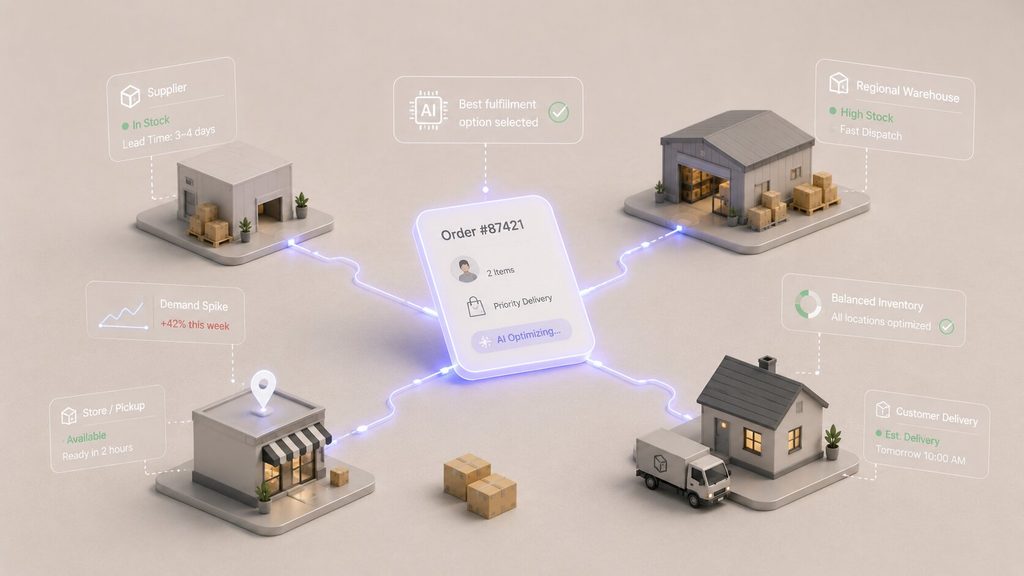
    Most AI-native conversations happen at the platform level: pricing tiers, SaaS dashboards, no-code app builders. We come at this from a different angle. As an Ahmedabad-based software engineering team, our focus is agent-first custom development, where AI agents handle the repeatable work and a human always reviews the outcomes that matter.

    That combination, agent-first execution paired with human-in-the-loop governance, is what separates AI-native systems that actually hold up in production from demos that look good in a pitch meeting. We build the data layer and the agent layer together, from the first sprint, not as a phase-two upgrade.

  • The Modern HealthTech Operating Model: Turning Patient Engagement & Operational Automation into Sustainable Growth

    The Modern HealthTech Operating Model: Turning Patient Engagement & Operational Automation into Sustainable Growth

    Healthcare leaders are under pressure from two directions at once: patients expect instant, personalized care, and boards expect leaner margins and measurable ROI. The organizations solving both problems are investing in patient engagement automation as a core part of their operating model, not as a side project bolted onto an old EHR.

    This shift is no longer optional. According to McKinsey‘s Provider Operating Model Survey, 81% of health system leaders say their current operating model is not effective or efficient, and 70% list operating model redesign among their top priorities, amid intensifying margin pressures and macroeconomic headwinds.

    Key Takeaways

    • Patient engagement automation reduces staff burden while improving adherence, satisfaction, and readmission rates.
    • Healthcare operational efficiency directly affects reimbursement, CAHPS scores, and margin, not just the back office.
    • Every automation layer must be built on HIPAA, SOC 2 Type II, and consent-first architecture, not patched in later.
    • Automation only works if it reaches every patient, including elderly and low-digital-literacy populations, via multilingual and SMS-first fallback options.
    • AI tools are becoming the default interface for patient questions, so health systems must modernize or lose the “source of truth” role.
    • Automation succeeds only when clinicians trust it and change management matters as much as the technology.
    • A federated operating model — governance centralized, execution local — drives the fastest gains in efficiency and quality.

    What Operational Efficiency in Healthcare Means for HealthTech Growth ?

    Operational efficiency in healthcare is a healthcare system’s ability to deliver consistent, high-quality care using fewer redundant processes, less manual labor, and better data. Most systems already have the technology, and what’s missing is a connected operating model.

    Let’s understand the real difference between traditional and modern operating model:

    Traditional ApproachModern Operating Model
    Reactive care deliveryPreventive, proactive care
    Manual administrative processesAI-assisted, automated workflows
    Disconnected patient dataInteroperable healthcare ecosystem
    Episodic patient touchpointsContinuous patient engagement
    Resource-heavy scalingTechnology-enabled scalability
    Compliance treated as an afterthoughtCompliance engineered into the architecture

    Why Patient Engagement Automation Is the Growth Lever

    Patients aren’t waiting for office hours to get answers. An OpenAI survey found that 60% of US adults have used AI tools for health-related questions in the past three months. Every health system is already competing with AI chatbots for patient trust. The winners aren’t banning AI—they are engineering their own compliant, AI-native engagement layer with custom event-driven pipelines so the health system stays the authoritative source.

    A modern stack typically includes video microlearning for pre- and post-visit instructions, omnichannel reminders tied to clinical triggers, EHR-integrated workflows that “prescribe” education automatically, and real-time analytics flagging patients who need human follow-up, resulting in fewer inbound calls, better-prepared patients, and reduced no-shows.

    Data Security, Privacy & Compliance

    When we talk about patient engagement automation strategy, the first key is and should always be compliance. An enterprise-grade AI-native healthcare architecture requires these strict baseline security protocols :

    • HIPAA compliance for every workflow touching Protected Health Information, including automated SMS, email, and chatbot interactions.
    • SOC 2 Type II certification for any vendor or cloud infrastructure handling patient data, proving controls hold up over time.
    • GDPR alignment if the health system serves EU patients or partners globally.
    • End-to-end encryption for data in transit and at rest, across every automated channel.
    • Granular patient consent management, so patients can opt in or out of specific communication types rather than a blanket consent.
    • Signed Business Associate Agreements (BAAs) with every vendor in the stack, including AI and messaging providers.

    A generic scheduling or chatbot tool that isn’t HIPAA-aware is a liability, not an efficiency gain. Self-scheduling platforms lacking a signed BAA should be disqualified immediately in vendor evaluation.

    Closing the Digital Divide: Accessibility for Every Patient

    Automation and AI chatbots only create value if every patient can use them. A meaningful share of the population elderly patients, rural populations, people with low digital literacy won’t download an app or navigate a complex portal.

    An inclusive patient engagement automation flow should include multi-language support, SMS fallback requiring no app or login, WCAG accessibility standards, and phone-based options for patients uncomfortable with text tools. Equity isn’t a “nice to have”, it determines whether automation reduces call center load or shifts the burden onto the patients least equipped to handle it.

    Importance of Healthcare Product Engineering

    None of this works without the right engineering foundation. Healthcare product engineering is the discipline of designing software, integrations, and data pipelines that make automation safe, compliant, and scalable. Most engagement failures aren’t caused by bad ideas.

    They’re caused by weak product engineering: brittle EHR integrations, siloed databases, and automation layered on broken workflows, which simply scales the inefficiency.

    The Real-World EHR Integration Challenge

    Interoperability sounds simple on a slide. In production, it’s the hardest part of any digital health product development project.

    Legacy platforms like Epic, Cerner, and Athenahealth each expose data differently. Their engineering teams routinely face inconsistent API implementations, rate limits, data mapping mismatches, and gaps between sandbox and production behavior.

    The teams that succeed treat EHR integration as its own product workstream, with dedicated data mapping and monitoring, rather than a one-time task to “get connected and move on.”

    Digital health product development needs a different mindset than typical enterprise software. It requires interoperability first with HL7/FHIR as the foundation, human in the loop design where AI drafts and flags but a clinician confirms anything touching a care decision, and an AI-Native, agent first architecture where specialized AI agents handle scheduling, education, and follow up with narrow, auditable responsibility.

    This is exactly how VectovateAI‘s software engineering team is approaching healthtech builds in 2026.

    Why Does Clinician Adoption Make or Break Automation?

    The most common reason a well-built automation platform fails is the staff resistance. Clinicians have been burned before by tools that promised to save time and instead added another screen to click through.

    A matched-control study at UChicago Medicine found clinicians using ambient AI documentation spent 8.5 percent less total time in the EHR, with over a 15 percent drop in time spent composing notes, multiple recovered hours per week for a clinician seeing 20 patients a day.

    Automation removes the charting fatigue that pulls doctors and nurses away from patient care. Health systems that lead with this message and involve clinicians in tool selection see far higher adoption than those that mandate a tool top-down.

    Tangible ROI: The Numbers Finance Teams Actually Want to See

    MetricReported Impact
    No-show rate reduction (automated reminders)25% to 38% reduction in missed appointments
    No-show reduction (AI-powered scheduling)Up to 42% reduction, outperforming manual reminders
    Inbound call center volumeUp to 50% drop after online self-scheduling
    Clinician burnout (30-day ambient AI pilot)Dropped from 51.9% to 38.8%
    Documentation time in the EHR8.5% less total time, 15%+ less time composing notes
    Cost per missed appointment~$200, scaling to $67,000+ per physician annually

    There’s also an indirect lever worth flagging for CFOs: reduced 30-day readmissions. CMS penalizes hospitals financially for excess readmissions under the Hospital Readmissions Reduction Program, so every improvement in post-discharge engagement and follow-up communication has a direct line to avoiding those penalties, on top of the savings above.

    Healthcare Operational Efficiency in Practice

    AI operational efficiency healthcare initiatives tend to succeed or fail based on governance, not technology. Chartis research found that a product-based structure, with a dedicated product manager owning a workflow in short agile cycles, consistently outperforms the traditional project-based IT model.

    MetricExample Target
    User satisfactionUp to 20% improvement through faster request handling
    Development speedUp to 25% reduction in project duration
    Incident resolutionUp to 30% faster mean time to resolve
    Internal revenue impactUp to 15% increase from improved product use

    The lesson for anyone evaluating healthcare operational efficiency tools is simple: the tool matters less than the operating model, compliance posture, and staff buy-in around it. A brilliant platform inside a fragmented governance structure will still underperform.

    A Practical Roadmap to Improve Operational Efficiency in Healthcare

    For teams asking how healthcare systems can improve operational efficiency through technology, the answer is a phased, deliberate rollout rather than a big-bang transformation.

    Step 1: Audit before automating:

    Map current workflows, staff burden, compliance gaps, and patient drop-off points before choosing any tool.

    Step 2: Build the compliance layer first:

    Confirm HIPAA readiness, SOC 2 Type II status of vendors, and consent management before a single automated message goes live.

    Step 3: Centralize standards, localize execution:

    McKinsey‘s research shows leading health systems are moving toward a federated model: governance, data standards, and shared services stay centralized, while day-to-day care delivery stays local. This approach has allowed systems to capitalize on AI solutions at scale across HR, finance, and other relevant departments while avoiding one-size-fits-all implementation at the facility level

    Step 4: Automate the highest-friction touchpoints first, with accessibility built in:

    Discharge instructions, appointment reminders, and pre-op education usually deliver the fastest ROI, but only if multilingual and SMS fallback options are included from day one.

    Step 5: Bring clinicians in early:

    Pilot with a small group, gather feedback, and communicate clearly that the goal is reducing charting fatigue, not replacing judgment.

    Step 6: Measure clinical, operational, and financial outcomes together:

    Track readmissions, CAHPS scores, no-show rates, call volume, and CMS penalty exposure side by side. One number alone tells an incomplete story.

    Conclusion

    The health systems that lead in the next few years will be the ones treating patient engagement automation, operational efficiency, compliance, accessibility, and clinician adoption as one connected strategy.

    The ideal software is the one that is agent-first where it makes sense, human-in-the-loop where it matters, and grounded in disciplined software engineering that turns a good idea into a system patients and providers can trust.

    Ready to build a patient engagement and automation strategy that’s secure, accessible, and clinician-approved from day one? Talk to our healthcare product engineering team today.

  • From Manual Healthcare Operations to Intelligent Operations: The 4-Pillar AI Framework HealthTech Companies Use to Drive Better Outcomes

    From Manual Healthcare Operations to Intelligent Operations: The 4-Pillar AI Framework HealthTech Companies Use to Drive Better Outcomes

    Most hospitals are drowning in sticky notes, endless spreadsheets, and five different software logins just to answer a single patient—and that operational mess is what actually drives clinician burnout and billing errors.

    Healthcare leaders need a clear approach to healthcare workflow automation that tells them where to start, what to automate first, how to layer in intelligence, and how to scale without losing control of the process.

    According to industry research from Grand View Research, Revenue Cycle Management and automated clinical workflows account for a massive share of healthcare IT adoption, while Fortune Business Insights projects AI deployment in healthcare operations to expand at over 43% CAGR through 2034. Organizations adopting a structured operational pipeline are already seeing clean claim rates approach 99% while drastically lowering cost-to-serve across multi-site care models.

    Here’s the 4-Pillar AI Framework leading HealthTech companies are using in 2026 to move from manual, reactive operations to proactive, intelligent ones with real use cases.

    Key Takeaways

    • Architectural Integration: High-performing HealthTech platforms build around four interconnected operational pillars rather than disconnected point software.
    • Elimination of Administrative Overhead: Workflow automation for healthcare strips away manual data entry, prior-authorization delays, and repetitive scheduling bottlenecks.
    • 24/7 Conversational Access: Healthcare AI agents extend patient intake, triage, and scheduling around the clock without inflating support staff headcount.
    • Proactive Interventions: Predictive analytics shifts operations from reactive to proactive by flagging risks and opportunities before they materialize.
    • Role-Tailored Visibility: Operational intelligence dashboards give leadership, managers, and care teams real-time, role-specific visibility into what’s actually working.

    The 4-Pillar AI Framework for Intelligent Healthcare Operations

    High-performing HealthTech companies are increasingly adopting a framework built around four interconnected pillars:

    • Pillar 1: Workflow Automation
    • Pillar 2: AI Agents & Intelligent Patient Engagement
    • Pillar 3: Predictive Analytics
    • Pillar 4: Operational Intelligence Dashboards

    Together, these pillars transform healthcare operations from reactive and manual to proactive and intelligent.

    Pillar 1: Workflow Automation

    Workflow automation is the foundation layer which targets the repeatable, rules-based tasks that quietly consume the majority of staff time across a healthcare organization, without requiring any change to clinical judgment or decision-making.

    For most organizations, this is where healthcare workflow automation software earns its keep first, and it’s the layer that turns scattered manual steps into a single, trackable process.

    What Can Be Automated?

    • Digital Intake & Dynamic Forms: Patients fill out intake forms online, and data syncs directly to the EHR via HL7/FHIR APIs—eliminating paper, lost files, and manual data re-entry.
    • Prior-Auth & Document Ingestion: Smart vision models parse medical faxes, notes, and insurance forms to prep prior-authorizations and route them directly to payers.
    • Automated Claims Validation: Pre-submission checks verify coding, coverage, and formats automatically to catch billing errors before they cause denials.
    • Rules-Based Routing: Referrals, lab orders, and sign-offs move through automated workflows, flagging staff only when human review is actually needed.

    Business Impact:

    When organizations automate healthcare provider workflows and move these processes off manual hands, they typically see:

    • Fewer scheduling errors and double-bookings
    • Reduced no-show rates through consistent, automated follow-up
    • Faster claims turnaround and fewer denials caused by manual data-entry mistakes
    • Lower administrative overhead per patient interaction
    • Clinical and administrative teams redirected toward complex care management.

    For most teams, the decision to automate healthcare workflow is about giving them back the hours currently lost to manual coordination.

    Pillar 2: AI Agents & Intelligent Patient Engagement

    The next layer is extending an organization’s capacity for AI patient engagement, reaching patients beyond business hours and beyond what human staff alone could ever manage at scale.

    How AI Agents Help:

    • Answering patient questions and routing requests around the clock, patients get responses at 11 PM on a Sunday, not just during office hours.
    • Guiding patients through self-service scheduling and intake, instead of waiting on hold, patients complete these steps conversationally, on their own time.
    • Sending personalized, two-way engagement and reminders, a conversation the patient can respond to, reschedule from, or ask a follow-up question in.
    • Supporting multilingual, always-on patient communication, removing language as a barrier to access, especially in diverse patient populations.

    Benefits for Healthcare Organizations

    • 24/7 responsiveness without scaling headcount linearly
    • Faster response times, which directly correlate with higher patient satisfaction scores
    • Patients get the same quality of information regardless of who (or what) they’re interacting with
    • Staff are freed from repetitive inbound questions (“what time is my appointment,” “do I need to fast before this test”) and can focus on more complex, higher-value interactions
    • Better first-contact resolution, since agents can be trained on the organization’s specific policies and workflows

    The key nuance here: healthcare AI agents work best as an extension of the team, not a wall between the patient and the organization. Escalation paths to a human need to be clear and fast whenever the conversation goes beyond what the agent should handle.

    Pillar 3: Predictive Analytics

    Predictive analytics converts raw operational data into forward-looking intelligence. Rather than discovering operational bottlenecks in a post-mortem monthly financial review, leadership and care management teams identify forming risks early enough to intervene.

    Key Use Cases

    • Forecasting patient demand and appointment volume, anticipating busy periods so staffing and scheduling capacity are matched to actual demand, not guessed at.
    • Identifying patients at risk of no-shows or disengagement, flagging patterns (missed past appointments, delayed responses, drop-off in communication) before the patient is lost entirely.
    • Flagging retention risk before it happens, spotting early signals that a patient may be shopping around or disengaging from a care plan.
    • Surfacing early signals in claims and billing that predict denials, catching the patterns that historically lead to a denied claim before submission, not after.

    Business Impact

    • Retention improves because intervention happens early, not after the patient has already left
    • Denial rates drop because problematic claims get caught and corrected before submission
    • Staffing and resource allocation become data-driven instead of based on gut feel or last year’s numbers
    • Leadership gets a forward-looking view of the business instead of only a historical one

    Predictive analytics depends heavily on the first two pillars, and it needs the clean, structured data that automated workflows and AI agent interactions generate. Sequencing matters a lot: you can’t predict well on messy, fragmented data, which is exactly why AI in healthcare workflow automation works best as a layered build.

    Pillar 4: Operational Intelligence Dashboards

    The final pillar turns everything generated by the first three into actionable, real-time intelligence tailored to who’s actually looking at it, because an executive, a department manager, and a care team need very different views of the same underlying data.

    Executive-Level Visibility: Leadership teams can monitor:

    • Patient acquisition
    • Patient retention
    • Revenue performance
    • Provider utilization
    • Operational efficiency

    Operational Visibility: Managers gain insight into:

    • Appointment volumes
    • Response times
    • Support performance
    • Staff productivity
    • Workflow effectiveness

    Clinical Visibility: Care teams can track:

    • Treatment adherence
    • Follow-up completion
    • Patient engagement levels
    • Outcome indicators

    Real-time dashboards turn data into actionable intelligence with a living view that surfaces problems and opportunities as they happen, so it is easier to make decisions before it escalates.

    How do these Four Pillars Work Together?

    Many organizations invest in one of these capabilities in isolation: a scheduling automation tool here, and a chatbot there. The highest-performing organizations connect all four, so each pillar strengthens the next.

    The transformation journey typically follows this sequence:

    Step 1: Automate Processes

    Deploy workflow automation to eliminate manual friction and establish clean, structured data pipelines.

    Step 2: Deploy AI Agents

    Deploy specialized AI agents to handle routine patient communications and intake around the clock.

    Step 3: Generate Predictive Insights

    Identify risks and opportunities before they occur, using the data generated by Steps 1 and 2.

    Step 4: Monitor Through Dashboards

    Monitor all system operational metrics via real-time dashboards, refining workflows dynamically.

    This interconnected architecture ensures that every patient interaction, automated claim, and scheduling update makes the overall system faster, smarter, and more cost-effective.

    Real-World Comparison: Manual vs. Intelligent Architecture

    Operational AreaLegacy / Manual ModelIntelligent 4-Pillar Framework
    Patient Intake & SchedulingManual phone calls, paper forms, static spreadsheets.Automated digital intake forms synced directly via FHIR APIs.
    Patient CommunicationLimited to office hours; slow response times.24/7 conversational AI agents with human care escalation paths.
    Claim & Prior-Auth ManagementManual data entry across multiple legacy payer portals.Automated OCR/LLM document parsing with pre-submission validation.
    No-Show ManagementReactive phone follow-ups after a missed appointment.Predictive risk-scoring that identifies and re-engages patients early.
    Operational VisibilityStatic, backward-looking month-end spreadsheets.Real-time, role-tailored dashboards tracking live KPIs.

    Navigating Security and Compliance

    When upgrading healthcare software, security and interoperability cannot be afterthoughts. Intelligent operational systems must meet strict enterprise standards:

    • EHR Interoperability: Systems must leverage modern HL7/FHIR protocols for seamless data exchange across platforms like Epic, Cerner, and Athenahealth.
    • Data Security & Privacy: Architectures handling PHI must be fully HIPAA and PHIPA compliant, featuring end-to-end encryption, zero-data-retention LLM agreements, and SOC 2 Type II logging.
    • Deterministic Guardrails: AI agents must use bounded prompt architectures with zero-hallucination controls, automatically routing medical advice requests to human clinical staff.

    The Future of Healthcare Operations

    Manual processes can’t keep up with modern patient expectations. People want the same speed and convenience from healthcare that they get everywhere else online.

    The organizations leading the shift are building a connected system:

    • Automation: Stripping away operational friction.
    • AI Agents: Extending patient support 24/7.
    • Predictive Analytics: Catching bottlenecks and denials early.
    • Real-Time Dashboards: Giving executives and care teams instant operational clarity.

    Final Words

    The journey from manual healthcare operations to intelligent operations is a competitive necessity.

    Organizations that embrace Workflow Automation, AI Agents, Predictive Analytics, and Operational Intelligence create a foundation for sustainable growth and superior patient outcomes.

    At VectovateAI, we help healthcare organizations build AI-native solutions that transform fragmented processes into intelligent, data-driven operations. By combining automation, AI, analytics, and operational visibility, healthcare organizations can reduce costs, improve patient engagement, and unlock measurable business outcomes through workflow automation healthcare teams can actually rely on day to day.