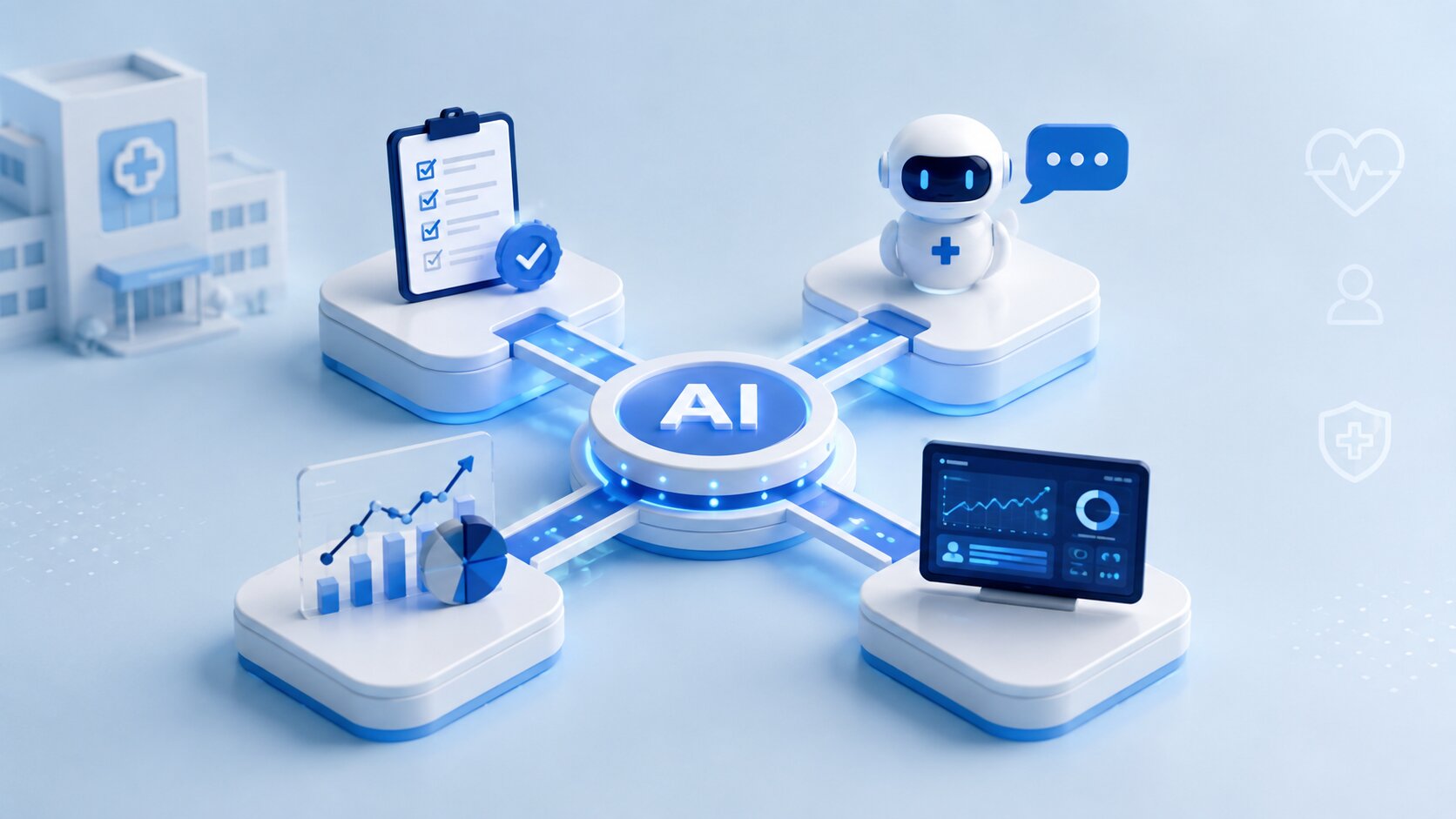
Most hospitals are drowning in sticky notes, endless spreadsheets, and five different software logins just to answer a single patient—and that operational mess is what actually drives clinician burnout and billing errors.
HealthTech and healthcare leaders need a clear approach to healthcare workflow automation that tells them where to start, what to automate first, how to layer in intelligence, and how to scale without losing control of the process.
According to industry research from Grand View Research, Revenue Cycle Management and automated clinical workflows account for a massive share of healthcare IT adoption, while Fortune Business Insights projects AI deployment in healthcare operations to expand at over 43% CAGR through 2034. Organizations adopting a structured operational pipeline are already seeing clean claim rates approach 99% while drastically lowering cost-to-serve across multi-site care models.
Here’s the 4-Pillar AI Framework leading HealthTech companies are using in 2026 to move from manual, reactive operations to proactive, intelligent ones with real use cases.
Key Takeaways
- Architectural Integration: High-performing HealthTech platforms build around four interconnected operational pillars rather than disconnected point software.
- Elimination of Administrative Overhead: Workflow automation for healthcare strips away manual data entry, prior-authorization delays, and repetitive scheduling bottlenecks.
- 24/7 Conversational Access: Healthcare AI agents extend patient intake, triage, and scheduling around the clock without inflating support staff headcount.
- Proactive Interventions: Predictive analytics shifts operations from reactive to proactive by flagging risks and opportunities before they materialize.
- Role-Tailored Visibility: Operational intelligence dashboards give leadership, managers, and care teams real-time, role-specific visibility into what’s actually working.
The 4-Pillar AI Framework for Intelligent Healthcare Operations
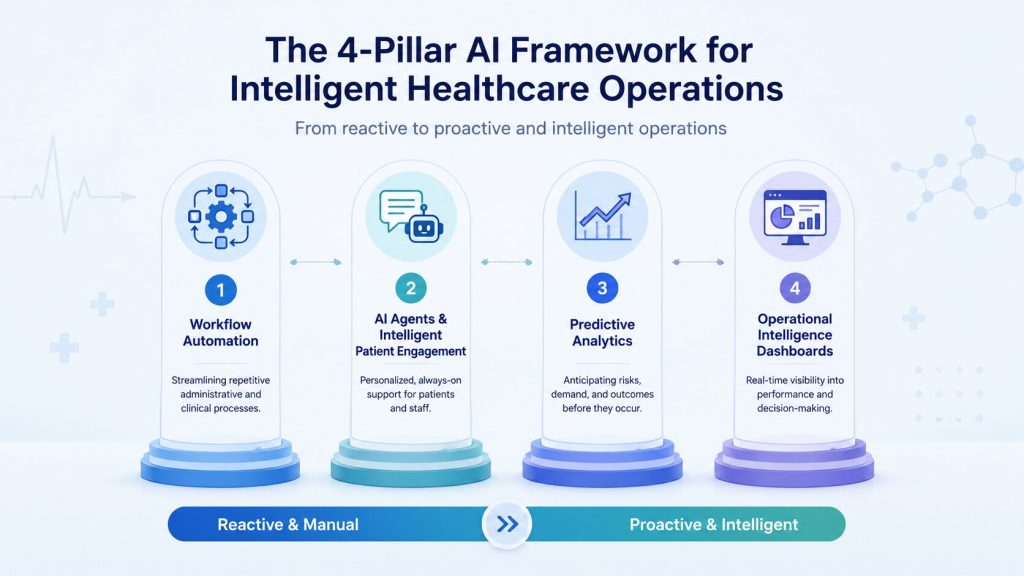
High-performing HealthTech companies are increasingly adopting a framework built around four interconnected pillars:
- Pillar 1: Workflow Automation
- Pillar 2: AI Agents & Intelligent Patient Engagement
- Pillar 3: Predictive Analytics
- Pillar 4: Operational Intelligence Dashboards
Together, these pillars transform healthcare operations from reactive and manual to proactive and intelligent.
Pillar 1: Healthcare Workflow Automation
Workflow automation is the foundation layer which targets the repeatable, rules-based tasks that quietly consume the majority of staff time across a healthcare organization, without requiring any change to clinical judgment or decision-making.
For most organizations, this is where healthcare workflow automation software earns its keep first, and it’s the layer that turns scattered manual steps into a single, trackable process.
What Can Be Automated?
- Digital Intake & Dynamic Forms: Patients fill out intake forms online, and data syncs directly to the EHR via HL7/FHIR APIs—eliminating paper, lost files, and manual data re-entry.
- Prior-Auth & Document Ingestion: Smart vision models parse medical faxes, notes, and insurance forms to prep prior-authorizations and route them directly to payers.
- Automated Claims Validation: Pre-submission checks verify coding, coverage, and formats automatically to catch billing errors before they cause denials.
- Rules-Based Routing: Referrals, lab orders, and sign-offs move through automated workflows, flagging staff only when human review is actually needed.
Business Impact:
When organizations automate healthcare provider workflows and move these processes off manual hands, they typically see:
- Fewer scheduling errors and double-bookings
- Reduced no-show rates through consistent, automated follow-up
- Faster claims turnaround and fewer denials caused by manual data-entry mistakes
- Lower administrative overhead per patient interaction
- Clinical and administrative teams redirected toward complex care management.
For most teams, the decision to automate healthcare workflow is about giving them back the hours currently lost to manual coordination.
Pillar 2: AI Agents & Intelligent Patient Engagement
The next layer is extending an organization’s capacity for AI patient engagement, reaching patients beyond business hours and beyond what human staff alone could ever manage at scale.
How AI Agents Help:
- Answering patient questions and routing requests around the clock, patients get responses at 11 PM on a Sunday, not just during office hours.
- Guiding patients through self-service scheduling and intake, instead of waiting on hold, patients complete these steps conversationally, on their own time.
- Sending personalized, two-way engagement and reminders, a conversation the patient can respond to, reschedule from, or ask a follow-up question in.
- Supporting multilingual, always-on patient communication, removing language as a barrier to access, especially in diverse patient populations.
Benefits for Healthcare Organizations
- 24/7 responsiveness without scaling headcount linearly
- Faster response times, which directly correlate with higher patient satisfaction scores
- Patients get the same quality of information regardless of who (or what) they’re interacting with
- Staff are freed from repetitive inbound questions (“what time is my appointment,” “do I need to fast before this test”) and can focus on more complex, higher-value interactions
- Better first-contact resolution, since agents can be trained on the organization’s specific policies and workflows
The key nuance here: healthcare AI agents work best as an extension of the team, not a wall between the patient and the organization. Escalation paths to a human need to be clear and fast whenever the conversation goes beyond what the agent should handle.
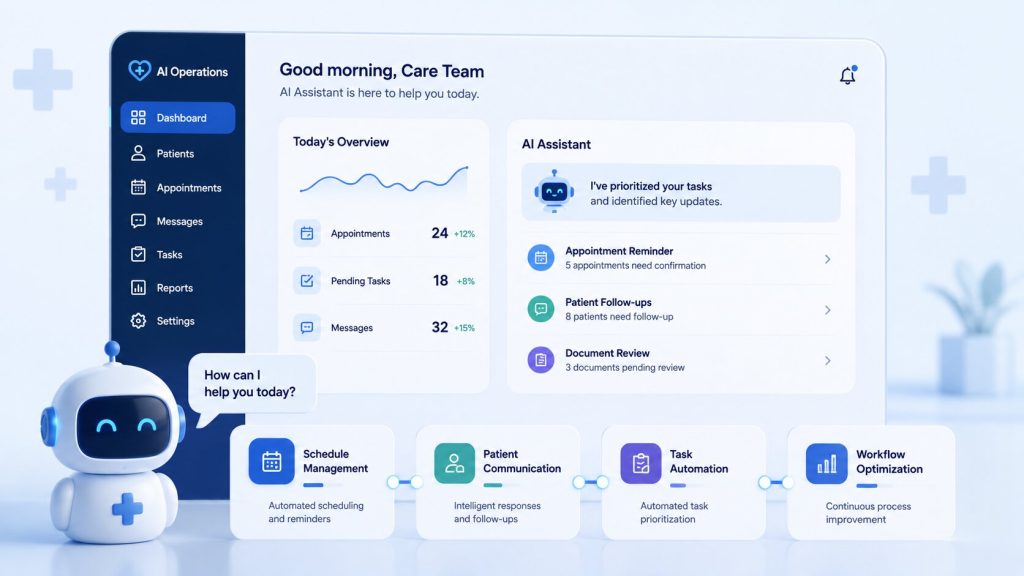
Pillar 3: Predictive Analytics
Predictive analytics converts raw operational data into forward-looking intelligence. Rather than discovering operational bottlenecks in a post-mortem monthly financial review, leadership and care management teams identify forming risks early enough to intervene.
Key Use Cases
- Forecasting patient demand and appointment volume, anticipating busy periods so staffing and scheduling capacity are matched to actual demand, not guessed at.
- Identifying patients at risk of no-shows or disengagement, flagging patterns (missed past appointments, delayed responses, drop-off in communication) before the patient is lost entirely.
- Flagging retention risk before it happens, spotting early signals that a patient may be shopping around or disengaging from a care plan.
- Surfacing early signals in claims and billing that predict denials, catching the patterns that historically lead to a denied claim before submission, not after.
Business Impact
- Retention improves because intervention happens early, not after the patient has already left
- Denial rates drop because problematic claims get caught and corrected before submission
- Staffing and resource allocation become data-driven instead of based on gut feel or last year’s numbers
- Leadership gets a forward-looking view of the business instead of only a historical one
Predictive analytics depends heavily on the first two pillars, and it needs the clean, structured data that automated workflows and AI agent interactions generate. Sequencing matters a lot: you can’t predict well on messy, fragmented data, which is exactly why AI in healthcare workflow automation works best as a layered build.
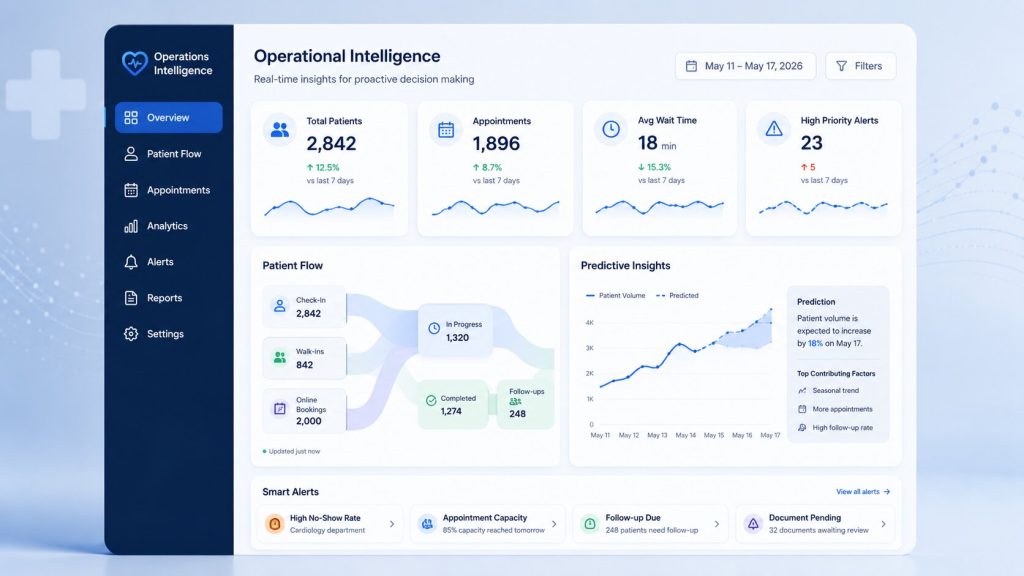
Pillar 4: Operational Intelligence Dashboards
The final pillar turns everything generated by the first three into actionable, real-time intelligence tailored to who’s actually looking at it, because an executive, a department manager, and a care team need very different views of the same underlying data.
Executive-Level Visibility: Leadership teams can monitor:
- Patient acquisition
- Patient retention
- Revenue performance
- Provider utilization
- Operational efficiency
Operational Visibility: Managers gain insight into:
- Appointment volumes
- Response times
- Support performance
- Staff productivity
- Workflow effectiveness
Clinical Visibility: Care teams can track:
- Treatment adherence
- Follow-up completion
- Patient engagement levels
- Outcome indicators
Real-time dashboards turn data into actionable intelligence with a living view that surfaces problems and opportunities as they happen, so it is easier to make decisions before it escalates.
How do these Four Pillars Work Together?
Many organizations invest in one of these capabilities in isolation: a scheduling automation tool here, and a chatbot there. The highest-performing organizations connect all four, so each pillar strengthens the next.
The transformation journey typically follows this sequence:
Step 1: Automate Processes
Deploy workflow automation to eliminate manual friction and establish clean, structured data pipelines.
Step 2: Deploy AI Agents
Deploy specialized AI agents to handle routine patient communications and intake around the clock.
Step 3: Generate Predictive Insights
Identify risks and opportunities before they occur, using the data generated by Steps 1 and 2.
Step 4: Monitor Through Dashboards
Monitor all system operational metrics via real-time dashboards, refining workflows dynamically.
This interconnected architecture ensures that every patient interaction, automated claim, and scheduling update makes the overall system faster, smarter, and more cost-effective.
Real-World Comparison: Manual vs. Intelligent Architecture
| Operational Area | Legacy / Manual Model | Intelligent 4-Pillar Framework |
|---|---|---|
| Patient Intake & Scheduling | Manual phone calls, paper forms, static spreadsheets. | Automated digital intake forms synced directly via FHIR APIs. |
| Patient Communication | Limited to office hours; slow response times. | 24/7 conversational AI agents with human care escalation paths. |
| Claim & Prior-Auth Management | Manual data entry across multiple legacy payer portals. | Automated OCR/LLM document parsing with pre-submission validation. |
| No-Show Management | Reactive phone follow-ups after a missed appointment. | Predictive risk-scoring that identifies and re-engages patients early. |
| Operational Visibility | Static, backward-looking month-end spreadsheets. | Real-time, role-tailored dashboards tracking live KPIs. |
Healthcare Automation Solutions: Build, Buy or Integrate?
Once the sequence is clear, the next question is tooling. HealthTech teams usually choose from four types of healthcare automation solutions, and most platforms end up using more than one:
- RPA bots: Scripted bots that click through legacy payer portals and EHR screens. Quick to deploy, but brittle when a screen layout changes.
- Intelligent document processing: OCR and LLM models that read faxes, referrals and insurance cards, then pass structured data downstream.
- Low-code workflow platforms: Tools like n8n or Power Automate for internal routing and notifications. Fast for operations teams, limited inside a customer-facing product.
- Custom, API-native automation: Workflows built into your own product and connected to EHRs over HL7/FHIR. More engineering up front, full control over data, logic and the patient experience.
For a HealthTech company, the test is simple. If the workflow is part of what your customers pay for, build it into the product. If it only runs your back office, buy or configure it.
Patient intake is where most teams start, because it touches every pillar that follows. Our guide to patient onboarding automation walks through that build step by step.
Navigating Security and Compliance
When upgrading healthcare software, security and interoperability cannot be afterthoughts. Intelligent operational systems must meet strict enterprise standards:
- EHR Interoperability: Systems must leverage modern HL7/FHIR protocols for seamless data exchange across platforms like Epic, Cerner, and Athenahealth.
- Data Security & Privacy: Architectures handling PHI must be fully HIPAA and PHIPA compliant, featuring end-to-end encryption, zero-data-retention LLM agreements, and SOC 2 Type II logging.
- Deterministic Guardrails: AI agents must use bounded prompt architectures with zero-hallucination controls, automatically routing medical advice requests to human clinical staff.
Best Practices for Workflow Automation in Healthcare
The framework tells you what to build. These practices decide whether it gets adopted:
- Map the workflow before you automate it: Shadow the real process, count the handoffs and logins, and find where work waits. Automating a broken process only makes it fail faster.
- Start with one high-volume, rules-based workflow: Intake, eligibility checks or appointment reminders. Prove the gain there before touching anything clinical.
- Design the human handoff first: Every automated flow needs a clear exception queue and a named owner for what the rules cannot handle.
- Integrate through FHIR, not screen scraping: API-level EHR connections survive vendor updates. Bots sitting on top of a UI break quietly.
- Log everything from day one: An audit trail for every automated action makes compliance reviews easier and gives your predictive analytics layer the clean data it needs.
- Measure against a baseline: Record turnaround time, error rate and staff hours before launch, so the ROI case rests on your own numbers.
The Future of Healthcare Operations
Manual processes can’t keep up with modern patient expectations. People want the same speed and convenience from healthcare that they get everywhere else online.
The organizations leading the shift are building a connected system:
- Automation: Stripping away operational friction.
- AI Agents: Extending patient support 24/7.
- Predictive Analytics: Catching bottlenecks and denials early.
- Real-Time Dashboards: Giving executives and care teams instant operational clarity.
Final Words
The journey from manual healthcare operations to intelligent operations is a competitive necessity.
Organizations that embrace Workflow Automation, AI Agents, Predictive Analytics, and Operational Intelligence create a foundation for sustainable growth and superior patient outcomes.
At VectovateAI, we help healthcare organizations build AI-native solutions that transform fragmented processes into intelligent, data-driven operations. By combining automation, AI, analytics, and operational visibility, healthcare organizations can reduce costs, improve patient engagement, and unlock measurable business outcomes through workflow automation healthcare teams can actually rely on day to day.
See the four pillars applied in our clinical scheduling automation case study, which lifted clinical efficiency by 35%, and read the modern HealthTech operating model for the strategy layer above it.
Ready to map the four pillars onto your own operations? Book a Free Healthcare AI Architecture Review with VectovateAI
Leave a Reply