
Walk into almost any hospital today, and you’ll feel it. Waiting rooms are packed. Nurses are running on fumes. Doctors are drowning in patient data they barely have time to read, let alone act on. Something has to give.
That’s exactly where AI in healthcare comes in. And no, this isn’t some far-off promise anymore. It’s already sitting in the room with doctors as they diagnose, in the back office as hospitals plan staffing, and in patients’ pockets as they get answers at 2 AM instead of waiting for a callback.
So what’s actually changed in 2026? That’s what this blog is here to unpack, with real data, real use cases, and a clear look at where the opportunity sits for your hospital, clinic, or health-tech business.
Key Takeaways
- AI in healthcare is already delivering measurable results, with around 60% of providers reporting improved outcomes.
- AI medical diagnosis tools now match or exceed human accuracy in specific imaging tasks like cancer detection.
- Generative AI in healthcare is moving beyond diagnostics into documentation, drug discovery, and patient communication.
- Conversational AI and AI voice agents are cutting no-shows and improving patient access to care.
- Strong AI governance in healthcare and clear ethical concerns management are non-negotiable for safe adoption.
What Does AI in Healthcare Actually Mean?
AI in healthcare means using intelligent systems to support clinical and operational decisions. It is all about providing doctors with the right tools and not replacing them. AI can assist doctors and lower their burden, so that they can entirely focus on treating patients.
These systems learn from patient records, lab results, medical images, and clinical notes. They spot patterns that are easy for humans to miss. They flag risks early. They speed up tasks that used to take hours.
Unlike older hospital software that just follows fixed rules, modern AI adapts. It gets better as it sees more data. And it works across settings, from big hospitals to small clinics to home-monitoring devices.
Why 2026 Is a Turning Point
Healthcare systems worldwide are under real pressure. Aging populations, chronic disease, and workforce shortages are pushing hospitals toward breaking point. According to Capgemini’s 2026 healthcare trends research, more than half of health spending among adults aged 55 and above already goes toward managing conditions that earlier detection could have prevented.
This is why the industry is shifting from reactive care to proactive care. Instead of treating illness after it becomes serious, providers are using AI predictive analytics in healthcare to catch risks before they escalate. That shift alone is redefining how hospitals plan budgets, staff shifts, and treatment protocols.
Top Benefits of AI in Healthcare
The benefits of AI in healthcare go beyond faster paperwork. Here is where the real impact shows up:
| Benefit | What It Means in Practice |
|---|---|
| AI medical diagnosis | AI reads X-rays, MRIs, and CT scans to catch early-stage tumors and abnormalities that are easy to miss on a busy shift. |
| Faster data processing | Reviewing thousands of patient records now takes minutes instead of weeks. |
| Personalized treatment | AI studies a patient’s history and lifestyle data to recommend care plans built around them. |
| Operational efficiency | Hospitals use AI to manage schedules, staffing, and bed capacity, cutting down avoidable delays. |
| Predictive insights | Providers get early warnings on chronic disease flare-ups and even population-level outbreak trends. |
Around 60% of healthcare providers already report better outcomes after adopting AI tools, which shows this is not experimental technology anymore. It is delivering measurable results today.
Generative AI in Healthcare: A New Layer of Capability
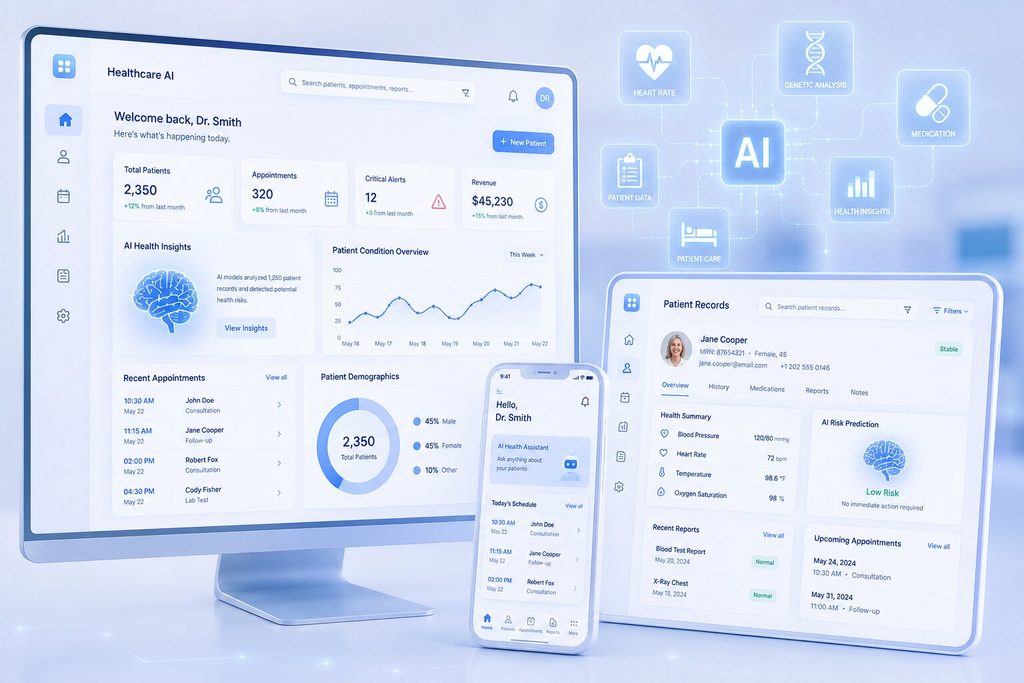
Generative AI in healthcare is opening doors that traditional machine learning could not. Instead of just flagging patterns, generative models can draft clinical notes, summarize patient histories, and even simulate how a disease might progress under different treatment paths.
Some of the strongest generative AI use cases in healthcare right now include:
- Clinical documentation: Doctors dictate notes, and AI drafts structured records in seconds.
- Drug discovery: AI models scan millions of chemical compounds to shortlist promising treatments, cutting years off early research.
- Patient education: Generative tools turn complex diagnoses into plain-language explanations patients can actually understand.
- Synthetic data for training: Hospitals use AI-generated (privacy-safe) patient data to train new models without exposing real records.
This is where the technical edge matters. Instead of just processing information, generative AI creates useful output from it, which is a big shift for time-strapped clinical teams.
Conversational AI and Voice Agents in Healthcare
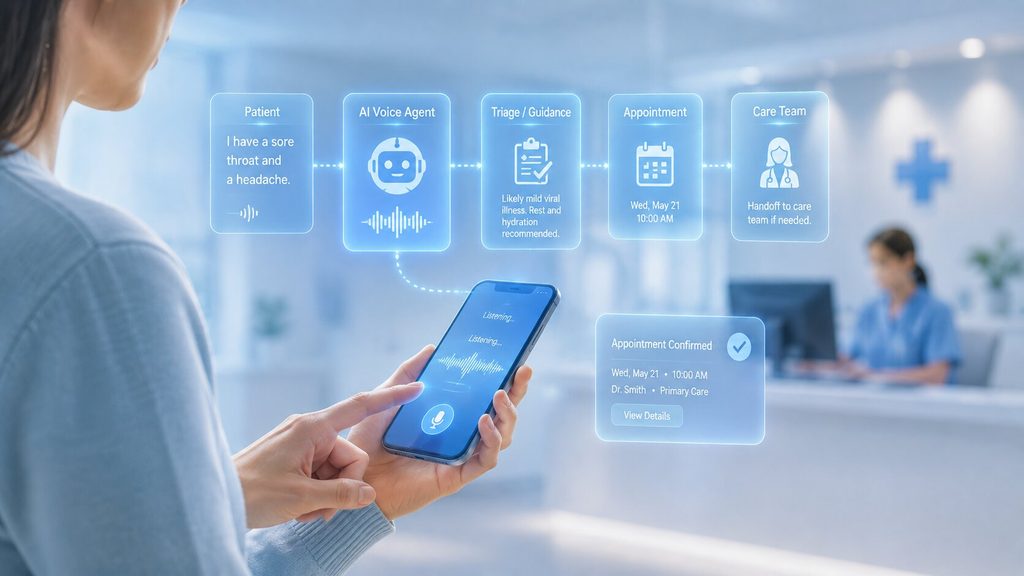
Patients want quick answers without having to hear hold music. Conversational AI in healthcare is now handling appointment booking, medication reminders, and basic symptom triage around the clock.
Recent patient-engagement research shows that a majority of patients would switch providers because of poor communication, and a significant share skip booking appointments entirely due to long phone waits. That is a direct revenue and outcomes problem, and it is exactly what conversational tools are built to fix.
An AI voice agent in healthcare takes this further. Instead of typing into a chatbot, patients simply speak, whether to check prescription refills, confirm appointment times, or get pre-visit instructions. For clinics, this means:
- Fewer missed calls and no-shows
- Round-the-clock patient support without adding headcount
- Faster triage, since urgent symptoms get flagged and escalated immediately
This is also becoming a core piece of the AI workflow assistant healthcare category, where AI does not just talk to patients but also automates the back-office grind: scheduling, claims processing, and clinical documentation, freeing staff to focus on actual patient care.
Real-World Applications Making an Impact

Here is where AI is already working:
- Predictive patient monitoring: In ICUs, AI tracks heart rate, oxygen levels, and blood pressure in real time, alerting staff before complications occur.
- AI-powered telemedicine: Remote platforms use AI to triage symptoms and prioritize patients needing urgent attention, extending quality care to rural and underserved regions.
- Early disease detection: AI imaging tools used for breast cancer screening now reach accuracy levels around 94%, catching tumors that could be missed by the human eye.
- Readmission reduction: Predictive models are helping hospitals cut readmission rates by up to 20% through better discharge planning and follow-up.
Pros and Cons of AI in Healthcare
No technology this powerful comes without trade-offs. Here is a balanced look at the pros and cons of AI in healthcare:
| Pros | Cons |
|---|---|
| Faster, more accurate diagnostics | High upfront implementation cost |
| Reduced administrative burden on staff | Risk of algorithmic bias if training data is unbalanced |
| Round-the-clock patient support | Regulatory approval can slow deployment |
| Better resource and bed management | Building patient and staff trust takes time |
| Early risk detection and prevention | Data privacy is a constant, serious concern |
Ethical Concerns and Governance in AI Healthcare
The ethical concerns of AI in healthcare are real and cannot be brushed aside. When AI helps decide who gets priority care or flags a high-risk pregnancy, the stakes are life and death. A wrong or biased output is not a minor bug; it is a patient safety issue.
This is why AI governance in healthcare has become a board-level priority. The World Health Organization has flagged that AI adoption in health is moving faster than the legal safeguards meant to govern it, with very few countries having clear liability standards for AI-driven medical decisions.
Strong governance in 2026 typically covers:
- Data privacy compliance, aligned with regulations like HIPAA, GDPR, PIPEDA, and PHIPA
- Bias audits, to make sure AI models perform fairly across different patient groups
- Explainability, so clinicians understand why an AI flagged a particular risk
- Human-in-the-loop checkpoints, ensuring a qualified professional reviews AI recommendations before they affect care decisions
This is also exactly why more hospitals and health-tech companies are turning to AI healthcare consulting partners. Getting the technology right is only half the job. Getting the governance, compliance, and change management right is what actually makes AI adoption safe and sustainable.
The Future of AI in Healthcare
The future of AI in healthcare points toward care that is predictive, personalized, and deeply human at the same time. Expect to see:
- Robotic surgery with AI-assisted precision becoming more common
- Deeper integration between AI and telemedicine for smarter remote care
- Genomic data feeding directly into personalized treatment plans
- Wearables offering real-time health insights that plug straight into clinical systems
The technology won’t replace the human touch. It will remove the noise, so doctors can spend more time actually treating patients instead of digging through data.
Conclusion
AI in healthcare is no longer a distant trend to watch. It is already changing how doctors diagnose, how hospitals run, and how patients get care every single day.
From catching early-stage cancer in scans to cutting patient no-shows with conversational AI, the impact is practical and measurable.
The organizations that move now, with the right governance and the right partner, will be the ones setting the pace for 2026 and beyond.
Ready to bring AI into your healthcare operations the right way? VectovateAI helps hospitals, clinics, and health-tech teams build AI solutions that actually work, safely, ethically, and built around real patient outcomes. Talk to our AI Architects to kick-start your project.
Leave a Reply