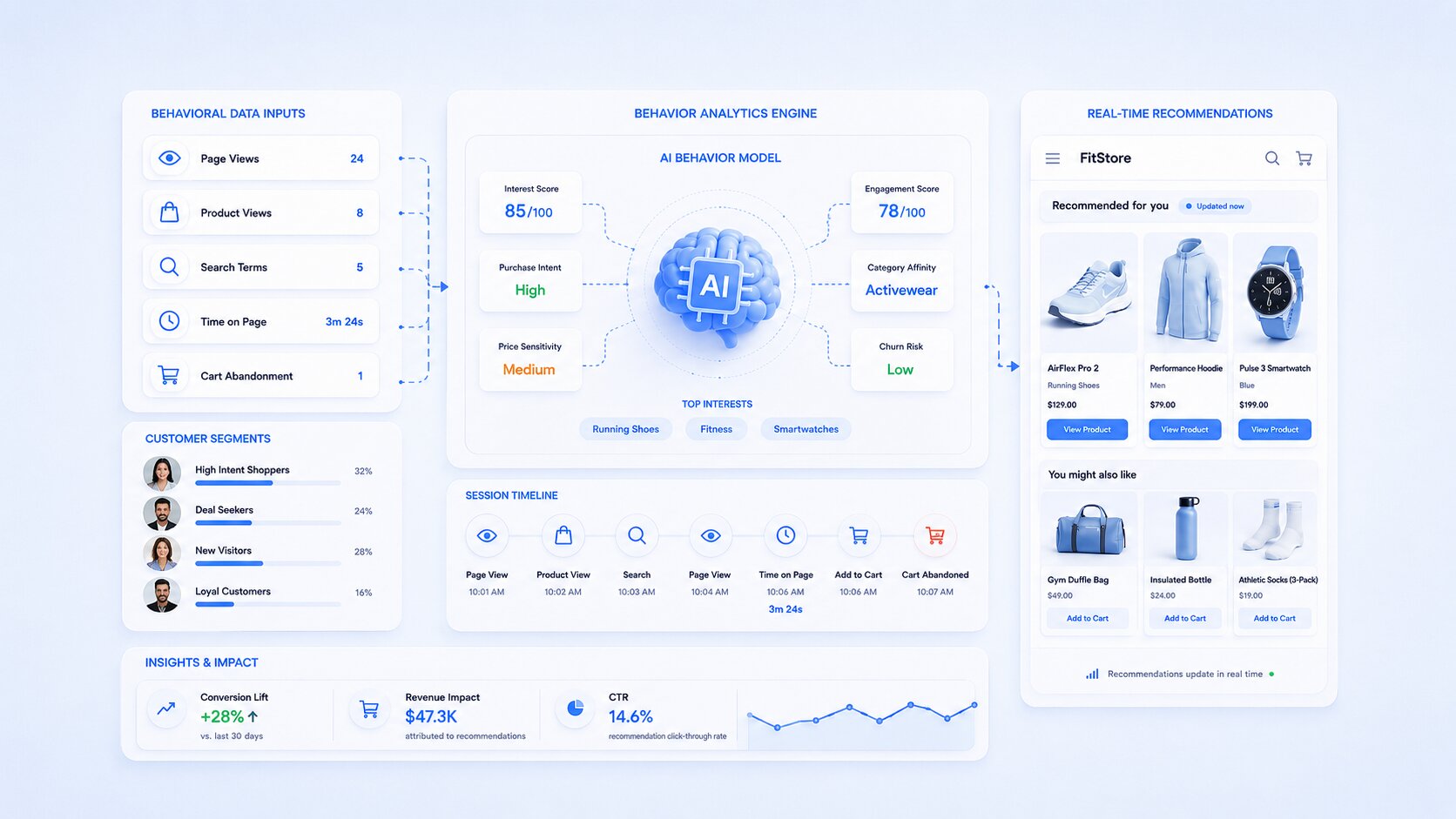
Every online store owner asks the same question at some point. Why do some shoppers buy more, faster, while others bounce after one page view? The answer, most of the time, is personalization. A well-built AI recommendation engine ecommerce brands rely on studies of each visitor’s behavior in real time and shows them products they actually want. Not generic bestsellers. Not random upsells. Real, relevant picks.
This is not a nice-to-have anymore. It is the difference between a store that scales and one that stalls.
Key Takeaways:
- An AI recommendation engine ecommerce stores use today can lift AOV by 15% to 25%, and in some cases much higher, when paired with strong behavioral data.
- Amazon still generates roughly 35% of its sales through personalized recommendations, the industry’s most cited proof point.
- Sessions where shoppers engage with a recommendation widget show AOV jumps as high as 369% compared to sessions without one.
- Ecommerce personalization software is not just for enterprise brands anymore. Mid-market and even free ecommerce personalization software options now exist for smaller catalogs.
- Personalization for anonymous and first-time shoppers is where most stores leave money on the table, and it is fixable with the right engine.
What Is an AI Recommendation Engine in eCommerce?
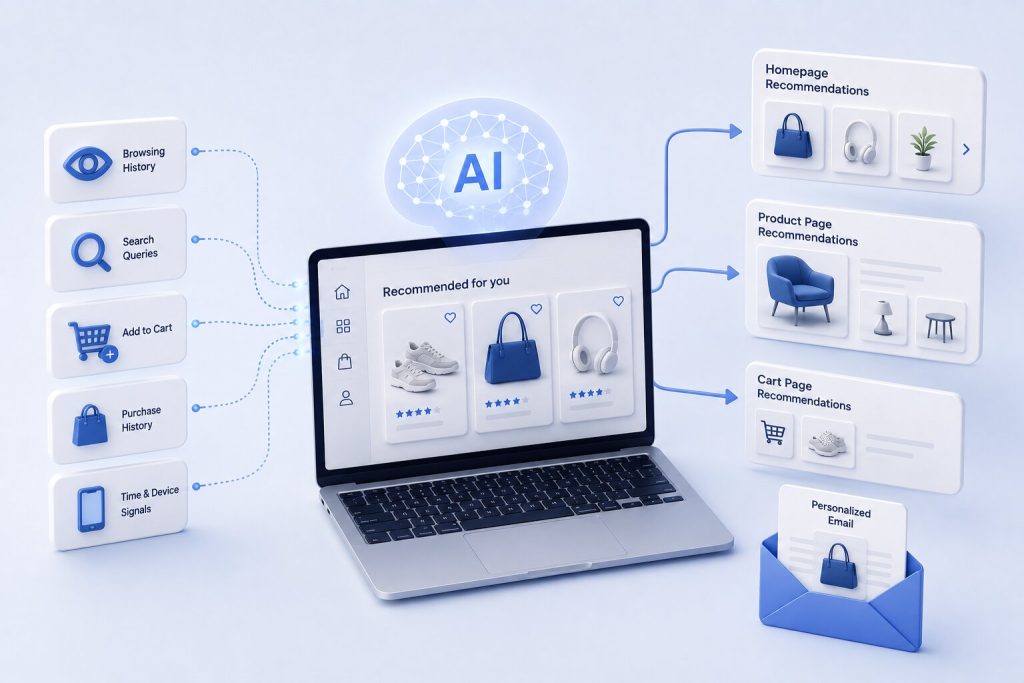
An AI recommendation engine ecommerce platforms use is a system that analyzes browsing patterns, purchase history, cart behavior, and even time-of-day activity to predict what a shopper wants next. It runs on machine learning models that get smarter with every click.
Unlike old-school “customers also bought” widgets, modern engines use customer behavior analytics to build a live profile of each visitor. This profile updates in real time. So the homepage a shopper sees on Monday morning can look completely different from what they see Friday evening, based on what they browsed in between.
Three components typically power this system:
- Data collection layer: tracks clicks, scroll depth, cart adds, and search queries
- Prediction model: scores products based on likelihood of purchase
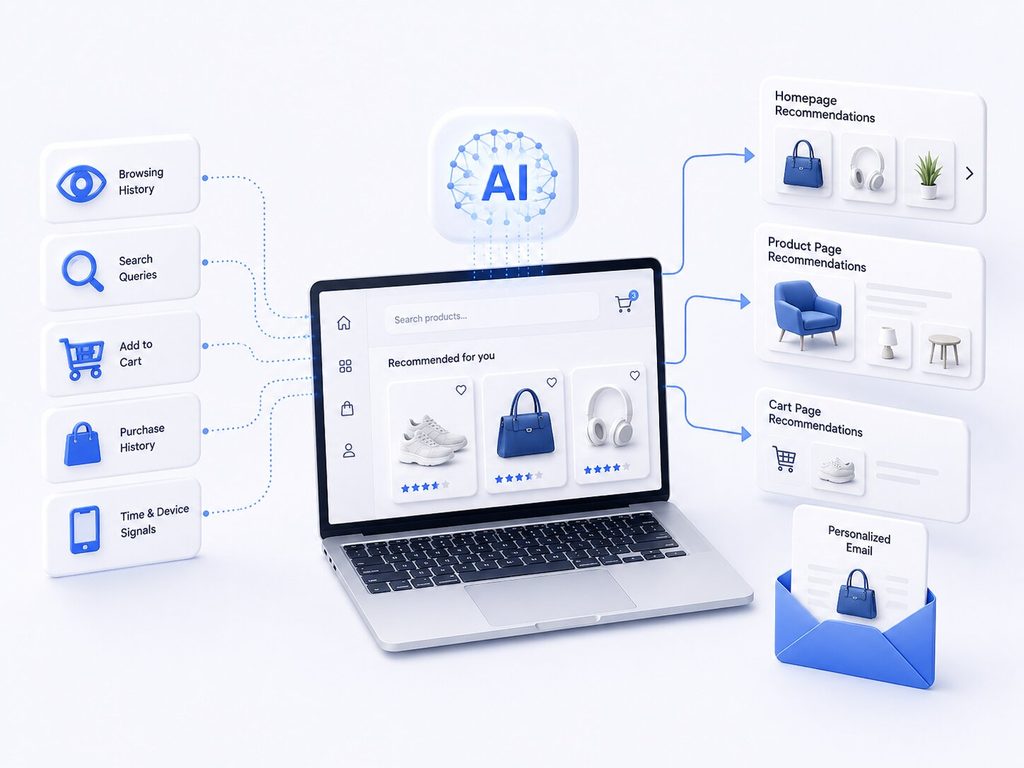
- Delivery layer: pushes recommendations to the homepage, product pages, cart, and email
Why is eCommerce Personalization Software No Longer Optional?
Shoppers today expect stores to know them. According to McKinsey research, companies that invest seriously in AI-driven personalization see 3% to 15% increases in revenue and 10% to 20% gains in sales ROI. That is not a small edge. That is the gap between a store that grows every quarter and one that plateaus.
Ecommerce personalization software has moved from a “premium feature” to table stakes because customer patience for generic experiences has dropped sharply. A shopper who lands on a site and sees irrelevant products simply leaves. There is no second chance in most cases. The next tab is always open.
This is exactly why AI personalization software for ecommerce has become one of the fastest-growing categories in retail tech. Brands are not buying it to look modern. They are buying it because it directly protects revenue.
How Customer Behavior Analytics Powers Smarter Recommendations
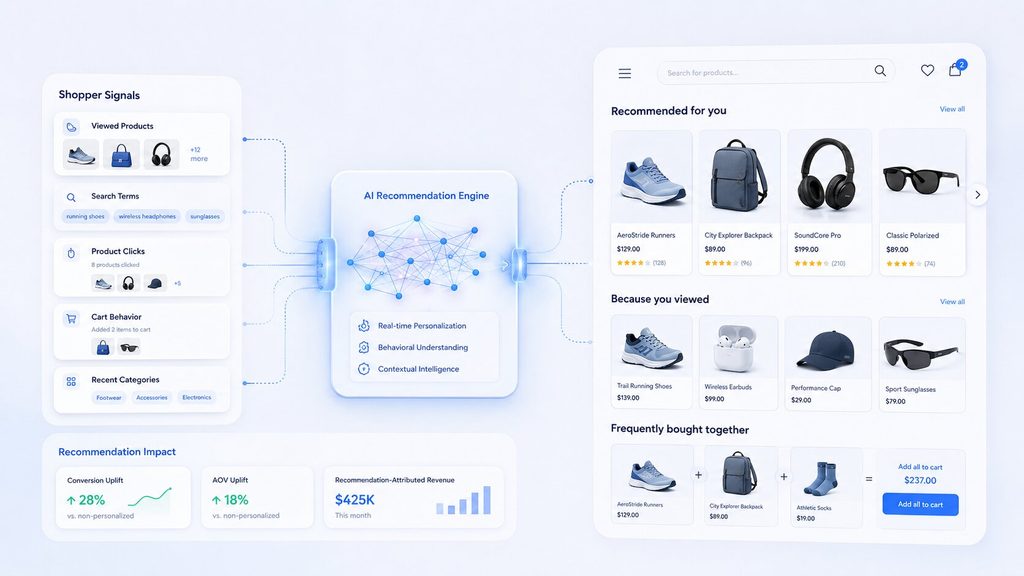
Good recommendations start with good data. Customer behavior analytics tracks signals most teams never think to measure manually, such as:
- Pages visited before abandoning a cart
- Products viewed but never added to cart
- Time spent on specific categories
- Device used and time of day shopping happens
- Search terms typed into the site’s own search bar
An ecommerce personalization engine combines these signals into a single behavioral score for each shopper. That score decides what gets shown next, on the homepage, in the cart, and in follow-up emails.
The more granular the data, the sharper the recommendation. This is why generic, rule-based “related products” sections underperform real AI engines. Rules cannot adapt. Behavior-driven models do.
Types of AI Recommendation Engines (And Which One Fits Your Store)
Not all recommendation engines work the same way. Picking the wrong type is one of the biggest reasons stores don’t see the lift they expect. Here is a quick breakdown.
| Engine Type | How It Works | Best For |
|---|---|---|
| Collaborative Filtering | Recommends based on what similar shoppers bought | Stores with large purchase history and repeat customers |
| Content-Based Filtering | Matches products based on attributes (color, category, price) | Stores with detailed product catalogs, low return traffic |
| Session-Based Models | Predicts intent from clicks within a single visit | Anonymous and first-time shoppers with no history |
| Hybrid Models | Combines collaborative and content-based signals | Most mid-to-large stores; highest accuracy overall |
Most modern AI recommendation engine ecommerce platforms now default to hybrid models, since relying on just one method leaves gaps. Collaborative filtering alone struggles with new products (the “cold start” problem), and content-based filtering alone misses behavioral nuance. Hybrid systems solve both.
The Real Impact: Conversions and AOV
Numbers make the case better than any pitch. Here is what independent research shows about personalization software for ecommerce and its impact on revenue metrics.
Real-World Examples: Brands Winning with AI Recommendations
- Amazon built its entire discovery experience around contextual recommendations, generating an estimated 35% of sales through personalization, still the most cited benchmark in the industry.
- Tatcha, a skincare brand, attributes 11.4% of total site revenue to its AI shopping assistant, with a 3x conversion lift and 38% AOV uplift from personalized product guidance.
- Victoria Beckham’s ecommerce store saw a 20% AOV increase after deploying AI-driven personalization at checkout.
- Wayfair uses AI-powered visualization alongside recommendations to help shoppers picture products in their own space, which cuts returns and lifts purchase confidence.
The pattern across all of these brands is the same. Personalization was not a side feature. It was tied directly to a revenue metric the business tracked weekly.
Choosing the Best eCommerce Personalization Software
Finding the best ecommerce personalization software depends on your catalog size, traffic volume, and technical resources. There is no single “best” option for every store. Here is how to think about it by business stage.
| Business Stage | What to Prioritize | Typical Investment |
|---|---|---|
| Small store, low traffic | Free ecommerce personalization software or built-in platform tools (Shopify, WooCommerce plugins) | $0 to $50/month |
| Growing DTC brand | Standalone AI engine with email and on-site sync | $200 to $2,000/month |
| Mid-market retailer | Full ecommerce personalization engine with behavioral analytics and A/B testing | $2,000 to $10,000/month |
| Enterprise brand | Custom-built engine integrated with CDP and CRM | Custom pricing, often six figures annually |
When researching best ecommerce personalization software 2024 and current 2026 options, look past marketing claims and check for three things: real-time data processing, cross-channel sync (site, email, app), and transparent reporting on what the AI actually influenced.
Personalization for Anonymous and First-Time Shoppers
Here is where most stores struggle. A returning customer with a purchase history is easy to personalize for. A first-time visitor with zero history is not.
This is exactly why ecommerce personalization software for anonymous and first-time shoppers has become its own specialized category. These tools use session-based signals instead of historical data:
- What the visitor clicked in the first 30 seconds
- Referral source (social, search, email link)
- Device type and location
- Product category first viewed
A strong engine builds a “cold start” profile within the first few clicks and adjusts recommendations mid-session. This matters because first-time visitors make up the majority of traffic for most growing stores, often 60% to 80% depending on the brand. Ignoring this segment means ignoring most of your funnel.
Best Personalized Product Recommendation Software: What to Look For
When comparing the best personalized product recommendation software for ecommerce, focus on these capabilities rather than flashy dashboards:
- Real-time scoring: recommendations update as the shopper browses, not after a batch process runs overnight
- Multi-surface delivery: the same intelligence should power homepage, cart, checkout, and email
- Explainability: you should be able to see why a product was recommended, not just that it was
- Easy A/B testing: to prove the lift is real, not assumed
- Data privacy compliance: especially important with GDPR and India’s DPDP Act now in effect
If you are asking what is the best personalized product recommendation software for ecommerce, the honest answer is: the one that fits your data maturity. A brand-new store with thin data needs a lighter, session-based tool. An established brand with years of purchase history can run a far more sophisticated model.
A Simple Rollout Plan
Do not try to personalize everything at once. Start narrow.
- Pick one high-traffic page (usually the homepage or a top category page)
- Connect your product and behavior data cleanly before turning anything on
- Run a small pilot with a percentage of traffic to measure actual lift
- Expand to cart and email once the on-site results prove out
- Layer in anonymous shopper logic last, since it needs the most tuning
This phased approach protects your budget while still letting you capture the bulk of the AOV and conversion gains research consistently points to.
Final Thought
Personalization is no longer a competitive edge reserved for giants like Amazon. With the right AI personalization software for ecommerce, even a mid-sized store can see meaningful lifts in both conversions and order value within months, not years. The technology has matured. The data costs have dropped. What is left is execution.
KPIs You Should Track After Launch
Rolling out a recommendation engine without tracking the right numbers is a common mistake. Watch these five metrics closely:
- Recommendation click-through rate
- Revenue per session with vs without recommendations
- AOV of engaged sessions
- Conversion rate by segment
- Recommendation-attributed revenue
Without this tracking, it is impossible to know if the engine is actually working or just running in the background unnoticed.
At VectovateAI, we design and build AI-native e-commerce architectures, recommendation layers, and vector search systems tailored for enterprise and mid-market retail and eCommerce brands. Operating from our development hub in Ahmedabad, India, our engineering team helps brands integrate real-time personalization directly into headless, microservices, or custom platform stacks—ensuring rapid execution with complete data ownership.
Ready to Lift Your Store’s AOV and Conversion Rates?
Whether you want to integrate a session-based recommendation engine or build a custom recommendation pipeline from scratch, our team is ready to help.
Our neural seasonal style analysis case study shows what a production recommendation layer delivers: a 40% lift in conversion rates. For the demand side of the same data, read our retail demand forecasting playbook.
Leave a Reply