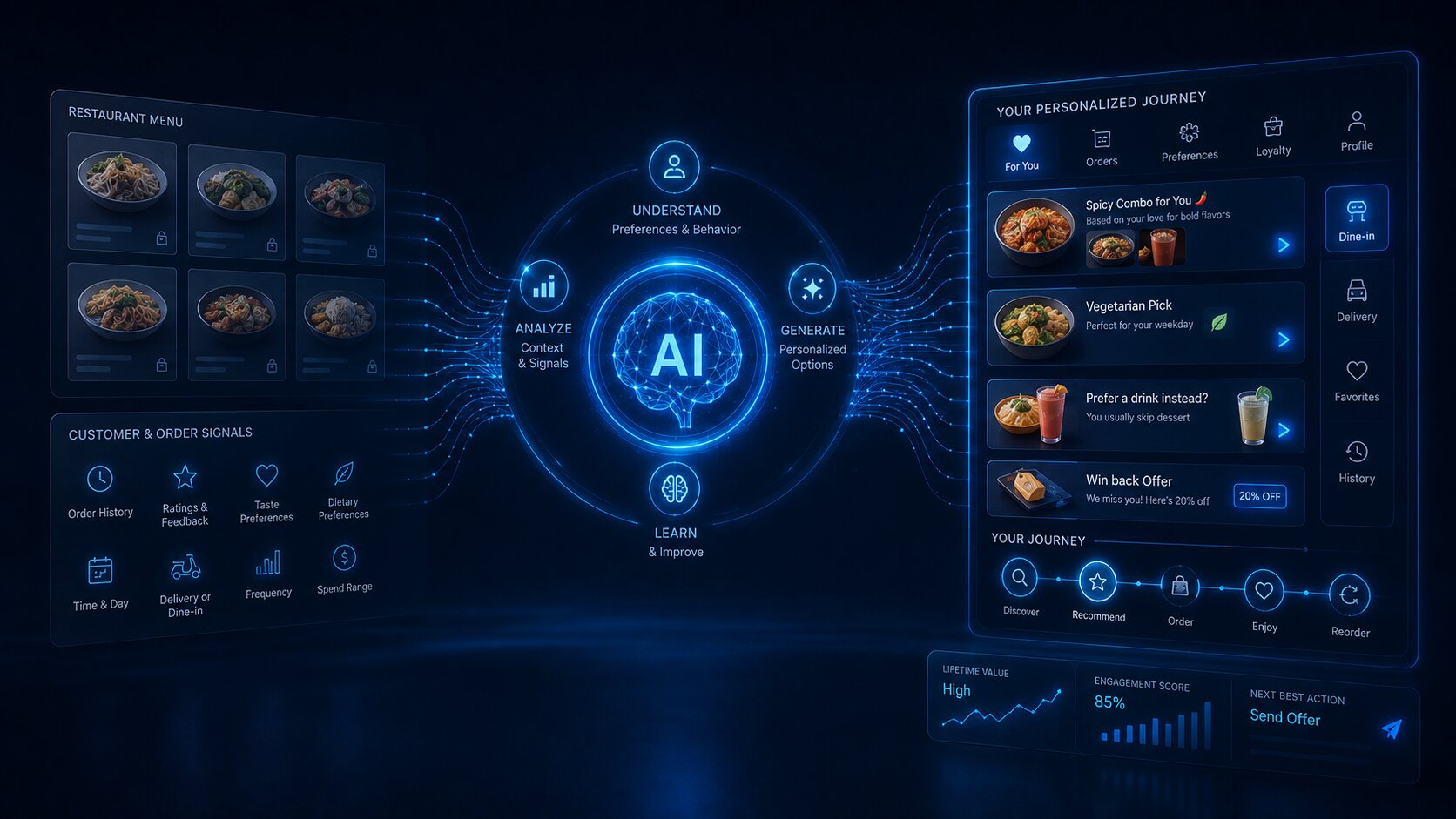
Restaurants have run on the same playbook for decades: one menu, one loyalty program, one marketing blast for every guest. That model is breaking down fast. AI in restaurants is now rewriting how guests discover, order, and return, and operators who ignore it are handing loyal customers to competitors who don’t.
In 2026, roughly one-third of restaurant operators are already using AI technologies, with nearly half planning to adopt them soon, spanning ordering, demand forecasting, menu personalization, and loyalty offers.
This isn’t a future trend anymore. Every week brings fresh AI in restaurants news, from new loyalty engines to voice-ordering pilots, and it’s becoming a competitive necessity playing out in kitchens, apps, and loyalty dashboards right now.
Key Takeaways
- AI in restaurants has moved from back-office analytics to guest-facing personalization across ordering, loyalty, and on-premise experiences.
- Generative AI builds dynamic customer persona AI profiles instead of static segments, using order history, sentiment, and behavior.
- Agentic AI in restaurants can now act autonomously: reordering stock, adjusting offers, or flagging churn risk without waiting on a human.
- AI demand forecasting in restaurants cuts waste and improves staffing accuracy, directly reducing operational costs.
- Human oversight still matters. The winning model pairs automation with a human-in-the-loop for high-stakes decisions.
Why Is the Generic Menu Losing Guests?
For years, “personalization” in the restaurant industry meant a birthday email or a loyalty punch card. It groups thousands of guests into a handful of buckets and calls it targeted marketing.
The gaps are obvious once you look closely:
- Static segments ignore how a guest’s mood, budget, or dietary needs change week to week.
- Underused data: POS systems, delivery apps, and loyalty platforms collect enormous amounts of guest data that never gets analyzed.
- Generic offers that feel like spam.
- Manual campaign building that simply can’t scale to thousands of individual guests.
The result is a guest who feels like a transaction number. And in a market saturated with delivery apps and dining options, that’s exactly the guest who churns to a competitor with a smarter app.
What Hyper-Personalization With Generative AI Actually Looks Like
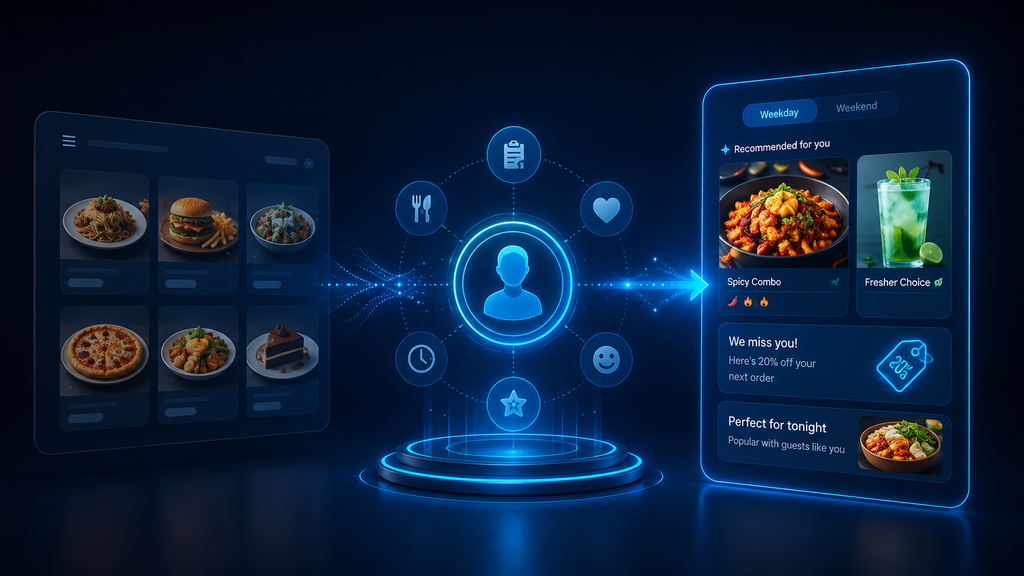
Generative AI doesn’t just tag a guest as a “frequent visitor.” It builds a living profile from every signal available: order history, time-of-day patterns, spice tolerance, delivery vs. dine-in preference, even sentiment from support chats or reviews. This is the foundation of real customer persona AI, an approach much closer to how a good server remembers a regular’s usual order than to a spreadsheet segment.
Here’s what that profile powers in practice:
| Guest Signal | AI Action | Business Outcome |
|---|---|---|
| Frequent late-night orders, spicy preference | Suggests a personalized combo at checkout | Higher average order value |
| Long gap since last visit | Triggers a win-back offer via app or SMS | Reduced churn |
| Consistently skips dessert | Stops pushing dessert upsells, offers a drink instead | Better conversion, less “noise” fatigue |
| Orders vegetarian on weekdays, non-veg on weekends | Adjusts default menu view by day | Faster ordering, higher satisfaction |
| Reviews mention slow delivery twice | Flags account for proactive service recovery | Retention before complaint escalates |
This kind of adaptive experience is already showing measurable results. AI-personalized emails in the restaurant sector are seeing 41% higher click-through rates than generic campaigns, and AI-driven personalization is lifting average order value by 12-18%. McKinsey’s broader research on personalization backs this up too: effective personalization can boost retention by 20-30% while raising average order values by 10-15%.
Under the Hood: How Real-Time Personalization Actually Works
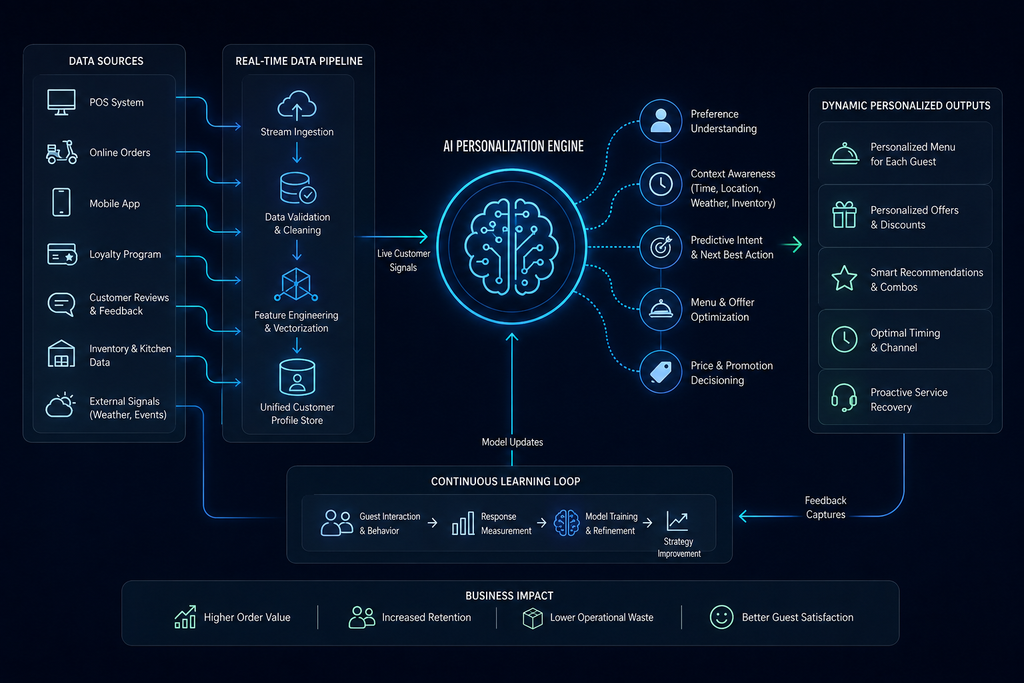
Off-the-shelf POS plugins usually fail here because they rely on simple static rules. Delivering real-time, dynamic menus at scale takes three key pieces working together seamlessly:
- Real-Time Data Pipelines: Stream data instantly from your POS, delivery apps, and mobile telemetry. By turning guest preferences into vector data, the system can match complex requests—like “spicy vegetarian under 600 calories”—against your live menu in milliseconds.
- Context-Aware Logic: When a guest opens your app, an orchestration engine checks their profile against live kitchen inventory, local weather, and current wait times. It then dynamically builds a menu tailored specifically to that moment.
- Sub-100ms Rendering: Speed is non-negotiable at checkout. Using edge caching ensures these personalized menu layouts render in under 80 milliseconds, keeping the user experience lightning-fast.
Agentic AI in Restaurants: From Suggestions to Actions
The next shift is even bigger than personalized recommendations. Agentic AI in restaurants doesn’t just suggest, it acts. Traditional AI tools flag an insight and wait for a manager to respond. Agentic systems take the next step on their own, within guardrails the business sets.
A few examples already playing out across the industry:
- An agent detects a guest has skipped their usual weekly order and automatically sends a personalized win-back offer, no marketing manager required.
- An agent monitors sentiment across reviews and support chats, and proactively routes an unhappy regular to a manager before they leave a bad review.
- An agent adjusts loyalty rewards dynamically based on individual spend patterns rather than a flat points system. Panera Bread’s MyPanera program, now over 60 million members, uses exactly this kind of surprise-and-delight model instead of standard points.
- An agent updates online menu visibility in real time based on kitchen capacity and ingredient stock, avoiding orders the kitchen can’t fulfil.
Industry analysts describe the near-term shift as “invisible AI,” systems that quietly run hyper-personalized loyalty, dynamic pricing, and real-time inventory forecasting in the background rather than through a visible chatbot or kiosk.
AI Demand Forecasting in Restaurants: The Cost Side of Personalization
Personalization gets the headlines, but the operational upside is just as significant. AI demand forecasting in restaurants and AI tools for reducing operational costs in restaurants solve a problem every operator knows well: over-ordering leads to waste, under-ordering leads to stockouts and angry guests.
Generative and predictive AI models analyze historical sales, weather, local events, and even social sentiment to forecast demand at the ingredient level. In adjacent retail and supply chain use cases, AI-enabled demand forecasting has reduced forecast error by 10-30%. Applied to a restaurant kitchen, that translates directly into:
- More accurate staff scheduling based on predicted footfall
- Fewer “sold out” moments during peak personalization campaigns
- Smarter dynamic pricing that reflects real demand instead of flat discounting
This is where operational AI and guest-facing personalization actually connect. A hyper-personalized offer is only as good as the kitchen’s ability to deliver it without delay, and forecasting is what makes that promise reliable.
The Best Conversational AI for Personalized Customer Journeys
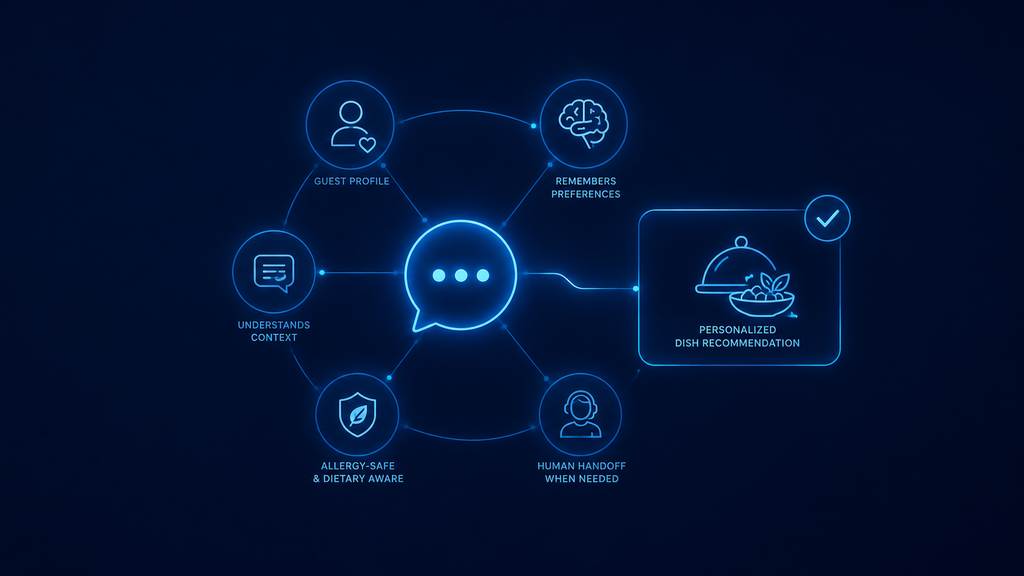
Chatbots used to mean canned responses and frustrated guests typing “AGENT” repeatedly. The best conversational AI for personalized customer journeys today can hold context across a guest’s entire relationship with a brand.
What separates a genuinely useful conversational agent, and the broader class of AI tools for personalizing guest experiences in restaurants, from a glorified FAQ bot:
- Memory across visits: the agent recalls a guest’s usual order, allergies, and preferences without asking again.
- Tone matching: casual for a quick-service brand, more polished for a full-service concept.
- Multilingual support: critical for markets with diverse guest bases, without needing separate headcount per language.
- Handoff intelligence: knowing exactly when to pull in a human, rather than looping a frustrated guest through more automated replies.
Guests consistently say they get frustrated when they have to repeat themselves to different agents or channels. Conversational AI grounded in a real customer profile removes that friction entirely, and that continuity is a major driver of loyalty in personalized service models. It’s also increasingly what customers expect by default: over 80% of restaurant executives now plan to increase AI spending, with customer experience cited as the single biggest area of expected impact.
Personalized Customer Strategy in the Age of AI: Where Human-in-the-Loop Fits
None of this works if it feels robotic or invasive. An AI for personalized customer experiences has to balance automation with human judgment, especially for anything sensitive like complaint resolution, VIP guest management, or pricing decisions.
The practical model most restaurants are converging on:
- Human-in-the-loop for high-stakes actions like refunds, VIP escalations, or public complaint responses, where a person reviews before anything goes out.
- Human-on-the-loop for repeatable, lower-risk workflows like sending a personalized offer or adjusting a menu recommendation, where AI acts, and humans monitor performance dashboards for anomalies.
- Clear data ownership: guests should know what data is used and have a simple way to opt out, especially given that data privacy incidents are already a real concern, with 16% of operators reporting a data-related incident in the past two years.
This isn’t about removing the human touch from hospitality. It’s about freeing staff from repetitive tasks so they can focus on the moments that actually need a human: a warm greeting, a thoughtful recommendation, a genuine apology when something goes wrong.
Engineering the Migration: How Enterprise Brands Transition to an AI-Native Architecture
For enterprise restaurant brands and multi-unit franchises, replacing legacy POS software overnight is rarely feasible. A realistic rollout relies on a decoupled, AI-Native architecture built in phased stages:
- Unify guest data from POS, delivery, and loyalty platforms into a single profile per guest.
- Start with one high-frequency use case, like personalized win-back offers or smart menu recommendations, using proven AI tools for restaurant customer personalization rather than building from scratch.
- Layer in agentic actions gradually, beginning with low-risk workflows like inventory alerts before moving to guest-facing automation.
- Pair every automated workflow with a monitoring dashboard so that managers can catch and correct issues early.
- Measure outcomes that matter: retention, average order value, and guest satisfaction.
The restaurants pulling ahead right now aren’t the ones with the flashiest kiosk or chatbot. They’re the ones quietly using AI in the restaurant industry to make every single guest feel like a regular.
Ready to bring AI in restaurants to your guest journey? VectovateAI builds agent-first, human-in-the-loop AI systems, engineered by senior architects.
Leave a Reply